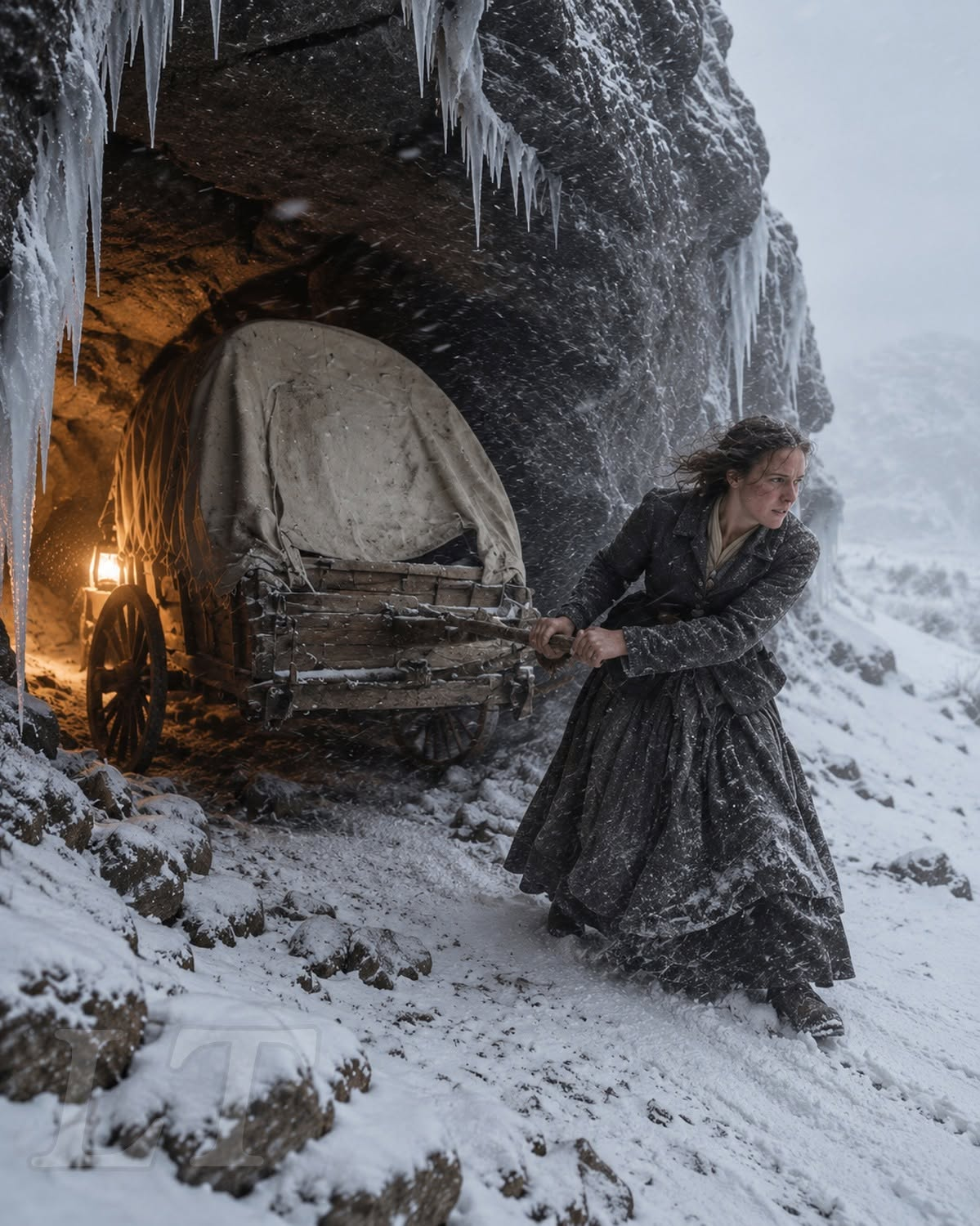
The shadow moved.
Elsa grabbed the hammer and stepped toward the failing wooden barrier.
For one terrible second, she thought something had broken through the entrance.
Then another gust struck the sandstone hollow.
Snow burst through the widening gap.
The shadow disappeared beneath a cloud of white powder, revealing the source of the movement.
The left side of the wagon bed had shifted inward.
The wooden brace that had supported it was sliding out of position, and the ground beneath the structure was collapsing.
Elsa dropped to her knees.
"No. No, no, no."
She pushed both hands against the wooden board.
The barrier moved.
Not much, but enough to tell her that its weight was no longer resting securely on the ground.
Another gust slammed against the canvas.
The entire structure shuddered.
Elsa felt the pressure through her arms.
She could not hold it alone.
She looked toward the mule.
The animal had backed against the sandstone wall, its eyes wide and its ears raised.
Elsa wanted to reach it.
She wanted to make sure it was safe.
But if the wooden barrier collapsed, neither of them would have a protected place to hide.
She forced herself to remain focused.
The failing support had to be replaced.
Immediately.
Elsa examined the ground beneath the left corner.
A section of frozen soil had broken away, leaving a shallow depression. The wooden bed was no longer resting evenly. Its weight had shifted toward the hollow.
She needed to lift that corner and place something solid underneath it.
But she could not lift several hundred pounds of timber by herself.
Her eyes moved toward the remaining wagon parts.
The damaged wheel.
The axle.
The wooden spokes.
The tools.
And the rope.
Then she remembered something her father had once demonstrated while repairing a fishing boat.
He had used a long wooden beam as a lever to raise one side of a heavy timber frame.
Elsa had been a little girl at the time.
She remembered watching him place a smaller piece of wood beneath the beam, creating a pivot.
The beam multiplied his strength.
He had lifted something that seemed far too heavy for one man.
"Never fight weight with weight," he had told her. "Use the ground. Let the ground do some of the work."
Elsa looked at the remaining wooden supports.
There was one long piece of timber beside the rear wall.
It had been part of the wagon's upper frame.
She hurried toward it.
The next gust struck before she reached the wood.
The barrier lurched inward.
A sharp crack echoed through the hollow.
Elsa turned.
The canvas had torn along its lower edge.
Snow poured through the opening.
She grabbed the wooden frame and dragged it toward the failing corner.
The timber scraped across the ground.
She positioned one end beneath the wagon bed.
Then she searched for a suitable pivot.
A flat sandstone rock lay near the rear wall.
She rolled it toward the wooden support and placed it beneath the beam.
The arrangement was awkward.
The timber was not perfectly straight, and the rock was uneven.
But it might work.
Elsa placed both hands against the long end of the beam.
She pushed downward.
The timber flexed slightly.
The wagon bed lifted.
Only a fraction of an inch.
But it lifted.
Elsa immediately reached for a piece of broken wheel spoke and shoved it beneath the raised corner.
The wood slid into place.
She released the lever.
The wagon bed settled against the new support.
For a moment, the structure held.
Elsa remained crouched, watching the wooden brace.
Then she pushed against the barrier.
It did not move.
She exhaled.
The first problem had been solved.
But the storm was becoming stronger.
She could hear the wind rushing over the ridge with a sound that reminded her of enormous waves breaking against a rocky shore.
The canvas continued snapping.
Snow pushed through the remaining openings.
And the wooden wall still vibrated under the pressure.
Elsa retrieved another piece of timber.
She placed it beside the first support, creating a second brace.
This time, she used two smaller stones as pivots.
She pushed the lever downward.
The wagon bed rose slightly.
She inserted another wooden wedge beneath the frame.
Then she tightened a rope around the brace and the nearest sandstone projection.
The support was stronger now.
She tested it carefully.
The wooden bed remained in position.
Elsa moved toward the damaged canvas.
The lower edge had begun tearing where the rope pulled against it.
She needed to reduce the tension.
Instead of allowing one section of fabric to carry the entire force, she would divide the load between several smaller ropes.
She retrieved the remaining hemp line.
Her fingers were stiff, but she managed to form several loops.
She secured one end around the upper wooden support.
Then she tied another section to a natural projection in the sandstone.
A third rope passed around the sideboard.
The canvas settled.
It still moved when the wind struck, but the pressure was no longer concentrated in one place.
Elsa stepped backward.
The arrangement looked crude.
Yet it was holding.
She looked toward the mule.
The animal had stopped moving.
Its head remained raised, and its breathing was quick.
Elsa approached slowly.
She placed her hand against its muzzle.
"Easy. We're all right."
The mule shifted its weight.
Elsa stroked its neck.
She wished she could offer the animal something to eat, but the remaining food had to be rationed carefully.
She reached into the wooden box and found a small piece of dried meat.
She hesitated.
It was not suitable food for the mule, but she had a few pieces of hardtack.
She broke off a small portion and held it out.
The animal sniffed it.
Then it accepted the food.
Elsa watched it chew.
For a few seconds, the sound of the storm seemed distant.
Then the wind struck again.
The mule raised its head sharply.
Elsa turned toward the entrance.
The wooden wall had moved.
This time, the movement came from the center.
The entire structure seemed to bend under the pressure.
Elsa rushed toward it.
She pressed both hands against the central board.
The timber vibrated.
She could feel the force of the storm pushing against the opposite side.
Her father had warned her about wind.
He had explained that a shelter did not need to stop every movement of air to provide protection.
It needed to prevent the strongest currents from entering and maintain a stable structure.
But the wagon bed was large.
The wind was striking a broad surface.
The pressure was being transferred through the boards into the side supports.
If one support failed, the others would carry more weight.
Then another might fail.
Elsa looked at the wooden braces.
The left side was secure for the moment.
The right side appeared stable.
But the central section lacked reinforcement.
She needed another support.
She walked toward the remaining wagon parts.
The damaged axle lay outside the hollow, partially covered by snow.
It was thick, heavy timber.
The crack made it unsuitable for carrying the wagon's weight on a road, but the undamaged section might still serve as a structural brace.
Elsa stepped outside.
The wind hit her immediately.
Snow swept across her face.
She lowered her head and moved toward the axle.
The frozen ground was difficult to navigate.
Her boots slipped twice.
She reached the timber and crouched beside it.
The axle was heavier than she remembered.
She pulled one end toward herself.
It barely moved.
She adjusted her grip and tried again.
The wood scraped across the ground.
Elsa dragged it several feet.
Then she stopped.
The wind was so strong that she could hardly keep her balance.
She looked toward the hollow.
The entrance was now partly obscured by blowing snow.
The lantern inside flickered like a distant orange point.
She forced herself forward.
One step.
Another.
The axle scraped behind her.
She finally reached the shelter.
With considerable effort, she pulled the timber through the entrance and lowered it beside the central section of the wagon bed.
She examined its length.
It was almost perfect.
She placed one end against the lower wooden frame and positioned the other beneath a strong section of the sandstone overhang.
The arrangement would help prevent the central boards from bending inward.
But the timber needed to be secured.
Elsa used a short length of rope to fasten the lower end.
Then she examined the upper connection.
There was no convenient place to tie it.
She retrieved her chisel and hammer.
The sandstone had a narrow natural indentation near the ceiling.
She carefully placed the chisel against the edge and struck it.
A small fragment broke away.
She struck again.
Another piece loosened.
She worked slowly, trying not to damage the surrounding stone.
Eventually, she created a shallow notch.
She raised the axle and positioned its upper end inside the opening.
The timber rested against the sandstone.
Elsa pushed against it.
It held.
She tightened the lower rope.
Then she placed a smaller wooden wedge behind the axle to prevent it from slipping sideways.
The central barrier was now reinforced.
Elsa stepped back.
The wooden wall looked different.
It no longer seemed like a collection of disconnected wagon parts.
It had become a structure.
An imperfect one.
But a structure nonetheless.
She checked the lantern.
Its flame was low.
The oil supply was limited, and she could not afford to waste it.
She adjusted the wick.
The light became steadier.
Then she examined the food and supplies again.
The wooden box contained her father's tools, a small amount of dried meat, and the hardtack.
The Dutch oven sat beside it.
Two wool blankets remained.
She unfolded one and placed it over the mule's back.
The animal moved its head but accepted the covering.
Elsa kept the second blanket for herself.
She would need it later.
She looked at the floor.
Snow had accumulated near the entrance, but the main area remained relatively dry.
She pushed the snow away with a piece of broken board.
Then she collected more dry grass and spread it along the place where she intended to sit.
The shelter was becoming usable.
But it was still cold.
Very cold.
Elsa rubbed her hands together.
Her fingers were stiff, and the cuts on her palms had begun to sting.
She examined the wooden barrier once more.
The canvas remained stretched.
The ropes were tight.
The side braces held.
The central axle support was secure.
She had repaired every obvious weakness she could find.
Yet she could not shake the feeling that something was missing.
She walked toward the entrance and listened.
The storm made a continuous roaring sound.
Occasionally, she could hear individual gusts strike the wooden barrier.
Each impact produced a different vibration.
Some were low and distant.
Others were sharp enough to make the boards tremble.
Elsa placed her hand against the timber.
She felt the movement.
She stepped away.
Then she noticed the wind entering through the upper left corner.
It was faint.
But it was there.
She reached for a small strip of canvas and pressed it into the opening.
The draft weakened.
She added dry grass.
Then another strip of cloth.
The opening disappeared.
Elsa moved to the opposite corner.
A similar gap remained.
She sealed that one too.
She checked the lower edge.
Then the side connections.
Then the upper canvas.
Her father had taught her that inspection was not something done once.
It was something repeated.
Especially when conditions changed.
She moved along the barrier again.
At the far right corner, she found a narrow opening between the wooden bed and the sandstone wall.
A small amount of snow had collected beneath it.
Elsa crouched and pressed her fingers into the gap.
The opening was deeper than it appeared.
She could feel air moving through the other side.
She reached for the remaining grass.
There was not enough.
She looked around.
The damaged wagon wheel had provided several useful spokes, but most of the remaining timber was now being used as braces.
The torn canvas was almost gone.
She needed another material.
Her eyes settled on the second wool blanket.
She looked toward the mule.
The animal already had the first blanket.
Elsa could sacrifice a small portion of the second without giving it up entirely.
She took out her knife.
Then she cut a long strip from the edge.
The fabric was thick and tightly woven.
She folded it several times and pressed it into the opening.
The gap narrowed.
She added another piece.
Then she secured the material with a small wooden wedge.
The draft stopped.
Elsa sat back.
Her hands were trembling.
She looked at the remaining blanket.
It was smaller now.
But it was still enough to cover her shoulders and legs.
She folded the cut pieces and placed them beside the entrance in case she needed them again.
The lantern flame flickered.
Elsa looked toward the mule.
The animal had finally lowered its head.
Its breathing had become slower.
That was a good sign.
She checked the water container.
Some snow had melted inside the Dutch oven.
She carefully poured the liquid into the container and added another small quantity of clean snow.
She did not want to use too much fuel or lantern oil.
There was no proper fireplace.
And lighting a large fire inside the cramped hollow could create dangerous smoke.
She would need to rely primarily on the shelter, the blankets, and her own body heat.
Elsa returned to the entrance.
The wind struck again.
The central axle support vibrated.
She watched it carefully.
The timber remained in place.
Another gust.
The wooden boards shook.
But the braces held.
Elsa closed her eyes for a moment.
She was beginning to understand the storm's rhythm.
The wind did not arrive as one continuous force.
It came in waves.
There were brief intervals when the pressure weakened, followed by sudden violent gusts.
Those intervals gave her opportunities to inspect and repair the shelter.
She needed to use them wisely.
She waited.
The wind weakened slightly.
Elsa moved toward the left support and checked the wedge.
It had shifted by a small amount.
She pushed it back into place.
Then she tightened the rope.
She moved to the center and examined the axle brace.
The upper end remained secure.
The lower knot had loosened slightly.
She pulled it tight.
Then she checked the right side.
Everything appeared stable.
She returned to the center.
For a moment, she allowed herself to believe that the worst of the structural problems had passed.
Then she noticed something unusual.
The lantern flame was leaning toward the wagon wall.
Elsa frowned.
The wind should have been pushing air inward through the entrance.
But the flame was moving sideways.
She raised one hand.
A faint current brushed against her fingers.
It was coming from somewhere near the rear of the hollow.
Elsa turned.
The sandstone wall behind her looked solid.
She walked toward it and examined the surface.
There were several natural cracks in the rock.
Most were shallow.
One extended along the lower edge, partly hidden by loose stones.
She crouched and moved the stones aside.
A narrow opening appeared.
Elsa leaned closer.
Cold air flowed through it.
The opening was not large enough for a person to pass through, but it connected to a deeper fracture in the sandstone.
The storm was forcing air through the rock formation itself.
Elsa pressed her hand against the opening.
The current was stronger than she expected.
She looked around for suitable material.
The remaining grass was almost gone.
The canvas was nearly exhausted.
And the second blanket had already been cut apart.
She could use loose soil and small stones, but the opening was irregular.
She would have to pack it carefully.
Elsa retrieved the wooden box and found a small piece of cloth.
She pushed it into the narrowest section.
Then she added soil.
She pressed the material firmly against the rock.
The draft weakened.
She added another layer.
Then a flat stone.
The opening became smaller.
Elsa was about to add the final wedge when a sudden sound came from above.
A deep rumbling vibration traveled through the sandstone.
She stopped.
The lantern flame flickered violently.
Dust fell from the ceiling.
Elsa looked upward.
Another rumble followed.
This one lasted longer.
She stepped away from the wall.
The sound seemed to come from beyond the overhanging ledge.
A large amount of snow might have accumulated above the hollow.
The storm could be loading the rock shelf with more weight than it was accustomed to carrying.
Elsa listened.
The wind roared.
The mule shifted.
Then the sandstone produced another low, grinding sound.
Elsa slowly backed toward the center of the shelter.
She had spent the entire afternoon worrying about the wooden barrier.
She had not considered the possibility that the natural roof itself might become dangerous.
She looked toward the entrance.
The wooden wall was still standing.
The canvas remained attached.
The braces held.
But above them, beyond the reach of the lantern, something heavy moved across the rock.
Elsa picked up her hammer.
She stood beside the mule.
Another rumble echoed through the hollow.
Then a long crack traveled across the sandstone ceiling.
Elsa raised her eyes.
A thin line of dust appeared above the entrance.
The mule suddenly pulled hard against its lead rope.
Elsa turned toward it.
And from somewhere directly above the wooden barrier came a sound that made her blood run cold.
The rock was beginning to split.






Comments 0