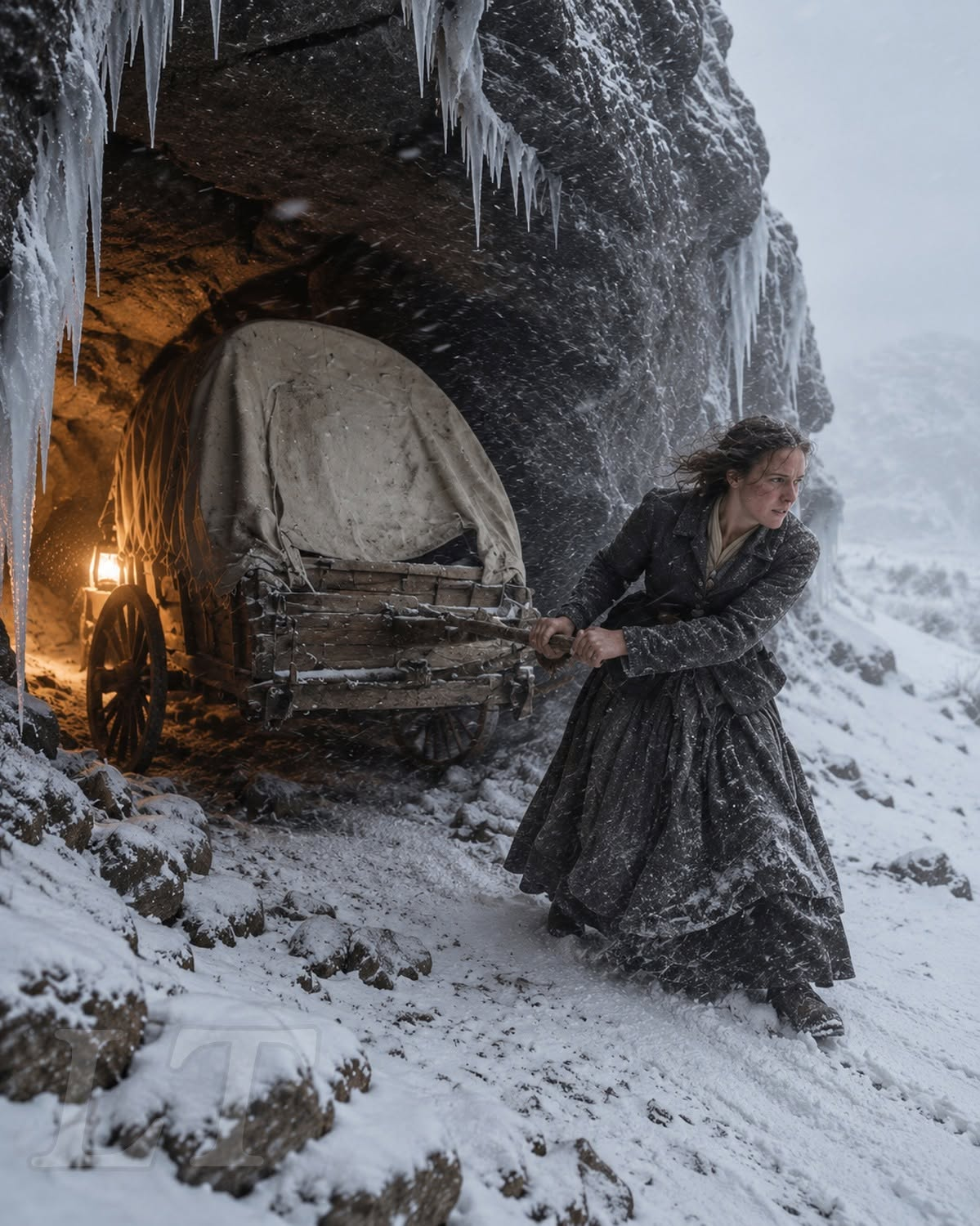
The rock was beginning to split.
Elsa stood motionless beneath the sandstone ceiling, listening to the deep grinding noise above her.
A thin line of dust drifted through the lantern light.
Then another.
She raised her eyes.
The crack extended from the overhanging ledge toward the center of the hollow. It was difficult to see clearly in the darkness, but the sound was unmistakable.
Something heavy was shifting above the shelter.
The mule pulled against its lead rope.
Elsa turned and placed one hand against its neck.
"Easy. Stay here."
The animal trembled.
Another rumble traveled through the sandstone.
This time, a small fragment of rock broke loose and struck the frozen ground near the entrance.
Elsa stepped backward.
She had spent hours turning the broken wagon into a protective wall. She had used every useful piece of timber, nearly all her rope, and much of the remaining canvas.
Now the very shelter she had chosen might be failing above her.
She looked toward the entrance.
The wooden barrier remained in place.
The central axle support held.
The side braces were still secure.
But the sandstone overhang was carrying an enormous amount of accumulated snow, and the approaching blizzard was adding more with every passing minute.
Elsa remembered her father's warning.
A shelter was only as reliable as the weakest part of its structure.
She had been so focused on closing the entrance that she had almost forgotten to inspect the roof.
She moved toward the back wall and placed the lantern on a flat stone.
Then she examined the ceiling.
The crack was longer than she had first thought.
It followed a natural fracture in the sandstone, beginning near the outer edge and extending toward the deeper section of the hollow.
Elsa could not tell how far it continued.
She ran her fingers along the lower edge of the rock.
A small piece of sandstone came away beneath her touch.
She stared at it.
The rock was not simply shedding surface dust.
The fracture was active.
She needed to understand what was happening before deciding what to do.
Elsa moved toward the entrance and looked outside.
The blizzard had transformed the landscape.
Snow swept across the ridge in thick horizontal sheets. The distant ground had disappeared behind a moving wall of white.
The sandstone ledge above the hollow was barely visible.
She could make out several uneven formations along its edge.
Snow had accumulated across them, creating a thick white layer.
Every gust pushed more snow against the rock.
Elsa estimated that the overhang extended several feet beyond the natural wall.
It had protected the hollow from ordinary rain and snowfall.
But the accumulated snow was now adding considerable weight.
She knew nothing about the precise strength of the sandstone.
She could not calculate how much weight the ledge could support.
But she understood enough about timber and construction to recognize danger.
A crack that continued growing was not something to ignore.
She stepped outside.
The wind struck her so violently that she nearly lost her footing.
She lowered her head and moved along the side of the hollow, staying close to the rock wall.
Snow entered her collar.
Her scarf snapped against her face.
She looked upward.
The overhanging ledge disappeared into the darkness of the storm.
Elsa moved only a few feet farther before the wind forced her to stop.
She could not safely inspect the entire formation from outside.
Nor could she climb onto the frozen rocks without risking a fall.
She returned to the shelter.
The moment she crossed the entrance, she felt the difference.
The air was still relatively protected.
The wooden wall was doing its job.
She looked at the structure with renewed appreciation.
Without the wagon bed, she would have been standing outside with no protection at all.
But the barrier was not enough to protect her from falling rock.
She needed to prepare for the possibility that part of the overhang might collapse.
Elsa examined the interior.
The mule was standing near the rear wall.
The wooden box containing her father's tools rested beside it.
The Dutch oven sat near the lantern.
Her blankets were folded against the sandstone.
She considered moving everything away from the entrance.
If the outer section of the roof collapsed, the debris might strike the wooden barrier or block the opening entirely.
The safest area appeared to be deeper inside the hollow, close to the rear sandstone wall.
She moved the wooden box first.
It was heavy, but she carried it carefully.
Then she shifted the Dutch oven.
The lantern followed.
She spread the remaining blanket over a dry section of ground.
Finally, she guided the mule farther into the shelter.
The animal resisted.
Elsa pulled gently on the lead rope.
"Come on. Just a little farther."
The mule moved several steps.
She secured its rope to a different sandstone projection, well away from the wagon barrier and the unstable section of ceiling.
Then she returned to the entrance.
A sudden cracking noise made her stop.
She looked upward.
Another fragment of sandstone fell.
It struck the wooden barrier and broke into several pieces.
Elsa ducked.
The mule stamped nervously.
For several seconds, neither moved.
Then the wind struck again.
The canvas snapped.
The wooden wall shuddered.
Elsa looked at the central support.
The axle remained in place.
But the upper section of the barrier was beginning to press inward.
The falling fragment had struck the timber near the central brace.
A small indentation appeared in the wood.
Elsa approached carefully.
She pressed her hand against the board.
It remained firm.
But she noticed that the upper rope had loosened.
She reached for it and pulled.
The knot tightened.
Then she examined the timber more closely.
The central support was doing more than holding the wooden wall upright.
It was helping distribute the force from the barrier into the sandstone.
If the rock around its upper connection fractured, the entire support could become unstable.
Elsa looked at the ceiling.
She needed to reinforce the upper connection.
But she could not attach anything directly to the fractured section.
She needed to find a stronger point farther inside the hollow.
She picked up the lantern and examined the surrounding stone.
The rear wall contained several natural projections.
One extended horizontally at approximately shoulder height.
It looked solid.
Elsa approached it and pressed her palm against the surface.
No movement.
She tapped it with the wooden handle of her hammer.
The sound was deep and consistent.
She tapped again.
The stone appeared sound.
She could use that projection as an additional anchor.
The problem was the distance.
The central axle support was already positioned near the entrance.
She would need another length of timber to connect it to the stronger section of sandstone.
Elsa looked toward the remaining wagon parts.
Only a few pieces of wood remained.
Most were short.
One long side rail, however, still lay near the outer wall.
She had removed it from the damaged wagon earlier that afternoon.
It was weathered but straight.
She dragged it toward the central support.
Then she examined its length.
It might work.
She placed one end against the axle brace and positioned the other near the stronger sandstone projection.
The rail was slightly too long.
Elsa used the saw to remove a small section.
The work was difficult because the timber was frozen.
The saw teeth repeatedly caught against the grain.
She adjusted the angle and continued.
Eventually, the rail fitted between the two points.
She tied one end to the central support.
Then she secured the opposite end around the natural stone projection.
The connection was not intended to carry the full weight of the roof.
It was meant to stabilize the wooden barrier and reduce the chance of the central support shifting.
Elsa tightened the rope.
She pulled against the rail.
It held.
She tested the connection again.
Still firm.
Then she stepped backward.
The additional support created a more stable arrangement.
For the first time since hearing the crack, she felt that she had done something useful.
But the rumbling continued.
She could hear the wind pressing against the outer edge of the sandstone ledge.
The sound traveled through the rock and into the hollow.
It was like listening to a distant ship groaning beneath a heavy sea.
Elsa returned to the ceiling.
The crack remained visible.
She examined its direction.
It appeared to widen near the entrance, where the overhang extended farthest beyond the natural wall.
She remembered something her father had once explained about timber roofs.
A roof did not fail simply because it was heavy.
It failed when the supporting structure could no longer distribute that weight.
The sandstone was different from timber, but the principle was familiar.
If the outer section was becoming unstable, the safest place was away from the edge.
She moved the blanket farther toward the rear wall.
Then she placed the wooden box beside it.
She kept the hammer and chisel within reach.
The lantern remained on a flat stone, positioned where it could illuminate the entrance without being exposed to falling debris.
She checked the mule.
The animal was restless but standing.
Elsa rubbed its neck.
"You have to trust me."
The mule lowered its head slightly.
She examined the lead rope again.
It had enough slack for the animal to move comfortably, but not so much that it could wander toward the entrance.
Satisfied, Elsa returned to the wooden barrier.
The wind was becoming stronger.
The canvas stretched inward.
The central boards vibrated.
She pressed her hand against them.
The structure remained in position.
She checked the lower packing.
The grass and soil had shifted slightly, but the main opening remained closed.
Elsa added a few more pieces of dry grass and pressed them into place.
Then she secured the outer edge with another flat stone.
She worked along the entire bottom section.
The repeated movement made her shoulders ache.
But she continued.
When she reached the left corner, she discovered that the ground beneath the support had become wet.
Snow was melting near the edge of the shelter.
A small amount of water had collected beneath the wooden bed.
Elsa frowned.
Water could weaken the frozen soil as temperatures changed.
It could also make the wooden support slippery.
She examined the area.
The ground sloped slightly toward the entrance.
That was helpful.
But the water was collecting in a shallow depression beneath the left brace.
She needed to move it away.
Elsa retrieved a flat piece of timber and used it to scrape a narrow channel through the loose soil.
The channel followed the natural slope toward the outer edge.
She removed several small stones.
Then she pushed the wet material aside.
The water began moving slowly toward the entrance.
She continued until the shallow pool disappeared.
The ground was still damp, but no longer collecting water beneath the support.
Elsa placed another stone beneath the brace.
She pushed against the wooden barrier.
It held.
She stood and looked at the lantern.
The oil was running low.
She needed to conserve it.
She lowered the wick slightly.
The flame became smaller, but remained steady.
The hollow grew darker.
Outside, the blizzard continued roaring.
Elsa sat beside the rear wall and rested her back against the sandstone.
Her body was exhausted.
She had been working for hours without proper food or rest.
Her hands hurt.
Her shoulders throbbed.
And the cold had begun to penetrate her clothing.
She unwrapped a small portion of dried meat and ate slowly.
Then she broke off a piece of hardtack.
It was dry and difficult to chew.
She swallowed it with a little water.
The food gave her some strength.
But it did not remove her exhaustion.
She looked toward the entrance.
The wooden wall remained standing.
The canvas moved with each gust.
The ropes held.
The side supports appeared stable.
Yet the crack in the ceiling continued troubling her.
She had no way to determine how much longer the overhang would remain intact.
She thought about Henrik.
His homestead was still sixty miles away.
He might be wondering where she was.
Perhaps he had expected her to arrive before the end of the week.
Perhaps he had already begun worrying.
Elsa had not seen another traveler for days.
She had no way to send a message.
No way to know whether anyone was searching for her.
The thought made her feel suddenly small.
She was alone in a frozen wilderness, inside a shelter assembled from the remains of a broken wagon.
The storm outside could last hours.
It could last days.
And if the roof failed, there might be no second opportunity.
She closed her eyes.
For a moment, she imagined her father's workshop.
The sound of his hammer.
The smell of freshly cut timber.
The warm light from the windows overlooking the Norwegian harbor.
She remembered sitting beside him while he repaired a wooden fishing boat.
He had once shown her a piece of timber that looked perfectly sound from the outside.
When he struck it, however, the sound was hollow.
He had cut it open and revealed that the interior had been damaged by water.
"Never trust what you see from one side," he had told her. "Look for what the surface is hiding."
Elsa opened her eyes.
She looked toward the sandstone ceiling.
Perhaps she had been making the same mistake.
She had inspected the visible crack.
She had examined the outer surface.
But she had not checked the stone beneath the overhang.
She rose and retrieved the lantern.
Moving carefully, she walked toward the deeper part of the hollow.
She examined the lower section of the ceiling.
Several small fractures were visible.
Most appeared natural and shallow.
One, however, extended behind a protruding section of rock.
Elsa raised the lantern.
The light revealed a narrow dark line.
She moved closer.
A small fragment of sandstone rested on a ledge above her head.
It looked as though it had recently broken away.
She reached upward with the handle of her hammer and touched it gently.
The fragment shifted.
Elsa immediately stepped backward.
The stone fell.
It struck the ground with a heavy crack.
The mule jerked against its rope.
Elsa stared at the broken fragment.
It was larger than she expected.
If it had fallen from a greater height, it could have caused serious injury.
She examined the area above it.
Another section of rock appeared loose.
She did not touch it.
Instead, she moved away and looked for a safer place to stand.
The ceiling was becoming unpredictable.
She returned to the center of the hollow.
Then she heard a new sound.
Not the wind.
Not the wooden barrier.
Something outside was moving across the snow.
Elsa turned toward the entrance.
At first, she saw nothing through the narrow gaps between the canvas and the wooden boards.
Then she heard it again.
A heavy scraping noise.
It traveled along the outside edge of the shelter.
Elsa picked up the hammer.
The mule raised its head.
She moved closer to the barrier and listened.
The sound stopped.
For several seconds, the only noise was the blizzard.
Then something struck the outer wooden wall.
A heavy impact.
The wagon bed shuddered.
Elsa stepped backward.
Another impact followed.
This time, it came from above.
She looked toward the ceiling.
A shower of dust fell.
The lantern flame flickered.
Elsa understood that the storm was no longer simply pushing snow against the shelter.
Something was moving across the sandstone ledge.
Perhaps accumulated snow was sliding.
Perhaps a section of the overhang was shifting.
She could not see what was happening outside.
She only knew that the impacts were becoming stronger.
She moved toward the mule and checked its rope.
The animal was trembling.
Elsa placed her hand against its neck.
"Stay close."
Then she looked at the wooden barrier.
The central axle support was still holding.
The side braces remained secure.
But the upper canvas was beginning to sag.
She hurried toward the rope connection and tightened it.
The fabric stretched again.
Another gust struck.
A deep crack echoed through the rock hollow.
Elsa froze.
This time, the sound came from directly above the entrance.
The lantern shook.
A long fracture appeared across the sandstone ceiling.
Dust poured down.
The mule pulled violently against its lead rope.
Elsa grabbed the nearest wooden support.
Then the entire overhanging ledge made a terrible grinding noise.
She looked upward.
A dark section of sandstone separated from the ceiling.
It began moving downward.
And Elsa realized that the roof above the entrance was about to come crashing down.






Comments 0