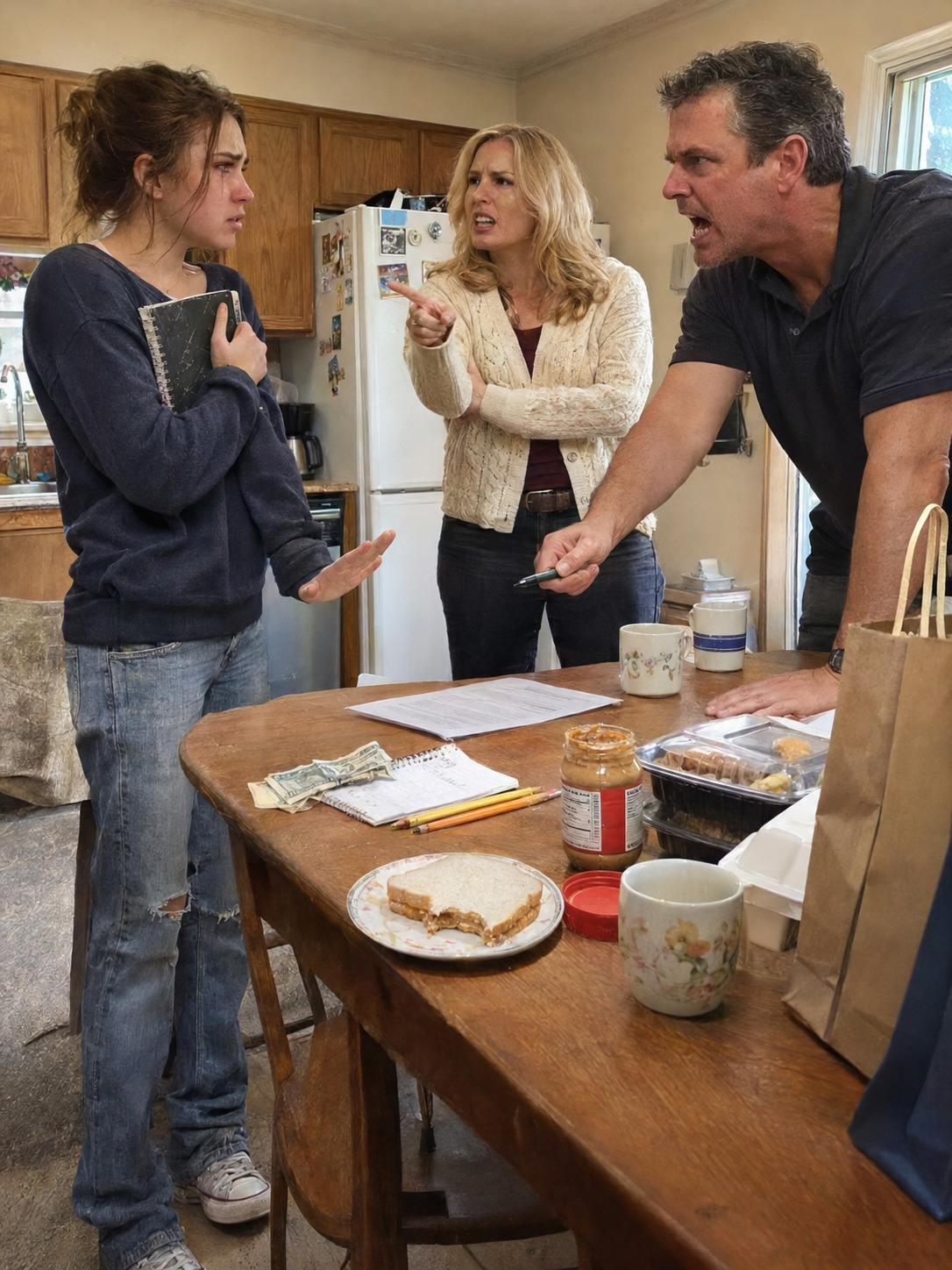
"Six hundred dollars a month. Plus utilities."
My father said it as though he were announcing the price of a used bicycle.
I stared at the rental agreement spread across our kitchen table.
$600.
The number sat inside a neat rectangular box beside the words MONTHLY RENT.
Underneath it was another line.
Utilities billed separately.
I looked up at Dad.
"Six hundred dollars?"
He nodded.
"That's right."
"Every month?"
"That's generally how rent works."
Mom stood beside him, her arms folded.
I looked from one face to the other, waiting for someone to laugh.
Nobody did.
I was fourteen years old.
I had never signed a lease.
I had never rented an apartment.
I had never even spent a night in a hotel without my parents.
But they were sitting across from me with a three-page rental agreement, expecting me to pay six hundred dollars for the bedroom I'd slept in since I was a little girl.
"I can't afford that," I whispered.
Dad leaned back in his chair.
"Then you'll need to earn more."
I stared at him.
"I have school."
"And?"
"And homework."
"Plenty of people work and go to school."
I looked down at the paper.
I knew exactly how much money I earned.
In a good month, when the weather cooperated and neighbors needed help, I might bring in seven hundred dollars.
But that wasn't profit.
Gasoline cost money.
Equipment needed maintenance.
And I still had to buy food, school supplies, clothes, and everything else my parents had stopped providing.
In winter, my income dropped sharply.
Sometimes I earned less than two hundred dollars.
Six hundred dollars wasn't a challenge.
It was impossible.
"What happens if I don't make enough?" I asked.
Dad tapped the agreement.
"That's why we're giving you a contract. So everyone understands the expectations."
I looked at the first page again.
The document had been printed on ordinary white paper.
At the top was a title in bold capital letters.
RESIDENTIAL RENTAL AGREEMENT.
Beneath it were spaces for names, addresses, and dates.
My father had filled in almost everything.
The property address was our home.
The landlord's name was his.
The tenant's name was mine.
Even seeing my name beside the word tenant made me feel sick.
I wasn't renting a room from strangers.
I was living with my parents.
At least, I had thought I was.
Mom pulled out the chair beside Dad.
"Sweetheart, you need to understand that things have changed."
I looked at her.
"I know Dad lost his job."
She nodded.
"Exactly."
"But I didn't lose my job."
The words came out before I could stop them.
Dad's expression darkened.
"What is that supposed to mean?"
I swallowed.
"Nothing."
"Then explain yourself."
I looked at the agreement.
"I mean, I already pay for my own things. I don't know how I'm supposed to pay for the house too."
Dad leaned forward.
"You're not paying for the house. You're paying for the space you occupy."
I stared at him.
"My bedroom?"
"Yes."
"The room I've always had?"
"Correct."
I glanced toward the hallway.
I could picture every inch of that room.
The narrow bed beneath the window.
The old dresser with one drawer that stuck.
The desk I'd used since elementary school.
The bookshelf with a missing wooden peg.
Nothing about it had changed.
Except now my father had decided it was worth six hundred dollars a month.
"Why six hundred?" I asked.
Dad sighed.
"Because that's a reasonable amount."
"How did you decide that?"
He gave me a long look.
"Do you want me to explain the housing market to you?"
"No."
"Then stop questioning every little detail."
I looked down.
Mom reached for the agreement.
"Your father spent a lot of time putting this together."
I stared at her.
That was what she wanted me to appreciate.
Not the fact that I was fourteen and being asked to pay rent.
The effort Dad had put into writing the contract.
"I appreciate that," I said quietly.
Dad nodded.
"Good."
"But I still can't afford it."
His expression hardened again.
"Then you'll have to make some changes."
I thought about my schedule.
School until three.
Dog walking until four.
Homework until six.
Babysitting on some evenings.
Lawn mowing on weekends.
There were only so many hours in a day.
"What changes?" I asked.
Dad shrugged.
"More customers. More hours. Better planning."
I looked at him.
"I can't mow lawns at night."
"Then find something else."
"I'm fourteen."
He gave a short laugh.
"You keep saying that like it's an excuse."
I stared at the table.
For two years, my parents had insisted I was old enough to buy my own food.
Now they were insisting I was old enough to pay rent.
But whenever I asked for a say in how things worked, they reminded me I was just a child.
I couldn't understand how I could be too young to make decisions and old enough to pay bills at the same time.
Mom slid a pen toward me.
"Just read it carefully."
I picked up the agreement.
Page one described the room.
Page two listed the monthly charges.
Page three contained rules.
I read them slowly.
Rent was due on the first day of every month.
Late payments would incur a fifty-dollar fee.
Utilities would be calculated by the landlords.
Failure to pay could result in termination of the agreement.
I stopped.
"What does termination mean?"
Dad looked up.
"It means the arrangement ends."
I stared at him.
"What arrangement?"
"Your right to stay here under these terms."
My heart began pounding.
I looked at Mom.
She didn't look surprised.
She didn't look upset.
She simply watched me.
"Are you saying I'd have to leave?" I asked.
Dad folded his arms.
"If you can't meet your obligations, yes."
The kitchen seemed to tilt.
I gripped the paper.
"Where would I go?"
He shrugged.
"That's something you'd have to figure out."
I stared at him.
He was serious.
My father was telling me that if I couldn't pay six hundred dollars a month, I might have to find somewhere else to live.
At fourteen.
I looked at Mom again.
"Mom?"
She sighed.
"Don't make this emotional."
I felt my throat tighten.
"Where am I supposed to live?"
"Your father is trying to motivate you."
"By telling me to leave?"
"By teaching you consequences."
I looked down at the agreement.
The words blurred.
For a moment, I couldn't read anything.
Then I heard Dad's voice.
"Look at me."
I raised my eyes.
"Nobody wants you to leave," he said.
I felt a tiny rush of relief.
Then he added, "But we're not going to let you live here for free forever."
I stared at him.
I wanted to ask what he meant by forever.
I was fourteen.
I had four years before I would even become an adult.
But Dad was already talking about me as though I were an unwanted tenant who had overstayed her welcome.
"Can I have time to think?" I asked.
He glanced at Mom.
Then he looked back at me.
"You have until tomorrow morning."
I swallowed.
"That's not much time."
"It's plenty."
I looked at the pen.
Then at the agreement.
Then at my parents.
I had a sudden, terrible feeling that if I signed the paper, something important would change.
Not just financially.
Something about who I was allowed to be in that house.
I would no longer be their daughter who happened to earn money.
I would be someone who owed them rent.
Someone whose place at the table depended on payment.
Someone who could be threatened with removal whenever money became tight.
"I need to read it upstairs," I said.
Dad nodded.
"Fine."
I reached for the papers.
Mom placed her hand on top of them.
"You're not planning to show this to anyone, are you?"
I froze.
"What?"
"The agreement."
I looked at her.
"Why?"
"Because it's a private family matter."
Dad nodded.
"Exactly."
I stared at the papers beneath her hand.
My parents had always said that.
Private family matter.
It was the phrase they used whenever something happened that they didn't want other people to know about.
When I skipped lunch.
When I bought my own shoes.
When Dad took food I'd purchased.
When Mom searched my room.
Everything was private.
Everything stayed inside the house.
And I was expected to carry it alone.
"I just want to read it," I said.
Mom studied me.
Then she removed her hand.
"Fine."
I took the agreement.
I went upstairs.
I closed my bedroom door.
Then I sat on my bed and stared at the first page.
Six hundred dollars.
Plus utilities.
I opened my budget notebook.
My most recent balance was $1,547.63.
That money had taken two years to save.
Two years of work.
Two years of skipped lunches and secondhand shoes.
Two years of saying no to things I wanted because I needed to be prepared for emergencies.
Now my parents wanted six hundred dollars every month.
I took out my calculator.
Six hundred times twelve.
Seven thousand two hundred dollars.
Before utilities.
Before food.
Before school supplies.
Before anything else.
I stared at the result.
$7,200.
I had never earned that much in a year.
Not even close.
I tried calculating what would happen if I used my savings.
The first month, I could pay.
The second month, maybe.
After that, I would be nearly broke.
And then what?
Would Dad really tell me to leave?
Would Mom stand beside him and call it a lesson?
I looked toward the door.
For a moment, I imagined packing a suitcase.
I imagined standing outside our house with nowhere to go.
I imagined knocking on Mrs. Henderson's door and trying to explain why my parents had decided I couldn't stay.
The thought made my chest hurt.
I closed the calculator.
Then I opened the agreement again.
I read every paragraph.
Some of the language sounded official.
Other parts seemed strangely vague.
There was no explanation of how utilities would be calculated.
No mention of what happened if the house needed repairs.
No clear description of what services the rent included.
And there was a clause about late fees that seemed designed to make the amount grow quickly.
I didn't know much about contracts.
But I knew enough about money to recognize a dangerous arrangement.
If Dad could decide what utilities cost, he could decide how much I owed.
If he could charge late fees, the debt could grow.
If he could threaten to terminate the agreement, he could use that threat whenever he wanted.
I looked at my notebook.
Then I began writing questions.
Why am I being charged rent?
Can parents charge a fourteen-year-old rent?
Can they make me leave?
What happens if I don't sign?
I stared at the last question.
It frightened me more than the others.
Because I didn't know whether refusing would make things worse.
Downstairs, I heard the television turn on.
The familiar opening music of Dad's favorite sports program drifted through the floor.
I looked at the agreement.
Then at the ceiling.
It was strange.
Dad could sit downstairs watching a sixty-inch television while I sat upstairs trying to calculate the price of remaining his daughter.
I opened my phone.
For a moment, I considered calling Emily.
But what would I say?
Hi, my parents want six hundred dollars a month or they're going to throw me out.
It sounded ridiculous.
Like something from a movie.
I imagined her laughing because she thought I was joking.
Then I imagined her telling her mother.
And her mother calling mine.
The thought made my stomach tighten.
I put the phone down.
Instead, I searched for information about parents charging rent to minors.
The results were confusing.
Some pages discussed adult children living at home.
Others described parents teaching teenagers financial responsibility.
A few mentioned legal obligations to provide necessities.
I clicked on one of those.
I read slowly.
Parents generally had responsibilities to provide food, shelter, and basic care for their minor children.
I stared at the screen.
Shelter.
Food.
Basic care.
Those were the exact things I'd been paying for or worrying about since I was twelve.
I read the sentence again.
Then I opened another page.
It said that a minor's signature on a document did not automatically make an arrangement enforceable.
I didn't understand every legal detail.
But I understood enough to feel something shift.
Maybe my parents weren't allowed to do this.
Maybe the agreement wasn't as powerful as Dad wanted me to believe.
Maybe I had more options than signing or leaving.
I thought about Mrs. Whitmore.
The teacher who had noticed when I wasn't eating lunch.
I remembered the blue student support form.
The question she'd asked.
Do you have access to food?
At the time, I'd been terrified that she would call my parents.
Now I wished I'd told her the truth.
I wondered whether she would remember me.
Then I remembered Mrs. Carter.
Our school counselor.
She had gray hair, a quiet voice, and small green plants on her office windowsill.
Earlier that year, she'd stopped me in the hallway after noticing how tired I looked.
"Everything okay?" she'd asked.
I'd smiled.
"Just busy."
She hadn't pushed.
But she'd said, "If you ever need to talk, my door is open."
I hadn't thought much about it then.
Now I couldn't stop thinking about those words.
My door is open.
I looked at the rental agreement.
Then I looked at my notebook.
I wrote one more question.
Can Mrs. Carter help me?
I stared at it.
For the first time that evening, I felt something other than fear.
Not confidence.
Not relief.
Just the smallest possibility that I didn't have to handle this alone.
I decided I would take the agreement to school.
Not to embarrass my parents.
Not to get them in trouble.
I simply needed an adult to tell me whether what they were asking was normal.
I needed someone who wasn't part of the argument.
Someone who wouldn't tell me that needing food made me ungrateful.
Someone who could explain what rights a fourteen-year-old actually had.
I placed the agreement inside my backpack.
Then I took it out again.
Mom had asked whether I planned to show anyone.
If she found out, she would be furious.
Dad might take away my phone.
They might stop letting me work.
They might decide that refusing to sign meant I had already chosen to leave.
I sat on the bed for a long time.
Then I opened the backpack and placed the papers inside.
I zipped it closed.
Downstairs, Dad laughed at something on television.
Mom called out that dinner was ready.
I didn't move.
I wasn't hungry anymore.
I was too frightened.
Eventually, I went downstairs.
Dad was eating takeout from a white cardboard container.
Mom had a plate of noodles.
There was no plate for me.
I went to the cabinet and took out bread.
I made a peanut butter sandwich with food I'd purchased myself.
Then I sat at the end of the table.
Dad glanced at me.
"Well?"
I looked up.
"Well what?"
"Have you decided?"
I swallowed.
"You said I had until tomorrow."
He nodded.
"That's right."
Mom smiled faintly.
"Don't overthink it, sweetheart. It's a simple agreement."
I looked at the sandwich in my hands.
Then at the television glowing in the living room.
Then at the two people who had raised me.
For a moment, I wanted to ask them whether they remembered when I was little.
When Dad used to carry me on his shoulders.
When Mom packed my lunch in a pink box with cartoon animals.
When I didn't have to calculate whether I could afford to eat.
But I didn't.
I took a bite of my sandwich.
Dad watched me.
"You're going to sign it," he said.
It wasn't a question.
I swallowed.
"I need to think."
He gave a short laugh.
"Fine. Think."
Mom shook her head.
"She'll come around."
I looked down.
They were so certain.
So confident that I had nowhere else to go.
And that was exactly what frightened me.
After dinner, I went upstairs.
I checked my backpack.
The agreement was still there.
I placed my notebook beside it.
Then I set my alarm for six-thirty.
I planned to leave early enough to speak with Mrs. Carter before classes began.
I didn't know what would happen.
I didn't know whether she could help.
I didn't know whether my parents would find out.
But I knew I couldn't sign the agreement without understanding it.
I turned off the light.
Then I lay awake listening to the house.
The television.
The refrigerator.
The distant sound of traffic.
At twelve forty-seven, I heard my parents talking downstairs.
Mom's voice was low.
"She'll sign. Where else is she going to go?"
Dad answered.
"Exactly."
I closed my eyes.
I wanted to disappear.
But then I remembered the agreement in my backpack.
I remembered Mrs. Carter's office.
I remembered the words I'd read online about parents' responsibilities.
And I knew that tomorrow, I was going to ask someone for help.
Just before one in the morning, I opened the agreement one final time.
A small line near the bottom of the third page caught my attention.
I hadn't noticed it before.
It was printed beneath the signature spaces in much smaller type.
I brought the paper closer to the light.
There, directly below my name, was a sentence beginning with the words:
"By signing, the tenant acknowledges..."
I leaned closer.
Then I read the rest of the sentence.
My hands went cold.
Because the contract didn't just demand six hundred dollars.
It said I was voluntarily agreeing that my parents were no longer responsible for providing my basic living expenses.
I stared at the words.
Then I looked at the signature line.
Dad had already typed my name beneath it.
And beside my name, in handwriting that looked almost exactly like mine, someone had written a date.
I turned the page toward the lamp.
There was a faint indentation in the paper.
A signature had been traced.
My signature.
But I hadn't signed anything.
I held the page closer.
The ink was still slightly shiny.
Someone had tried to sign my name before I ever agreed.
And then I heard my bedroom doorknob begin to turn.






Comments 0