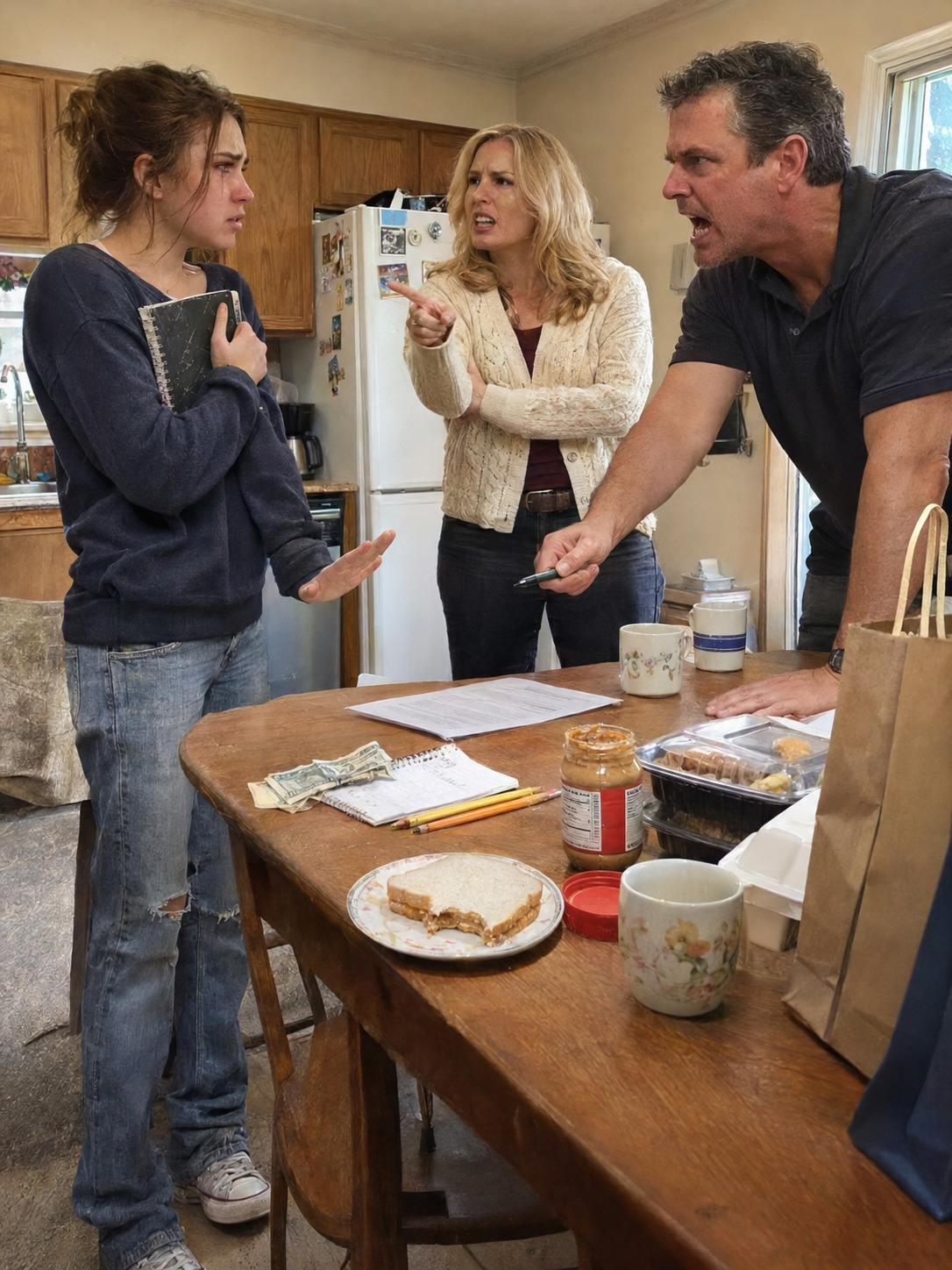
"Why is there a child protection investigator standing at my front door?"
My father's voice echoed through Mrs. Carter's office.
I sat frozen in my chair.
The words seemed to hang in the air long after he had spoken them.
Mrs. Carter calmly closed the folder on her desk.
"Mr. Lawson, I need you to remain in the waiting area while we clarify a few things."
Dad stared at her.
"Clarify what?"
"Some concerns have been raised about your daughter's access to food and the financial agreement you've presented to her."
His face changed.
"That's ridiculous. She's perfectly taken care of."
I looked down at my hands.
Dad continued.
"She's making money. We encouraged her to become independent. That's all this is."
Mrs. Carter didn't argue.
She simply said, "I'd like you to wait outside."
Dad looked at me.
His eyes narrowed.
"You told them everything?"
I couldn't answer.
"After everything we've done for you?"
Mrs. Carter stepped between us.
"Please don't question her right now."
Dad shook his head.
Then he walked out.
The door closed.
For several seconds, nobody spoke.
I could hear footsteps moving down the hallway.
Then a chair scraped against the floor outside.
Mrs. Carter looked at me.
"Take a breath."
I tried.
My lungs felt tight.
"Is he going to be angry?"
"Possibly. But right now, we're going to focus on making sure you're safe."
She picked up the telephone and spoke quietly to someone at the front office.
A few minutes later, a woman entered.
She was probably in her forties, with shoulder-length light brown hair and a navy blazer. She carried a leather folder and introduced herself as Karen Mitchell, a child protection investigator.
She pulled a chair beside Mrs. Carter.
"Hi," she said gently. "I've heard a little about what's happening, but I'd like to hear it from you."
I nodded.
"Okay."
She explained that her job was to understand whether children were safe and whether their basic needs were being met.
She wasn't there to punish me.
She wasn't there to make me choose between my parents.
She wanted to understand what had happened.
I looked at Mrs. Carter.
She gave me a small nod.
So I began.
I told Karen about the school lunch form when I was twelve.
I explained how Mom had stopped paying for my lunches and school supplies.
I described the babysitting jobs, the dog walking, and the lawns I'd mowed.
I told her how I'd started buying my own groceries.
Then I explained the household contribution demands.
The twenty-percent management fee.
The family financial agreement.
The demand for two hundred dollars.
Finally, I took out the rental contract.
Karen read it carefully.
She didn't interrupt.
When she reached the six-hundred-dollar rent clause, she paused.
Then she turned to the last page.
Her eyes stopped at the signature.
"Did you sign this?"
"No."
"Did you give anyone permission to sign it for you?"
"No."
She looked at me.
"Are you certain?"
I nodded.
"I took pictures last night because I was worried they might take the paper away."
Karen looked toward Mrs. Carter.
"Could you send me copies of those photographs?"
Mrs. Carter nodded.
Karen returned to the document.
"Did your father tell you that you would have to leave if you couldn't pay?"
"Yes."
"When?"
"Last night. He said the agreement could be terminated."
"Did he tell you where you would go?"
I shook my head.
"He said I'd have to figure it out."
Karen wrote something in her folder.
Then she asked a question that made my stomach tighten.
"Have you ever been physically hurt by either parent?"
"No."
"Have they ever threatened to hurt you?"
"No."
"Have you ever been locked outside the house?"
"No."
"Do you have a bedroom and a bed?"
"Yes."
"Do you have access to clean water and a bathroom?"
"Yes."
I nodded.
I wanted to make sure she understood that I wasn't saying everything at home was terrible.
There were good things.
Sometimes Dad made pancakes on Sundays.
Sometimes Mom bought my favorite cereal.
Sometimes we watched movies together.
I still loved them.
That was what made everything so confusing.
Karen listened as I explained.
Then she asked, "Do you currently have enough food to eat every day?"
I hesitated.
I looked at the backpack beside my chair.
Inside it was the notebook that contained two years of grocery expenses.
"No," I whispered.
Karen stopped writing.
"Can you tell me why?"
"Because I have to buy it myself. Sometimes I don't have enough money."
"Have you gone without meals recently?"
I nodded.
"How recently?"
"Last week."
Mrs. Carter looked at me.
I hadn't told her that part.
Karen's expression became more serious.
"Thank you for telling me."
I looked down.
"I don't want my parents to lose their house."
Nobody spoke.
Then Karen said, "That's not something you are responsible for fixing."
I stared at her.
She continued.
"Your parents' employment situation and household finances are adult responsibilities. You should not have to sacrifice food or basic necessities to solve them."
My eyes filled.
I quickly wiped them.
I didn't want to cry again.
But something about hearing an adult say that made me feel as though I'd been carrying a heavy bag for so long that I'd forgotten I could put it down.
Karen asked whether she could look through my budget notebook.
I handed it to her.
She turned through the pages.
There were dates, customer names, payments, grocery receipts, and handwritten calculations.
She stopped at a page from when I was twelve.
Food: $42.
School supplies: $18.
Clothing: $0.
Savings: $15.
She looked up.
"You were buying your own groceries at twelve?"
I nodded.
"Yes."
"And you were attending school full-time?"
"Yes."
She turned another page.
There was a list of jobs.
Dog walking.
Babysitting.
Yard work.
Leaf removal.
She looked at the total income.
Then at the expenses.
"Who helped you learn to manage all of this?"
"Nobody."
I felt embarrassed saying it.
"I just figured it out."
Karen closed the notebook gently.
"You shouldn't have had to."
For the first time that morning, I believed someone.
Not because she was telling me what I wanted to hear.
Because she had read the records.
She had seen the dates.
She had looked at the numbers.
And she understood that they weren't just numbers.
They represented a child trying to make sure she had enough to eat.
Karen explained that she would need to speak with my parents separately.
She also wanted to understand the legal situation surrounding the rental agreement.
She was careful not to promise a particular outcome.
"These things take time," she said. "But we're going to make sure the right people review everything."
I nodded.
Then she asked, "Would you feel safe going home today?"
I hesitated.
"I think so."
"Are you worried about how your father might react?"
I looked at the door.
"Yes."
Karen wrote that down.
"Thank you for being honest."
She spoke with Mrs. Carter for a few minutes.
They discussed a temporary plan to make sure I had access to school meals and someone at school I could speak with if things became difficult.
Karen also mentioned connecting me with a legal aid attorney who worked with families and minors.
I felt relieved.
Then I remembered Dad waiting outside.
"What happens now?"
Karen looked at me.
"I'll speak with your parents. You don't need to participate in that conversation unless we decide it's appropriate and safe."
I nodded.
She stood and collected the rental agreement.
"Can I keep this?"
I looked at the document.
For a moment, I felt protective of it.
It was the paper that had frightened me.
But it was also evidence.
"Can I have a copy?"
"Of course."
Mrs. Carter placed the original in a folder and made another copy for me.
I slipped mine into my backpack.
Then Karen left the office.
Mrs. Carter stayed with me.
She offered me a sandwich from the school kitchen.
I accepted.
While I ate, she asked about my classes.
I told her I was struggling in math because I'd missed several assignments.
She offered to contact my teacher.
Then she asked whether I wanted to join the school's free lunch program.
I nodded.
"Yes, please."
She smiled.
"All right. We'll take care of the paperwork."
I ate slowly.
The sandwich was turkey and cheese.
There was lettuce inside.
I hadn't realized how hungry I was until I finished it.
Mrs. Carter didn't comment.
She simply placed an apple beside my notebook.
When I looked at her, she said, "For later."
I thanked her.
A few minutes passed.
Then she asked, "Can I ask you something personal?"
I nodded.
"Why didn't you tell anyone sooner?"
I looked down at the table.
"I thought it was normal."
She waited.
"My parents said it was responsibility. They said other kids were spoiled because their parents paid for everything."
I swallowed.
"And I didn't want people thinking my parents were bad."
Mrs. Carter nodded.
"That makes sense."
I looked up.
"Does it?"
"Yes. Children love their parents. Sometimes that makes it difficult to recognize when something isn't right."
I stared at her.
She continued.
"You can love your parents and still ask for help. Those things aren't opposites."
I felt my throat tighten.
I nodded.
Then the office door opened.
Karen returned.
She looked more serious than before.
"Your father would like to speak with you."
My stomach dropped.
"Do I have to?"
"No," she answered immediately. "We can discuss whether that's appropriate."
I looked at Mrs. Carter.
She didn't tell me what to do.
She simply waited.
I thought about Dad.
I thought about how angry he had looked in the hallway.
But I also thought about the fact that he was my father.
I wanted him to understand.
I wanted him to stop.
"Maybe," I said. "If someone stays with us."
Karen nodded.
"That can be arranged."
We walked to a small conference room near the front office.
Dad was already there.
He sat with his arms folded.
Mom was beside him.
She looked pale.
When I entered, she immediately stood.
"Sweetheart."
I stopped.
She walked toward me.
Then she looked at Karen.
"Can we please talk as a family?"
Karen gestured toward the chairs.
"We can talk about the concerns that have been raised. I need everyone to remain calm."
I sat beside Mrs. Carter.
Dad stared at me.
Mom reached across the table.
"Why didn't you come to us?"
I looked at her.
"I did."
She blinked.
"When?"
"When I told you I couldn't afford the money."
Mom looked away.
Dad leaned forward.
"We were trying to teach you something."
Karen spoke.
"Mr. Lawson, can you explain the purpose of the rental agreement?"
Dad nodded.
"She's been earning money for years. We thought it was time she learned about household responsibilities."
"Why six hundred dollars?"
"That's what we estimated her room would cost."
Karen glanced at the document.
"Did you consider her age and legal status?"
Dad frowned.
"What does that have to do with it?"
Karen remained calm.
"She's fourteen."
Dad shook his head.
"She's old enough to work."
"Being permitted to earn money does not automatically make a minor responsible for adult housing expenses."
Dad looked at me.
"See? This is exactly what I was worried about. She's making us look like criminals."
I lowered my eyes.
Mom started crying.
"We're struggling. Her father lost his job. We didn't know what else to do."
Karen nodded.
"I understand that financial hardship can be stressful. But your daughter's access to food and basic necessities is a separate concern."
Mom wiped her cheeks.
"We never wanted her to go hungry."
I looked up.
I wanted to believe her.
I really did.
But I remembered the nights I'd sat upstairs listening to them eat takeout.
I remembered the empty cabinets.
I remembered buying bread with the last few dollars in my pocket.
I couldn't pretend those memories hadn't happened.
Dad pointed toward my backpack.
"She has more than fifteen hundred dollars saved. We asked her to help us, and she refused."
Karen looked at him.
"Is that money from her employment?"
"Yes."
"Did she earn it herself?"
Dad hesitated.
"Yes, but—"
"Did you provide the equipment she used?"
"Some of it."
I looked up.
The mower was mine.
The gloves were mine.
The gasoline was mine.
Even the notebook was mine.
But I didn't interrupt.
Karen continued.
"Did you take any of her savings?"
"No."
"Did you attempt to require her to transfer the money?"
Dad looked irritated.
"We discussed a family agreement."
"Was she free to refuse?"
He didn't answer immediately.
Mom looked down.
Karen waited.
Finally, Dad said, "We expected her to contribute."
Karen glanced at the rental agreement.
"And what would have happened if she didn't?"
Dad sighed.
"We would have discussed other arrangements."
I felt my stomach tighten.
That wasn't what he'd told me.
He'd told me to find somewhere else to live.
Karen turned toward me.
"Is that what he told you?"
I nodded.
"Yes."
Dad shook his head.
"I was frustrated. I didn't mean it literally."
I looked at him.
"You said I'd have to figure out where to go."
He stared at me.
For a moment, he said nothing.
Then he looked away.
The room became quiet.
Karen asked to see the family financial agreement.
I handed over my copy.
She read it.
Then she asked Mom whether she had written it.
Mom shook her head.
"Your father prepared it."
"Did you agree with its contents?"
Mom hesitated.
"We thought she should contribute."
"All of her earnings and savings?"
Mom looked at Dad.
Then she whispered, "Not all of it."
Dad turned toward her.
"What?"
She swallowed.
"I didn't think we should take everything."
Dad's face hardened.
I stared at my mother.
It was the first time she'd disagreed with him in front of someone else.
Karen made a note.
Then she asked whether the rental agreement had been signed.
Dad shook his head.
"No."
"Has your daughter signed it?"
"No."
Karen looked at me.
I shook my head.
"Good," she said. "Do not sign anything until you've received appropriate legal advice."
I nodded.
Dad shifted in his chair.
"This is getting out of hand."
Karen remained composed.
"Our purpose is to understand the situation and make sure your daughter is safe."
She explained that the concerns would need further review.
She also discussed the immediate arrangements for food, school support, and a safe way to address the financial demands at home.
I listened carefully.
I didn't understand every detail.
But I understood that I wasn't being asked to solve the situation by myself anymore.
When the meeting ended, Karen asked me to remain with Mrs. Carter for a few minutes.
My parents left first.
Mom paused at the door.
She looked at me.
Her eyes were wet.
"Can we talk tonight?"
I didn't know what to say.
I nodded slightly.
She left.
Dad didn't look back.
Mrs. Carter walked me to the hallway.
"How are you feeling?"
I thought about the question.
"Tired."
She smiled faintly.
"That makes sense."
Then she handed me a school meal application.
"We'll finish this together."
I took it.
For the first time in a long while, I didn't feel embarrassed about needing help.
I completed the form.
Mrs. Carter helped me arrange a meeting with the legal aid office.
She also asked whether I wanted to speak with my math teacher about the missing assignments.
I said yes.
By lunchtime, I had eaten a proper meal.
I sat with Emily.
She looked at my tray.
"Since when do you get school lunch?"
I hesitated.
"Since today."
She smiled.
"That's good."
Then she noticed my expression.
"Are you okay?"
I nodded.
"I'm getting help."
She didn't ask for details.
She simply moved her apple toward me.
"Want half?"
I laughed softly.
"No, thanks."
For once, I wasn't calculating whether I could afford the food in front of me.
But when school ended, I still had to go home.
I walked slowly.
My backpack felt heavier than usual.
Inside were the rental agreement, my notebook, and the school paperwork.
I wasn't sure what Dad would say.
I wasn't sure whether Mom would apologize.
I wasn't even sure whether I would be allowed to keep working for Mrs. Henderson.
When I reached the house, I noticed something immediately.
The front door was unlocked.
I stepped inside.
The television was off.
The kitchen was silent.
On the counter sat a white envelope with my name written across it.
I picked it up.
Inside was a single sheet of paper.
At the top was a heading I hadn't seen before.
NOTICE OF TERMINATION OF OCCUPANCY.
My hands went cold.
Beneath the heading was a date.
Tomorrow.
And at the bottom, beneath my father's signature, was a second signature.
My mother's.
But this time, there was something else.
A handwritten note.
Five words.
Your father doesn't know about this.
I stared at the note.
Then I heard Mom's bedroom door open behind me.






Comments 0