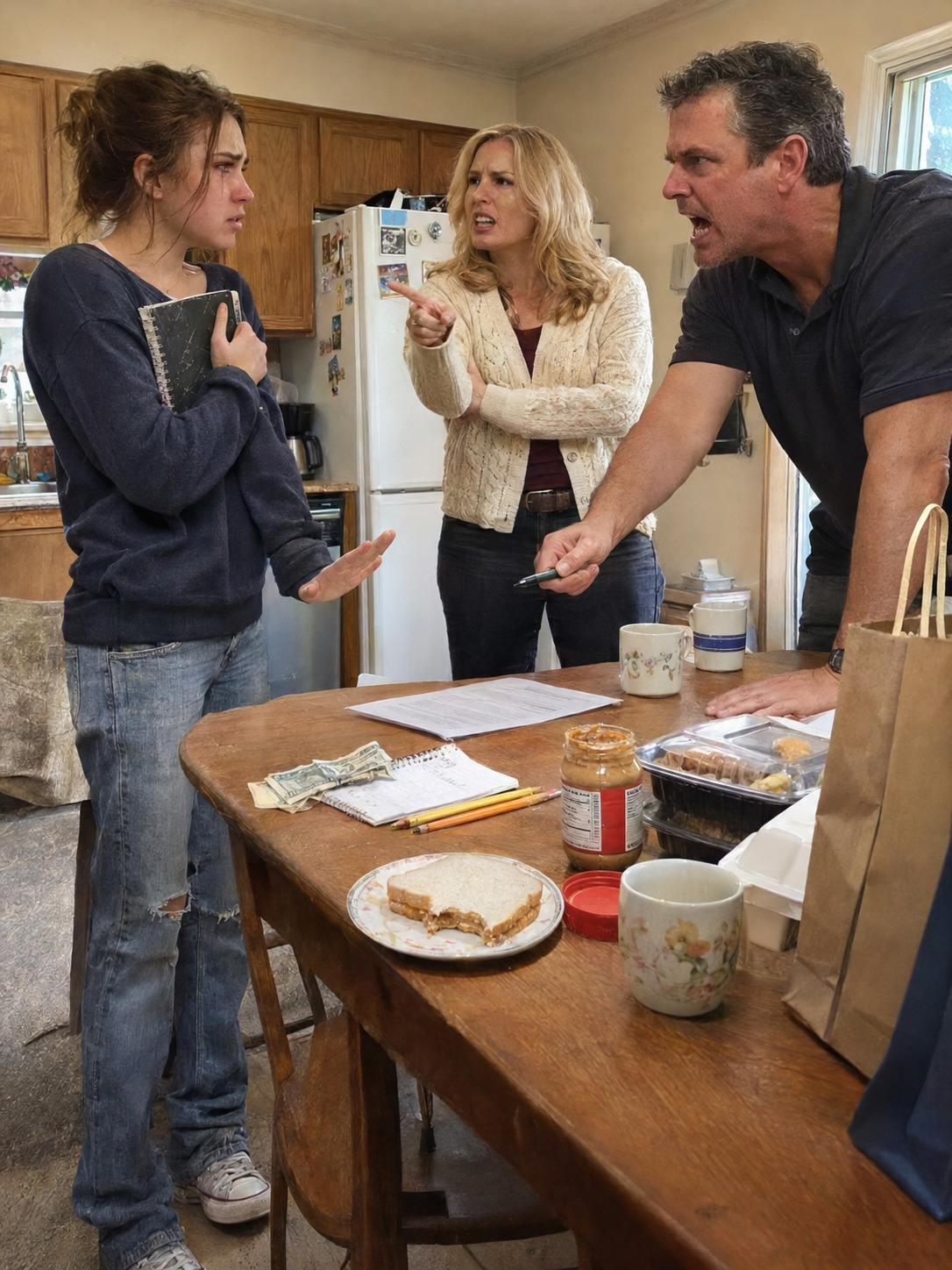
"Twenty percent. That's what you owe us."
My father pushed my business notebook across the kitchen table and pointed at the new column he'd added beside my customers' names.
PARENTAL MANAGEMENT FEE: 20%.
I stared at the number.
I was thirteen years old, and my parents had apparently decided that raising me entitled them to a percentage of the money I earned.
"What are you managing?" I asked.
Dad looked up sharply.
"Excuse me?"
I immediately regretted the question.
Not because it was unreasonable.
Because I knew how he reacted whenever I asked him to explain something he thought I should simply accept.
Mom stood beside the refrigerator, watching us.
"Your father has been very generous about letting you run this little business," she said.
I looked at her.
"Letting me?"
"Yes. Letting you."
I glanced toward the garage.
My used lawn mower was parked against the wall, exactly where I'd left it after cleaning the grass from underneath the deck.
I'd bought it with my own money.
I'd found my own customers.
I'd arranged my own schedule.
I bought gasoline, replaced worn gloves, and kept records of every payment.
The only thing my parents had contributed was permission to store the mower in a garage they rarely used.
"What does twenty percent pay for?" I asked.
Dad leaned forward.
"You're using our property. Our address. Our reputation."
I blinked.
"Your reputation?"
"People know you're our daughter. That matters."
I thought about Mrs. Henderson recommending me because I'd been dependable.
I thought about Mr. Alvarez paying me extra because I'd finished his yard carefully.
I thought about all the afternoons I'd spent working while my parents watched television.
But I didn't say any of it.
Dad tapped the notebook again.
"If you earn a hundred dollars, twenty goes to the household. Simple."
I looked at the page.
"And I still buy my own food?"
Mom sighed.
"Why do you keep bringing that up?"
"Because I need the money for groceries."
"Then earn enough for both."
I stared at her.
She said it as though earning more money were as easy as opening a drawer.
As though I could simply decide that every neighbor on our street needed their lawn mowed twice a week.
As though I didn't have school, homework, and the ordinary exhaustion of being thirteen.
Dad pushed a pen toward me.
"Write down what you earned last week."
I didn't touch it.
"Why?"
"So we can calculate your contribution."
My stomach tightened.
I had earned eighty-five dollars that week.
Seventeen dollars would be twenty percent.
Seventeen dollars was enough to buy bread, peanut butter, eggs, and fruit for several days.
I looked at my notebook.
Then I looked at Dad.
"I don't think I can afford that."
His expression hardened.
"You're getting awfully comfortable telling us no."
"I'm not trying to be disrespectful."
"Then stop arguing."
Mom folded her arms.
"Your father and I are doing you a favor by teaching you how businesses work."
I wanted to tell her that businesses didn't normally pay management fees to people who provided no management.
Instead, I said, "Can I keep track of it first? So I know what I can afford?"
Dad stared at me for a moment.
Then he pushed the notebook away.
"Fine. But don't think this conversation is over."
It wasn't.
For the next several months, the management fee became one of those threats that floated around our house without ever becoming a consistent rule.
Some weeks Dad asked how much I'd earned.
Other weeks he forgot.
Occasionally he demanded twenty dollars for household expenses.
Sometimes he called it a contribution.
Sometimes he called it repayment for using the garage.
Once, he called it a lesson in taxes.
I never understood which explanation he believed.
I only understood that money I had earned could suddenly become money he thought he deserved.
I started keeping my business records more carefully.
Every job went into my notebook.
Every expense had a receipt.
I separated business money from grocery money.
I learned to calculate profit instead of simply counting cash.
And I stopped telling my parents how much I had saved.
Not because I wanted to deceive them.
Because every time they learned I had money, they found a new reason I should give it to them.
By the time I turned fourteen, I had built a routine that almost worked.
During warmer months, I mowed lawns.
During colder months, I walked dogs, babysat, and helped neighbors with small chores.
Mrs. Henderson remained my most dependable customer.
She had become more than the woman whose dog I walked.
She was someone who noticed things.
If I looked tired, she asked whether I'd been sleeping.
If I arrived without gloves, she offered me a spare pair.
If I finished a job near lunchtime, she sometimes invited me inside for soup or a sandwich.
I usually refused.
Not because I wasn't hungry.
Because accepting food still made me uncomfortable.
One afternoon, after I'd finished cleaning leaves from her front walkway, she invited me into the kitchen.
"I made too much chicken noodle soup," she said. "Help me out."
I smiled.
"You always make too much."
She laughed.
"Funny how that keeps happening."
I sat at her kitchen table.
She placed a bowl in front of me, along with two slices of buttered bread.
The soup smelled wonderful.
I took a spoonful.
Then another.
Mrs. Henderson sat across from me.
"How's school?"
"Good."
"Grades?"
"Mostly A's."
"That's wonderful."
I looked down at my soup.
She watched me for a moment.
"Are you getting enough time to be a kid?"
I stopped eating.
"What do you mean?"
"You work an awful lot."
I shrugged.
"I like saving money."
"There's nothing wrong with that."
She paused.
"But there's also nothing wrong with resting."
I nodded.
I didn't know how to explain that resting felt expensive.
Every afternoon I didn't work was money I wouldn't earn.
Every dollar I didn't earn was one less dollar available for food, school supplies, or emergencies.
I had become so accustomed to calculating everything that even free time felt like something I couldn't afford.
Mrs. Henderson didn't press me.
Instead, she asked whether I wanted more soup.
I said yes.
That afternoon, I ate until I was full.
Then I went home and finished my homework.
I remember that day because it was one of the few times I didn't worry about dinner.
A week later, everything began to change.
Dad came home from work earlier than usual.
I was sitting at the kitchen table reviewing vocabulary words when I heard the front door open.
Normally, he arrived around six.
That day, it was barely three-thirty.
He walked inside carrying a cardboard box.
Inside were a framed photograph, a coffee mug, a small desk calendar, and a plant with drooping leaves.
I looked up.
"Hi, Dad."
He didn't answer.
He placed the box on the counter.
Mom appeared from the laundry room.
"You're home early."
Dad loosened his tie.
"Yeah."
She looked at the box.
"What happened?"
He didn't speak immediately.
Then he said, "They let me go."
The kitchen became very quiet.
Mom stared at him.
"What?"
"Budget cuts. Restructuring. Whatever they want to call it."
He pulled out a chair and sat down.
"They eliminated my position."
I looked at the box.
I had never seen Dad bring his office things home before.
He'd worked for the same company for years.
He complained about his boss, his coworkers, and the commute, but I had always assumed his job would be there.
Now it wasn't.
Mom sat across from him.
"Did they give you severance?"
"A little."
"How much?"
Dad rubbed his forehead.
"Not enough."
I stayed very still.
For the first time, I saw my father look frightened.
Not angry.
Not irritated.
Frightened.
His shoulders seemed smaller.
He stared at the table as though he expected it to give him an answer.
I felt sorry for him.
I really did.
Whatever had happened between us, he was still my father.
And losing a job was terrible.
"I'm sorry, Dad," I said.
He looked at me.
For a moment, his expression softened.
"Thanks."
Then Mom asked about the mortgage.
Dad's face hardened again.
"We'll figure it out."
She began listing expenses.
Insurance.
Car payments.
Utilities.
Groceries.
I listened quietly.
I knew more about household budgeting than most children my age, but hearing my parents discuss those numbers was different.
Their expenses were enormous compared with mine.
I understood why they were worried.
What I didn't understand was why the first thing Mom suggested cutting was the money they spent on me.
"She can handle more of her own expenses," Mom said, glancing in my direction.
I looked up.
Dad nodded slowly.
"She's already doing that."
"Then maybe she can help with groceries too."
My stomach tightened.
"I already buy my groceries," I said.
Mom waved a hand.
"I mean household groceries."
I stared at her.
"For everyone?"
"Don't make it sound so dramatic."
Dad rubbed his forehead.
"We're not deciding anything tonight."
I felt a small rush of relief.
Then he added, "But we're all going to have to make sacrifices."
I nodded.
I wanted to help.
I wanted my parents to be okay.
I wanted our house to remain our house.
But I also knew that I couldn't afford to feed three people.
I was barely managing to feed myself.
That evening, Dad didn't watch television.
He sat at the kitchen table with his laptop open, looking through job listings.
Mom made pasta for dinner.
For the first time in months, she told me to sit down and eat with them.
I almost didn't know what to do.
I took a small serving.
Mom noticed.
"There's plenty."
I looked at her.
"Are you sure?"
She frowned.
"Of course I'm sure."
I added another spoonful.
The three of us ate quietly.
Dad talked about applying for positions at other companies.
Mom said he had years of experience.
He nodded.
I listened.
For a few minutes, we felt like a normal family.
I let myself hope that maybe the situation would bring us closer.
Maybe losing his job would make Dad understand how frightening financial uncertainty could be.
Maybe Mom would realize that I had been living with a smaller version of that fear for two years.
Maybe we'd finally start helping one another instead of keeping score.
That hope lasted eleven days.
At first, Dad applied for jobs every morning.
He updated his résumé.
He made phone calls.
He attended an interview.
He came home disappointed.
Then another interview fell through.
A company said it had decided to hire internally.
Another never called back.
Dad became quieter.
Then angrier.
He started sleeping late.
He complained that nobody appreciated experience anymore.
He said employers wanted younger people they could pay less.
Mom tried to encourage him.
But as the weeks passed, her encouragement turned into criticism.
"You can't just sit around waiting," she told him one afternoon.
"I'm not sitting around."
"Then why haven't you found anything?"
Dad slammed his laptop shut.
"Because nobody's hiring!"
I was upstairs when I heard the argument.
I closed my bedroom door.
Then I opened my budget notebook.
I had saved a little over a thousand dollars by then.
Most of it had come from lawn mowing during the summer.
I was proud of that money.
It represented two years of work.
But as I listened to my parents arguing downstairs, I began to feel guilty for having it.
They were worried about the mortgage.
I was worried about buying groceries.
And somehow, the fact that I had savings made me feel as though I was doing something wrong.
A few days later, Dad asked about my bank account.
We were alone in the kitchen.
He was making coffee.
I was packing my school bag.
"How much do you have saved now?"
I hesitated.
"Some."
He looked at me.
"How much is some?"
I stared at the zipper on my backpack.
"About a thousand."
His eyebrows rose.
"A thousand dollars?"
I nodded.
He gave a low whistle.
"That's impressive."
I smiled weakly.
Then he asked, "What are you planning to do with it?"
"Save it."
"For what?"
"College. Emergencies."
He laughed.
"You're fourteen. You don't need an emergency fund."
I looked at him.
I wanted to tell him that I had needed one since I was twelve.
But I didn't.
Dad stirred his coffee.
"Well, it's good to know there's some money in the family."
The words stayed with me all day.
Money in the family.
Not my savings.
Not my college fund.
Money in the family.
That evening, I moved my bank statements into a folder and placed it at the bottom of my backpack.
I didn't want to hide money from my parents.
But I had begun to understand that they saw my savings differently than I did.
To me, it was protection.
To them, it was available cash.
Over the next month, Dad's job search continued without success.
He became increasingly frustrated.
The television was on more often.
The kitchen table filled with unopened mail.
Mom started complaining about every purchase.
She criticized the cost of groceries.
She complained about the electricity bill.
She reminded Dad that their savings wouldn't last forever.
Then she began watching me whenever I came home from work.
"How many lawns today?"
"Two."
"How much did you make?"
"About fifty dollars."
She nodded thoughtfully.
Sometimes she asked whether I'd been paid in cash.
Sometimes she asked whether I'd deposited the money.
Sometimes she wanted to know how much I had left after buying groceries.
I answered carefully.
But the questions became more frequent.
One Saturday, I came home after mowing three lawns.
I was exhausted.
My hands were sore.
I had grass clippings stuck to my socks.
Mom was sitting at the kitchen table with a stack of bills.
"Come here," she said.
I stopped.
"What's wrong?"
"Nothing. Sit down."
I sat.
She pushed an electricity bill toward me.
"Look at this."
I glanced at the total.
It was higher than the previous month.
"Okay."
"Do you know why it's so high?"
I shook my head.
"Because people in this house use electricity without thinking about what it costs."
I stared at the paper.
"I turn off my lights."
"You charge your phone. You use the internet. You take showers."
I looked up.
"Showers don't use electricity."
"The water heater does."
I nodded.
She tapped the bill.
"Your father and I can't keep paying for everything."
I felt my stomach tighten.
"Are you asking me to help?"
Mom looked at me.
"Would that be so unreasonable?"
I thought about my savings.
I thought about Dad's job.
I thought about the mortgage.
Then I thought about the groceries I'd bought that morning.
"I don't have much extra," I said.
She sighed.
"There's that word again."
"What word?"
"Extra."
I stared at her.
"You're always acting like your money is somehow different from ours."
I didn't answer.
She leaned forward.
"Families share burdens."
I looked down at the bill.
For a moment, I considered offering twenty dollars.
Maybe thirty.
I wanted to help.
But I was afraid that once I started, the requests would never stop.
"I can help a little," I said carefully.
Mom's expression softened.
"That's better."
"Maybe twenty dollars this month."
Her smile disappeared.
"Twenty?"
I nodded.
She laughed once.
"Sweetheart, twenty dollars barely covers anything."
I looked at the bill.
"That's all I can afford."
Mom leaned back.
"Your father and I have been talking about this."
My heart began to pound.
"About what?"
"About how everyone needs to contribute fairly."
I stared at her.
She folded the electricity bill and placed it beside the others.
"We're going to work out something more permanent."
I didn't like the sound of that.
But before I could ask what she meant, Dad entered the kitchen.
He looked tired.
His hair was messy.
He had been wearing the same gray sweatshirt for three days.
Mom looked at him.
"Did you tell her?"
Dad stopped.
"Not yet."
My stomach dropped.
"Tell me what?"
They exchanged a glance.
Then Dad pulled out the chair across from me.
"Listen," he said. "Things are different now."
I nodded slowly.
"I know."
"Your mother and I have been carrying this family for years."
I didn't answer.
"And now we're going through a difficult time."
"I know."
He leaned forward.
"That means everyone has to step up."
I looked at Mom.
She was watching me closely.
"What do you want me to do?"
Dad glanced at the stack of bills.
Then he looked back at me.
"We need to know exactly how much money you have."
I felt cold.
"Why?"
"Because we need to make a plan."
I swallowed.
"For the house?"
"For the family."
I looked down at my hands.
They were still scratched from yard work.
I had spent the entire morning earning money so I could buy food and save for school.
Now my parents were looking at me as though I were another source of income.
"I have some savings," I said.
"How much?"
I hesitated.
Dad's expression hardened.
"Don't make this difficult."
I told him the amount.
One thousand, two hundred and eighty-four dollars.
He stared at me.
Mom's eyebrows rose.
For a moment, neither spoke.
Then Dad leaned back.
"Well."
Mom looked at him.
"That's more than I thought."
I felt a sudden urge to take the words back.
To tell them I'd made a mistake.
To say the account belonged to someone else.
But it was too late.
Dad was already calculating.
I could see it in his face.
He looked at the bills.
Then at me.
Then back at the bills.
"That money could really help us," he said.
My throat tightened.
"It's for college."
"College is years away."
"And emergencies."
Dad gave a short laugh.
"Well, what do you think this is?"
I didn't answer.
Mom reached across the table and touched the bank statement I'd brought downstairs.
"You've done a wonderful job saving," she said.
Her voice was gentle.
Too gentle.
"And now you have a chance to do something important for your family."
I stared at her hand.
For two years, I'd worked because my parents told me I needed to take care of myself.
Now they wanted the money I'd earned doing exactly that.
"I need to think," I whispered.
Dad's expression changed.
"There's nothing to think about."
I looked up.
He pushed his chair back.
"You're not going to sit on over a thousand dollars while your parents struggle."
I felt tears burning behind my eyes.
But I didn't cry.
I had learned that crying rarely helped.
Sometimes it made things worse.
"I just don't want to lose everything I've saved."
Dad stared at me.
Then he said something I would remember long after the conversation ended.
"You're acting like that money matters more than your family."
I looked at him.
I wanted to say that I had never asked him to choose between feeding me and buying something for himself.
I wanted to say that I'd been making sacrifices for two years.
I wanted to ask why my savings were suddenly a family resource when my hunger had always been my responsibility.
But I couldn't make the words come out.
Mom stood.
"We'll discuss this tomorrow."
Dad nodded.
"Tomorrow."
I gathered my backpack and went upstairs.
I sat on my bed for a long time.
Then I opened my notebook.
I wrote down the date.
The amount in my savings account.
The amount my parents wanted to know about.
And the exact words Dad had used.
That money could really help us.
I stared at the sentence.
Then I turned to a fresh page and began calculating how long I could survive if my savings disappeared.
The answer frightened me.
Without that money, one broken mower or one bad month could leave me unable to buy food.
I closed the notebook.
Then I heard footsteps in the hallway.
They stopped outside my door.
Mom knocked.
"Sweetheart?"
I looked up.
"Yes?"
"Your father and I have made a decision."
My heart began pounding.
I stood slowly.
"What decision?"
She didn't answer.
Instead, I heard paper sliding beneath my bedroom door.
A single white sheet appeared on the carpet.
I picked it up.
At the top, in my father's handwriting, were the words:
FAMILY FINANCIAL AGREEMENT.
And beneath them was a sentence beginning:
"Effective immediately, all earnings and savings belonging to..."






Comments 0