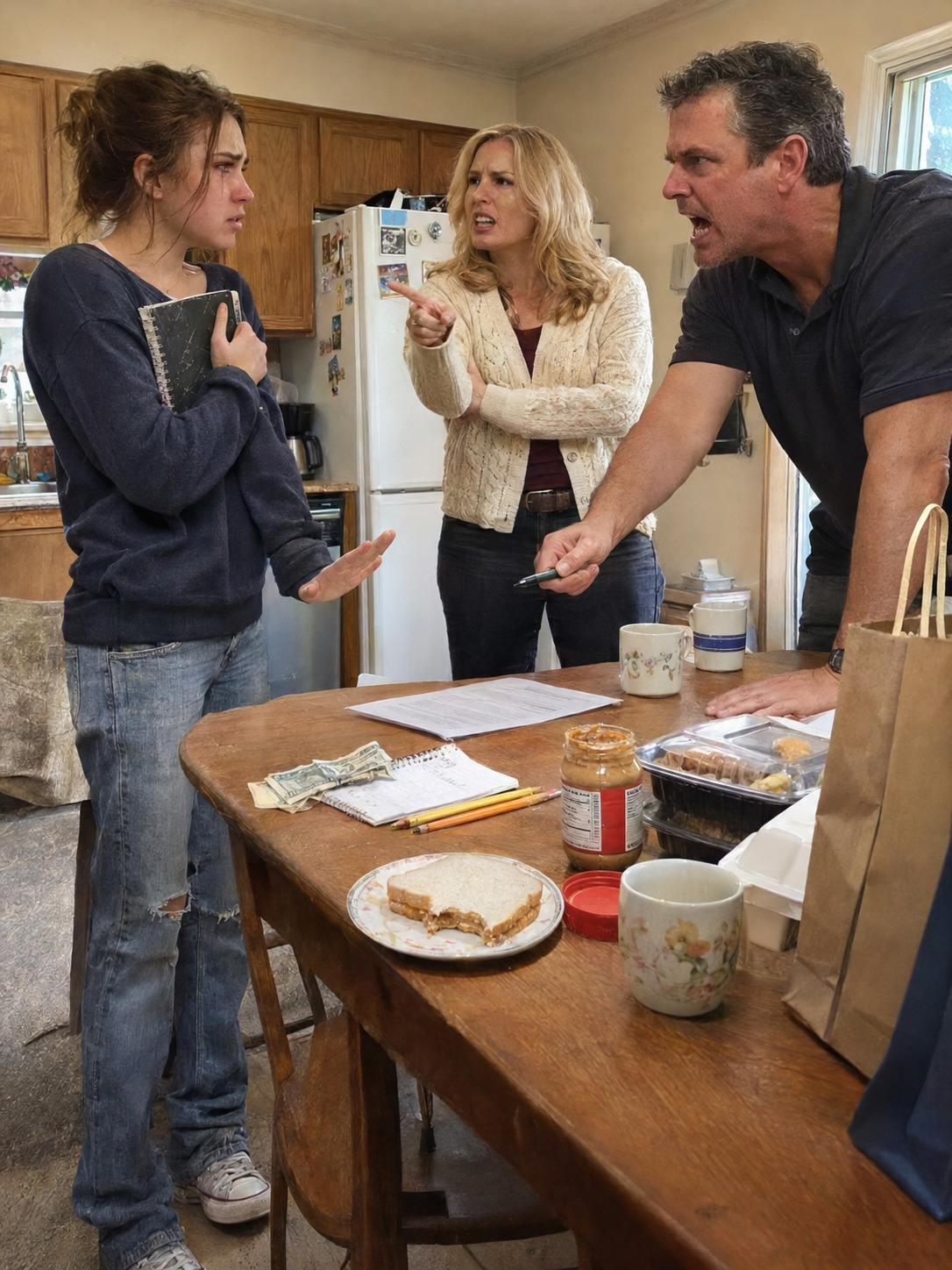
"How much money do you think we spend keeping you alive?"
My father asked the question while holding the sheet of paper he'd taken from my dresser.
On the back, beneath a column of household expenses written in his handwriting, was a number circled three times.
$425.
I stared at it.
Dad tapped the figure.
"That's what you cost us every month, and that's a conservative estimate."
I was twelve years old.
And apparently, I had become an expense my parents wanted me to feel guilty about.
"What is that?" I asked.
Mom stood beside my open budget notebook, her arms folded.
"Your father and I thought it was time you understood how much we sacrifice for you."
I looked at the paper again.
There were numbers beside words like electricity, water, mortgage, insurance, and property taxes.
Dad had even included a portion of the internet bill.
I recognized some of the amounts because I'd heard my parents discussing them.
Others seemed completely random.
"Why did you take my notebook?" I asked.
Mom's eyes narrowed.
"Excuse me?"
"It was in my backpack."
"We're your parents," she said. "We don't need permission to look through your things."
I looked toward the envelopes on the table.
They had been opened and emptied.
My money lay in three separate piles.
Seven dollars in one.
Fourteen in another.
Thirty-two in the last.
It wasn't much.
But every dollar represented something I'd done.
A dog walked.
A yard cleaned.
An afternoon spent watching someone else's children.
"Did you count my money?" I asked.
Dad gave a short laugh.
"Of course we counted it. We wanted to see what you've been doing with it."
"Why?"
"Because you're living under our roof."
There it was again.
The roof.
It was becoming the answer to everything.
If I needed school supplies, they reminded me about the roof.
If I asked for groceries, they reminded me about the roof.
If I questioned why I had to pay for things other children received from their parents, they reminded me that I had a bedroom.
Sometimes I wondered whether Dad thought the roof belonged to him personally, rather than being part of the house he and Mom had chosen to buy before I was born.
He slid the paper toward me.
"Read it."
I looked down.
Mortgage contribution: $250.
Electricity: $45.
Water: $20.
Internet: $30.
Household maintenance: $80.
Total: $425.
My throat tightened.
"Am I supposed to pay this?"
Mom sighed.
"Nobody said that."
Dad added, "Not yet. We're showing you what things cost."
I looked at him.
"Not yet?"
He leaned forward.
"Don't focus on one word. Focus on the lesson."
I wanted to ask why my parents had gone through my bedroom to find a page I'd deliberately hidden.
I wanted to ask why they'd opened my envelopes.
Most of all, I wanted to ask why they'd written a price beside the things they were supposed to provide.
Instead, I stared at the paper.
Dad mistook my silence for agreement.
"See? Once you understand the numbers, everything makes more sense."
But nothing made sense.
Not the way he wanted it to.
If I really cost four hundred and twenty-five dollars every month, how could they also insist that I was responsible for buying my own meals, clothes, and school supplies?
And if the household was struggling so badly, why had Dad purchased a new television?
I knew better than to ask that question.
Unfortunately, knowing better didn't always stop me.
"What about the TV?" I said.
Dad's expression changed.
"What about it?"
"The big one."
"What does that have to do with anything?"
"Wasn't it expensive?"
Mom made an irritated sound.
"Your father works hard."
"I know."
"Then he deserves to enjoy his money."
I looked at the sheet again.
"Then why am I supposed to pay for everything I need?"
Dad straightened.
"Because we're trying to teach you responsibility."
"But the TV—"
"Enough."
His voice was sharp enough to make me stop.
He placed his palm flat against the table.
"You don't get to question how adults spend their money."
I looked down at my own money.
Apparently, adults were allowed to question every penny I earned.
Mom gathered the bills and pushed them toward me.
"Put your little savings away. And stop writing things that make us look like terrible parents."
I stared at her.
"What did I write?"
She picked up the page I'd hidden in my dresser.
At the top was the question I'd been too frightened to ask aloud.
What are parents supposed to pay for?
Mom shook the paper.
"This."
I swallowed.
"It was just a question."
"It was an accusation."
"No, it wasn't."
"Don't argue with me."
I stopped.
She folded the page and slipped it into her pocket.
"You have a good home. You should be grateful."
I collected my money.
Then I picked up my notebook.
The envelopes felt lighter than they should have, even though every dollar was still there.
I walked upstairs without another word.
That evening, I learned something about privacy.
It didn't exist for me.
My parents could enter my bedroom, open my belongings, read my private thoughts, and question my finances.
But I wasn't allowed to ask why there was money for a television and not for my lunch.
I sat on my bed and counted the bills again.
Fifty-three dollars.
I wrote the amount on a fresh page.
Then I paused.
For the first time, I wondered whether keeping my records at home was safe.
Not because I believed my parents would necessarily take the money.
Because they seemed to believe that knowing about it gave them some kind of claim over it.
I hid the envelopes inside an old shoebox beneath my winter clothes.
Then I put the notebook in my backpack.
From that day forward, I carried it everywhere.
The following Saturday, Dad invited two friends over to watch a football game.
They arrived carrying chips, soda, and a large bag of takeout food.
I was upstairs finishing homework when I heard the doorbell.
A few minutes later, the living room filled with laughter.
Dad had turned the television volume up so high that I could hear the commentators through my bedroom floor.
I went downstairs around one o'clock.
My stomach was growling.
I had eaten toast for breakfast.
There was no bread left in the bag I'd purchased earlier that week.
I opened the kitchen cabinet.
One sleeve of crackers.
A nearly empty jar of peanut butter.
Two cans of vegetables.
I checked the refrigerator.
Milk.
Mustard.
A container of leftovers marked with Mom's name.
A package of cheese I knew I wasn't supposed to touch.
I stood there with the refrigerator door open.
From the living room, Dad shouted at the television.
"Come on! You've got to catch that!"
His friends laughed.
I closed the refrigerator.
Mom entered the kitchen carrying an empty serving bowl.
"What are you doing?"
"Looking for lunch."
She glanced at the cabinets.
"Didn't you go grocery shopping?"
"Last weekend."
"Then what happened to everything?"
"I ate it."
She frowned.
"Well, you'll have to plan better next time."
I looked at the takeout bags on the counter.
There were three of them.
The smell of fried chicken filled the kitchen.
"Can I have some of that?" I asked.
Mom followed my gaze.
"That's for your father's guests."
"Is there extra?"
"I don't know."
I waited.
She picked up the bags and carried them into the living room.
"Don't stand around in the kitchen all afternoon," she called over her shoulder.
I opened the cabinet again.
Then I closed it.
There was nothing I wanted to eat.
But wanting had become a luxury.
I took the crackers upstairs.
I ate six.
Then I put the rest away for dinner.
Around three, Dad called me downstairs.
I thought maybe there was leftover food.
Instead, he wanted me to meet his friends.
"Come here," he said proudly. "Tell them about your little business."
I stood beside the couch.
One of his friends, a man named Rick, smiled.
"Your dad says you're quite the entrepreneur."
I shrugged.
"I walk dogs."
"And babysit," Dad added. "And she does yard work too."
Rick looked impressed.
"At your age? That's pretty ambitious."
Dad grinned.
"That's what happens when you don't hand kids everything."
The other man nodded.
"More parents should do that."
I stood there listening.
Dad leaned back in his recliner.
"She buys her own school supplies. Handles her own spending money. Learning the value of a dollar."
Rick laughed.
"Sounds like she'll be running a company someday."
I smiled because everyone was looking at me.
But I couldn't stop staring at the empty takeout container on the coffee table.
A piece of chicken remained inside.
Dad's friend had eaten half his meal and pushed the rest away.
I wondered whether anyone would notice if I asked for it.
Then I hated myself for wondering.
Dad waved toward the television.
"Look at this picture quality. Best purchase I've made all year."
His friends admired the screen.
I went back upstairs.
That night, I wrote something in my notebook that I never showed anyone.
Dad is proud that I work because he doesn't have to pay for me.
I stared at the sentence for a long time.
Then I crossed it out.
I wasn't sure whether it was fair.
I still wanted to believe my parents loved me in a way I simply didn't understand.
I wanted to believe their lessons were difficult because they cared about my future.
But love was becoming harder to recognize.
Especially when it came with a price tag.
By the following month, I had begun looking for more work.
Mrs. Henderson introduced me to a neighbor who needed help pulling weeds.
The job paid twenty dollars.
I accepted immediately.
I spent three hours kneeling in damp soil, filling two large trash bags.
By the time I finished, my knees hurt and my hands were scratched.
The neighbor thanked me and handed me the money.
I walked home feeling exhausted but relieved.
Twenty dollars meant several days of food.
I stopped at the grocery store.
Bread.
Peanut butter.
Bananas.
A small package of pasta.
Tomato sauce.
I compared prices carefully.
The store-brand pasta was cheaper, so I chose that.
At checkout, I counted my money twice.
The cashier gave me my change.
I carried everything home in one bag.
Mom was sitting at the kitchen table when I arrived.
She looked at the groceries.
"What's that?"
"Food."
"I can see that."
I placed the bag on the counter.
She watched me unpack it.
"You're spending a lot on groceries lately."
I stared at her.
"I need to eat."
"Don't get an attitude."
"I'm not."
She picked up the pasta.
"You could probably find cheaper meals if you planned better."
I looked at the price tag.
Ninety-nine cents.
I couldn't imagine what she expected me to buy for less.
But I nodded.
"Okay."
She put the pasta down.
"Your father and I are trying to help you become financially responsible. You should appreciate that."
I didn't answer.
That evening, I made pasta.
I cooked half the package and saved the rest.
I added a little sauce and put the leftovers in a plastic container.
Then I wrote my name on a piece of masking tape.
The next morning, the container was gone.
I searched the refrigerator.
Nothing.
I checked the sink.
The empty container sat beside Dad's coffee mug.
I stood there for a moment.
Then I asked, "Did someone eat my pasta?"
Dad looked up from his phone.
"Yeah. I had it last night."
I swallowed.
"That was supposed to be my lunch."
He shrugged.
"Make something else."
"There isn't anything else."
He frowned.
"Don't be dramatic."
I looked at the empty container.
"I bought that."
Dad lowered his phone.
"And?"
"And I needed it."
His expression hardened.
"You're really going to complain about feeding your own father?"
I stared at him.
"No."
"Good."
He returned to his phone.
I rinsed the container.
Then I went upstairs.
I didn't eat lunch that day.
At school, Emily offered me half her sandwich.
This time, I accepted.
She didn't make a big deal out of it.
She simply slid the sandwich across the table and continued talking about a science project.
I was grateful for that.
Sometimes kindness was easier to accept when nobody announced it.
That afternoon, I walked Cooper and earned five dollars.
I stopped at the grocery store on the way home.
I bought bread and a jar of peanut butter.
Then I went to my room and updated my notebook.
I added a new category.
Food taken by family.
Underneath, I wrote:
Pasta: approximately $1.20.
Cake: unknown.
Crackers: several times.
I stared at the list.
It felt petty.
I knew my parents would call it petty.
But I also knew that when you only had a few dollars, losing even one meal mattered.
I began keeping photographs of my receipts.
At first, I told myself it was for budgeting.
Later, I realized I wanted proof.
Proof that I wasn't imagining how much I spent.
Proof that I wasn't exaggerating.
Proof that the food I purchased really did disappear.
The photographs accumulated quietly on my phone.
Grocery bags.
Receipts.
Nearly empty cabinets.
A refrigerator full of food I wasn't allowed to use.
I didn't know why I kept them.
I only knew I couldn't bring myself to delete them.
As spring turned into summer, my parents continued living exactly as before.
Dad played golf on weekends.
Mom ordered takeout when she didn't feel like cooking.
The enormous television remained the center of the living room.
And I continued working.
I began mowing lawns with an old mower borrowed from Mrs. Henderson.
She taught me how to check the oil and clean the grass from underneath the deck.
I was nervous the first time I used it.
The machine was heavy.
The engine was loud.
But when I finished my first yard, the homeowner handed me thirty dollars.
Thirty dollars.
For one afternoon.
I held the bills in my hand and felt something I hadn't experienced in months.
Possibility.
Maybe I could earn enough to stop worrying about food.
Maybe I could save for better shoes.
Maybe I could buy school supplies before the next semester began.
I started making a list of neighbors who might need yard work.
I wrote down addresses and phone numbers.
I calculated how much gasoline would cost.
I began thinking about buying my own used mower someday.
For the first time, my notebook contained plans instead of just expenses.
Then one evening, Dad noticed the list.
He picked it up from the kitchen table.
"What's this?"
"Customers."
He scanned the page.
"You're mowing lawns now?"
I nodded.
"Mrs. Henderson let me borrow her mower."
Dad looked impressed.
"How much are you charging?"
"Depends on the yard."
"Give me a number."
"Usually twenty-five or thirty dollars."
He whistled.
"That's real money."
I smiled.
For a moment, I thought he might offer to help.
Maybe he would teach me how to maintain the mower.
Maybe he would offer to drive me to jobs farther away.
Instead, he asked, "How many lawns can you do in a week?"
I hesitated.
"Maybe four."
He started calculating aloud.
"Four times thirty. That's a hundred and twenty dollars."
I nodded.
"And that's just one week."
"Sometimes."
Dad looked toward Mom.
"See? I told you she had potential."
Mom smiled.
"All she needed was motivation."
They looked pleased with themselves.
I looked at my notebook.
I had worked hard for every name on that list.
But somehow, my parents were taking credit for it.
Dad handed the notebook back.
"Keep this up," he said. "You might be surprised how much money you can make."
I nodded.
Then I went upstairs.
That night, I added another envelope to my collection.
BUSINESS.
I put ten dollars inside.
It was the beginning of a savings fund for equipment.
I wanted my own mower.
My own supplies.
Something nobody could take away simply because they decided I hadn't been grateful enough.
I went to sleep thinking about the future.
For once, I wasn't thinking about what I couldn't afford.
I was thinking about what I might build.
The next morning, I came downstairs early to make breakfast.
Dad was already sitting at the kitchen table.
My business notebook lay open in front of him.
Beside it was a calculator.
He looked up when I entered.
"Good. You're awake."
I stopped.
"What's wrong?"
He tapped the notebook.
"I've been doing some thinking about all this money you're making."
My stomach tightened.
Mom appeared in the doorway behind me.
Dad turned the calculator around.
A number glowed on the screen.
Then he reached into a drawer and pulled out a blank sheet of paper.
At the top, in large capital letters, he had written three words.
HOUSEHOLD CONTRIBUTION PLAN.
He picked up his pen.
And beneath the heading, he began writing a monthly amount.






Comments 0