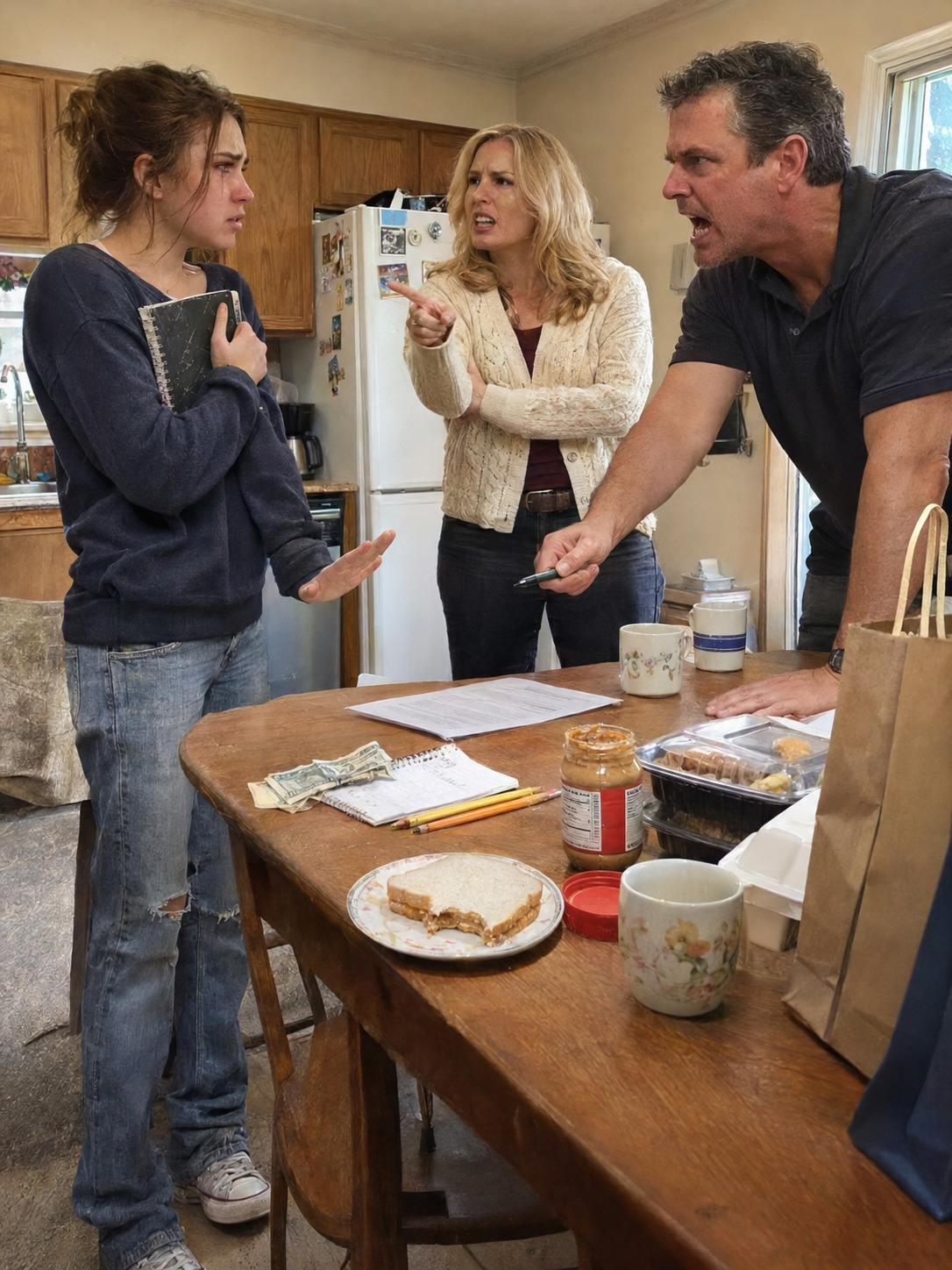
"Effective immediately, all earnings and savings belonging to our daughter will be considered available for household expenses."
I read the sentence three times.
Then I read it again.
The paper my mother had slipped beneath my bedroom door wasn't a suggestion.
It wasn't a request.
It was a declaration.
My parents had decided that the money I'd spent two years earning was now something they could claim whenever they needed it.
And they expected me to accept that decision without asking questions.
I sat on the edge of my bed, holding the sheet between my fingers.
At the bottom were two signature lines.
One for my father.
One for my mother.
Both had already been signed.
There wasn't a line for me.
That was the part I couldn't stop staring at.
They hadn't even pretended I had a choice.
I looked at the date.
It was the first Monday of the month.
Dad had been unemployed for several weeks.
The bills were piling up.
Mom was becoming increasingly nervous about money.
I understood all of that.
I understood that losing a job was frightening.
I understood that families sometimes had to change their spending habits.
What I didn't understand was why the first solution my parents had chosen involved taking money from their fourteen-year-old daughter.
I turned the paper over.
Nothing.
Just a blank white page.
I wished there were an explanation on the back.
Something that would make the words less frightening.
Instead, I read the sentence again.
All earnings and savings.
Not some.
Not a temporary contribution.
All.
I placed the paper beside my budget notebook and opened the banking app on my phone.
$1,284.17.
That was the balance I'd shown Dad the previous evening.
I stared at it.
I remembered earning almost every dollar.
The summer afternoons when the heat made the pavement shimmer.
The mornings I'd woken early to walk Cooper before school.
The evenings I'd babysat while my classmates went to movies.
The Saturdays I'd spent cleaning yards instead of sleeping late.
The money wasn't just a number.
It was two years of saying no to things other children took for granted.
Two years of buying the cheapest groceries I could find.
Two years of learning to repair things because replacing them cost too much.
And now my parents wanted to call it household money.
I heard footsteps downstairs.
Then Dad's voice.
"Did she get it?"
Mom answered.
"Yes."
"What did she say?"
"Nothing yet."
Dad made an impatient sound.
"She'll come around."
I stared at the paper.
I wondered whether he really believed that.
Or whether he simply expected me to give up because I was too young to argue.
I folded the agreement carefully.
Then I slipped it into my notebook.
I didn't sign anything.
There was nothing for me to sign.
But I wasn't going to throw it away either.
For some reason, I felt that keeping the paper mattered.
Maybe because my parents had a habit of changing the way they described conversations after they happened.
A demand became a suggestion.
A threat became a joke.
An argument became a misunderstanding.
I wanted something that couldn't be explained away.
The next morning, Dad was waiting in the kitchen.
He sat at the table with his coffee, looking at his laptop.
Mom stood beside the sink.
I knew immediately that they had been waiting for me.
"Morning," Dad said.
"Morning."
He closed the laptop.
"Did you read the agreement?"
I nodded.
"And?"
I put my backpack on the floor.
"I don't understand it."
Dad sighed.
"What's there to understand?"
"It says all my earnings and savings are available for household expenses."
"Correct."
"Does that mean you're taking all my money?"
Mom turned around.
"Nobody said we're taking anything."
I looked at her.
"That's what the paper says."
Dad leaned back.
"You're being dramatic."
I swallowed.
"I'm just asking."
"Your mother and I are going through a difficult time. We're asking everyone in this family to contribute."
I looked at him.
"How much?"
He frowned.
"What?"
"How much do you need?"
Dad glanced at Mom.
Then he looked back at me.
"We haven't decided."
My stomach tightened.
"Then how am I supposed to know what I can afford?"
Mom set down her dish towel.
"Sweetheart, you don't need to worry about managing the entire household."
I stared at her.
"But you're asking for my savings."
"We're asking you to trust us."
That word made something inside me twist.
Trust.
I had trusted them when they told me buying my own lunch would teach me responsibility.
I had trusted them when they said working hard would make me independent.
I had trusted them when they told me saving money was important.
Now they were asking me to trust them while they claimed the money I'd saved by following their instructions.
"I need some of it for groceries," I said.
Dad rubbed his forehead.
"Again with the groceries."
I looked down.
"I have to eat."
"Nobody is stopping you from eating."
I wanted to tell him about the days I'd skipped lunch.
About the food I'd bought that disappeared from the refrigerator.
About the times I'd stood in grocery aisles trying to decide whether I could afford fruit.
But I knew what he would say.
He would tell me I was exaggerating.
He would remind me that there was food in the house.
He would say I was making my parents look bad.
So I said something simpler.
"I can't give you everything."
Dad stared at me.
Then his expression hardened.
"Nobody said everything."
I looked toward the folded paper in my notebook.
I wanted to pull it out and read the sentence aloud.
Instead, I asked, "Can we agree on an amount?"
Mom sighed.
"Why do you always make things so complicated?"
"Because I need to know what I have left."
Dad pushed his chair back.
"Fine. Two hundred dollars."
I froze.
"Two hundred?"
"To start."
I stared at him.
"That's almost everything I make in some months."
"Then use your savings."
My throat tightened.
"But that's for college."
"College is four years away."
"And emergencies."
Dad laughed bitterly.
"This is an emergency."
I looked at him.
For a moment, I saw how tired he was.
His eyes were shadowed.
His shoulders sagged.
He had been rejected from several jobs.
I knew he was frightened.
I wanted to help.
I really did.
But I also knew that giving him two hundred dollars wouldn't solve the problem.
The mortgage alone was far more than that.
And if I gave him two hundred this month, what would happen next month?
Would he ask for another two hundred?
Three hundred?
Would there ever be an amount that satisfied him?
"I can give you fifty," I said quietly.
Mom stared at me.
"Fifty dollars?"
I nodded.
"That's what I can afford."
Dad's face turned red.
"You're sitting on over a thousand dollars and offering us fifty?"
I swallowed.
"That's my emergency money."
He stood.
"Your emergency money?"
I nodded.
He laughed once.
"Do you hear yourself?"
Mom folded her arms.
"Your father is unemployed, and you're worried about your little savings account."
I looked at her.
"I'm worried about food."
"Enough!"
Dad's voice filled the kitchen.
I flinched.
He pointed toward the hallway.
"Go to school. We'll deal with this later."
I picked up my backpack.
My hands were shaking.
I wanted to cry.
But I didn't.
I walked out the front door and kept walking until I reached the corner.
Then I stopped.
I leaned against a fence and tried to breathe normally.
The morning air was cold.
Cars passed.
A dog barked somewhere behind a house.
Everything looked ordinary.
But I felt as though something important had changed.
For two years, I'd believed that if I worked hard enough, I could create a little safety for myself.
Now my parents were telling me that safety belonged to them.
At school, I couldn't concentrate.
During math, I wrote the same equation three times and got three different answers.
During history, I stared at the clock.
At lunch, Emily sat across from me.
"You look terrible," she said.
"Thanks."
"I'm serious."
I forced a smile.
"Didn't sleep much."
She studied me.
"Is something happening at home?"
I looked down at my sandwich.
I had made it that morning using bread I'd bought myself.
Peanut butter.
Nothing else.
I was suddenly so tired of pretending that I almost told her everything.
Instead, I asked, "Can I ask you something weird?"
Emily nodded.
"Sure."
"Do your parents ever ask you for money?"
She laughed.
"Like borrowing five bucks?"
"More than that."
Her smile faded.
"What do you mean?"
I hesitated.
"Like if you had savings, would they ask you to help pay bills?"
Emily stared at me.
"I'm fourteen."
"I know."
"So are you."
I looked down.
She leaned forward.
"Why are you asking?"
I shrugged.
"Just wondering."
Emily didn't believe me.
I could tell.
But she didn't push.
Instead, she said, "My mom says parents are supposed to take care of kids until they're grown."
I stared at her.
"She said that?"
"Yeah. Why?"
I shook my head.
"No reason."
But the words stayed with me.
Parents are supposed to take care of kids.
It sounded so simple.
So obvious.
And yet it was completely different from what I'd been hearing at home.
That afternoon, I walked Cooper.
Mrs. Henderson noticed immediately that something was wrong.
"Long day?" she asked.
I nodded.
She handed me the leash.
"Take your time."
I walked Cooper around the block.
He stopped at every tree.
He chased a leaf.
He tried to greet a cat that wanted nothing to do with him.
Normally, his ridiculous behavior made me laugh.
That day, I barely noticed.
When we returned, Mrs. Henderson invited me inside for hot chocolate.
I accepted.
She placed a mug in front of me.
Then she sat down.
"Something on your mind?"
I stared at the marshmallows floating in the chocolate.
I wanted to tell her.
I wanted to say that my parents were asking for money I couldn't afford to give.
I wanted to ask whether that was normal.
But I was afraid.
If she thought my parents were doing something wrong, would she confront them?
Would they stop letting me work for her?
Would they take away my phone?
Would they make things worse?
"I'm just tired," I said.
Mrs. Henderson nodded.
"Well, you work hard. Maybe too hard."
I smiled weakly.
She watched me for a moment.
Then she said, "You know, sweetheart, being responsible doesn't mean you have to carry everything by yourself."
I looked up.
Her expression was gentle.
I felt tears sting my eyes.
I blinked them away.
"Thanks."
She didn't ask anything else.
But when I left, she handed me a small container of homemade soup.
"For dinner," she said.
I tried to refuse.
She shook her head.
"I made too much."
I almost laughed.
She always made too much.
I carried the soup home.
That evening, Dad was sitting in the living room watching television.
Mom was at the kitchen counter.
I placed the soup in the refrigerator.
She noticed.
"What's that?"
"Mrs. Henderson gave me some soup."
Mom frowned.
"Why?"
"She made extra."
Mom stared at the container.
"Did you tell her we don't feed you?"
My stomach dropped.
"No."
"Then why is she giving you food?"
"Because she wanted to."
Mom's expression hardened.
"I don't want people thinking we can't take care of our own child."
I looked at her.
I wanted to say that I didn't want people thinking that either.
I wanted to say that I'd spent two years making sure nobody knew how often I bought my own meals.
Instead, I said, "I didn't tell her anything."
Mom studied me.
Then she turned away.
"Good."
I went upstairs.
I sat on my bed and opened my notebook.
I wrote down everything that had happened that morning.
The agreement.
The demand for two hundred dollars.
My offer of fifty.
Dad's anger.
Mom's accusation.
I didn't know why I was documenting it so carefully.
I only knew that I wanted a record.
Something I could look at later and know I hadn't imagined it.
The next day, Dad asked again.
"Have you decided about the money?"
I was standing in the kitchen packing my lunch.
I looked up.
"I told you I can give fifty."
He stared at me.
"That's not enough."
"It's what I can afford."
He crossed his arms.
"Then maybe we need to reconsider what you get from this household."
My stomach tightened.
"What do you mean?"
He shrugged.
"Privileges."
I looked at him.
"What privileges?"
"The internet. Electricity. Your room."
I froze.
"My room?"
Dad gave me a long look.
"Nothing in life is free."
I stared at him.
For the first time, the words didn't sound like a lesson.
They sounded like a warning.
I didn't answer.
I finished packing my lunch.
Then I went to school.
For the next several weeks, the arguments continued.
Dad asked for money.
Mom complained that I wasn't helping enough.
I offered small amounts when I could.
They treated those offers as insults.
Meanwhile, Dad's job search grew less consistent.
Some mornings he applied for positions.
Other mornings he watched television.
He complained about employers.
He complained about the economy.
He complained about how expensive everything had become.
And increasingly, he complained about me.
If I came home from mowing lawns, he asked how much I'd earned.
If I bought groceries, he asked why I'd spent so much.
If I deposited money into savings, he asked why I wasn't contributing more.
I began feeling guilty every time I earned a dollar.
That was the worst part.
The business that had once made me feel proud now made me anxious.
I started hiding my receipts.
I stopped leaving my notebook unattended.
I kept my bank statements in my backpack.
I even began buying groceries in smaller amounts so my parents wouldn't notice how much I spent.
It was exhausting.
But I didn't know what else to do.
By the beginning of the next month, Dad still hadn't found a job.
The bills were piling up.
Mom was increasingly tense.
And I had managed to save a little more money.
My balance was now just over fifteen hundred dollars.
I didn't tell them.
I knew better.
Then one Friday evening, I came home from babysitting.
It was nearly nine.
I was tired.
My legs ached.
I had earned forty dollars.
I walked into the kitchen expecting to find it empty.
Instead, both my parents were sitting at the table.
Dad had a stack of papers in front of him.
Mom had her arms folded.
I stopped.
"What's going on?"
Dad looked up.
"Sit down."
My stomach tightened.
"Why?"
He tapped the papers.
"We've made a decision."
I stared at him.
"About what?"
"Your financial responsibilities."
I felt cold.
"Dad, we've already talked about this."
"Not like this."
Mom leaned forward.
"Your father and I can't keep carrying you."
I looked at her.
I was fourteen.
I bought my own food.
I paid for my school supplies.
I bought my own clothes.
I worked after school and on weekends.
And somehow, they still believed they were carrying me.
Dad slid the papers across the table.
"Read it."
I looked down.
At the top of the first page were the words:
RESIDENTIAL RENTAL AGREEMENT.
My heart began pounding.
I stared at the title.
Then at the line beneath it.
TENANT: __________________.
Dad picked up a pen.
"Starting next month, things are going to be different."
I looked up.
"Different how?"
He turned the page.
There was a table of monthly charges.
Rent.
Utilities.
Late fees.
I couldn't breathe.
Mom watched me closely.
Dad pointed at the first line.
Then he said, "We've decided what your room is worth."
I lowered my eyes to the amount.
And the number printed beside MONTHLY RENT was...






Comments 0