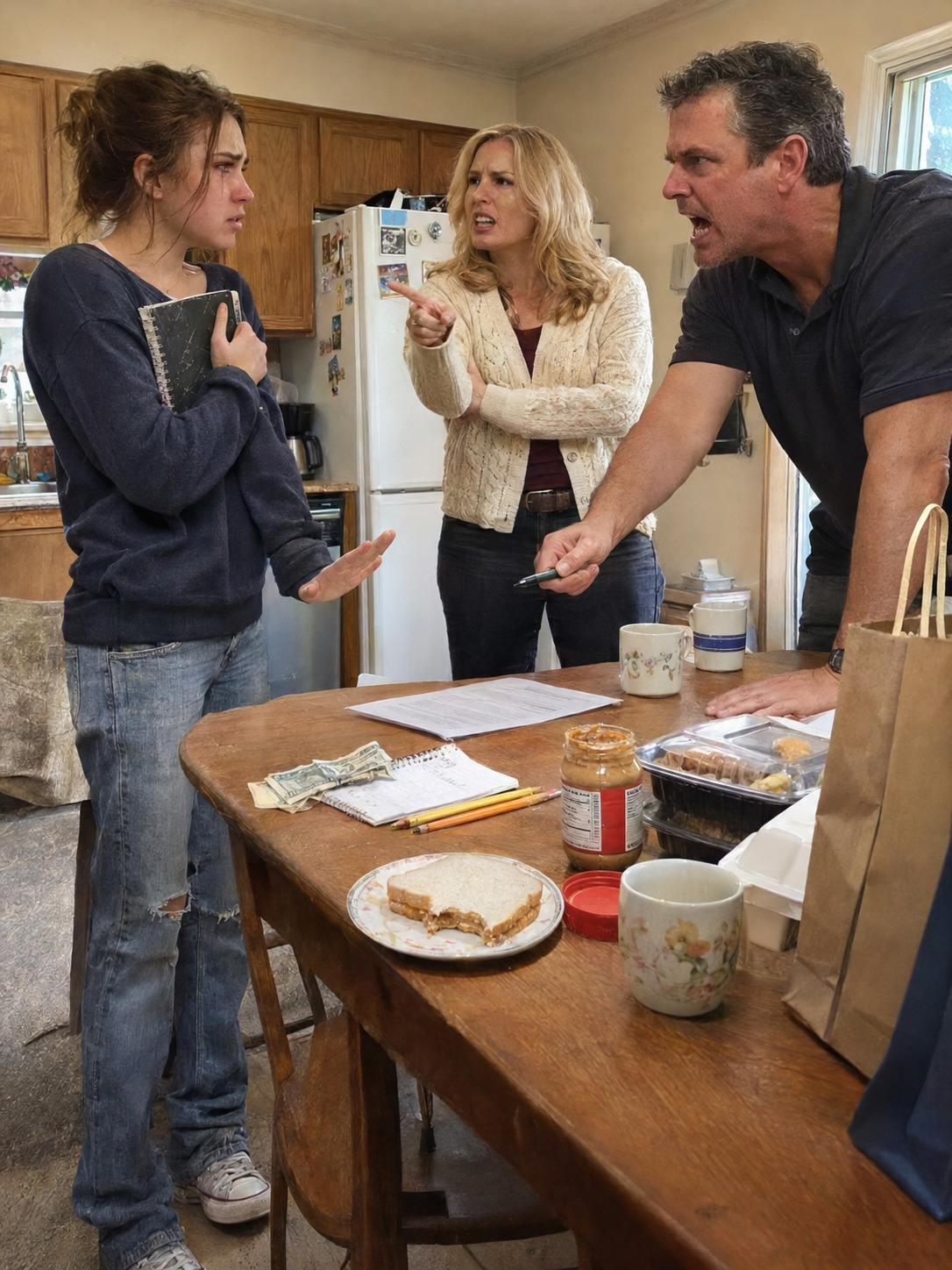
My father stared at the property record in my hands.
For several seconds, neither of us spoke.
Then he reached toward me.
"Give me that."
I stepped backward.
"No."
His expression hardened.
"That document doesn't mean what you think it means."
I looked at the name printed beneath the company registration.
My name.
My father's company had been registered using my identity, and somehow my name had appeared on paperwork connected to the house where I'd lived my entire life.
Mom stood beside the car, trembling.
"Please don't take it from her," she said.
Dad turned toward her.
"Stay out of this."
"No," Mom replied. "Not anymore."
It was the first time I had heard her say those words without immediately apologizing afterward.
Dad looked between us.
Then my phone rang.
Karen Mitchell.
I answered.
"Hello?"
"Are you somewhere safe?"
I looked at my father.
"Yes. I'm outside my house."
"Good. I need you to know that we've received the property documents. There are serious questions about how your name was used. Please don't sign anything or hand over any original paperwork."
I nodded.
"Okay."
"An appropriate legal professional will review the filing. We've also arranged for you to receive support while this is investigated."
I thanked her.
When I ended the call, Dad was pacing beside the car.
"This is unbelievable," he muttered.
I looked at him.
"What did you put my name on?"
He stopped.
"I was trying to protect the house."
"How?"
"There's a financial arrangement you wouldn't understand."
"Then explain it."
He stared at me.
For once, I wasn't asking because I hoped he would approve of me.
I was asking because I deserved an answer.
He rubbed his forehead.
"The company was supposed to help reorganize the property finances. I was looking at options."
"Why is my name on it?"
He didn't answer.
Mom stepped forward.
"Because he thought using your name would make the arrangement easier."
Dad turned sharply.
"That's not what happened."
"Then tell her what happened."
He looked at Mom.
She continued.
"You told me the company needed a young beneficiary. You said the paperwork was temporary. You never explained why our daughter's name was being used."
Dad's jaw tightened.
I felt sick.
"Did you use my information without asking?"
He looked away.
That silence told me more than his explanations had.
I didn't argue.
I didn't shout.
I simply walked toward the front door.
For the first time, I understood that I didn't need to win an argument with my father to protect myself.
I needed people who could help me establish the facts.
And I finally had them.
The following days were difficult.
The property paperwork went to legal review.
Karen arranged for the appropriate authorities to examine the documents and determine how my personal information had been used.
A legal aid attorney named Daniel Lawson, the same man Mrs. Carter had introduced me to earlier, helped explain what could and could not happen.
He told me that the property filing did not automatically make me responsible for my father's financial obligations.
He also explained that the signatures and documents needed to be examined before anyone could draw conclusions.
I listened carefully.
He reviewed the bank paperwork, the rental agreement, the family financial agreement, and the property records.
Then he looked at me.
"You have done the right thing by keeping copies."
I nodded.
"Can my father take my savings?"
"Not simply because he wants them. We'll work with the bank to clarify the account structure and protect your interests."
He helped arrange a formal review of the account.
The bank placed additional safeguards on the disputed transfer request while the authorized access arrangements were examined.
My father could no longer simply walk in and expect the money to be moved.
The account remained mine, subject to the rules governing a minor's account.
That was the first piece of good news.
The second came from school.
Mrs. Carter helped me catch up on missed assignments.
My teachers received an explanation that I was dealing with a difficult family situation.
Nobody demanded that I explain everything to my classmates.
I was enrolled in the school meal program.
I received lunch every day.
And for the first time in two years, I stopped calculating whether I could afford something to eat before opening my lunchbox.
It was such a small thing.
But I noticed it every morning.
I could sit with Emily, open my food, and talk about homework.
I didn't have to pretend I wasn't hungry.
I didn't have to hide an empty lunchbox.
I could simply eat.
Meanwhile, the investigation continued.
My father initially insisted that everything had been misunderstood.
He claimed the rental agreement was an educational exercise.
He described the savings transfer as a family budgeting proposal.
He said the property filing was part of a financial restructuring plan.
But the documents told a more complicated story.
The rental agreement had contained terms that would have required me to surrender money I earned through my own work.
The transfer request had sought the entire available balance of my savings.
The property records showed that my personal information had been used without my informed consent.
The investigation also established that the termination notice Mom had written was not a valid eviction order.
That mattered.
My parents could not simply declare that I had lost my right to shelter because I refused to sign their private agreement.
Daniel explained that my parents still had legal responsibilities toward me as their minor child.
The rental demand was not an enforceable way to avoid those responsibilities.
The attempted property arrangement was referred for further review, and the questionable filing was not allowed to proceed as submitted.
My name was removed from the proposed transaction after the necessary legal steps were completed.
The company did not gain ownership of our home.
And my savings remained protected.
But resolving the paperwork was only part of the story.
The harder part was figuring out what would happen inside our family.
Three weeks after the first school meeting, my parents attended another conference.
Karen was there.
Daniel joined by telephone.
Mrs. Carter sat beside me.
Dad looked different.
He had lost weight.
His hair was uncombed, and he seemed unable to sit still.
Mom looked exhausted.
Karen explained the findings and the remaining requirements.
My father was required to cooperate with the financial review.
He also had to stop demanding payments from me as a condition of receiving basic care.
The school and family support professionals would continue checking that my needs were being met.
Daniel explained that the disputed financial documents would not become binding agreements simply because my parents had prepared them.
Dad listened with his arms folded.
When everyone finished speaking, he looked at me.
"Do you understand what this has done to us?"
I looked at him.
For a moment, the old instinct returned.
I wanted to apologize.
I wanted to tell him I hadn't meant to cause trouble.
But I stopped myself.
"I understand that money has been difficult."
He nodded.
"Exactly."
"But I didn't cause you to lose your job."
His expression changed.
I continued.
"I didn't decide to stop buying my own school supplies. I didn't write the rental agreement. I didn't ask you to transfer my savings."
Nobody spoke.
"I was fourteen. I was trying to buy lunch and go to school."
Mom began crying.
Dad looked down.
Then he said something I hadn't expected.
"I thought you were doing fine."
I stared at him.
"Because I didn't complain?"
He nodded faintly.
I swallowed.
"I didn't complain because you told me that asking for things made me spoiled."
Dad's face tightened.
"I didn't realize how bad it was."
I looked at him.
"You never asked."
That was the first time he didn't have an answer.
Mom reached for my hand.
I let her hold it.
Dad finally looked up.
"I was scared," he said.
His voice was quieter now.
"When I lost my job, I thought everything was falling apart. I didn't know how we were going to pay the mortgage. I saw that you had savings, and I convinced myself that you could help."
I listened.
He continued.
"Then you refused, and I felt like you were turning against us."
I looked at him.
"I wasn't turning against you."
He lowered his eyes.
"I know that now."
For a moment, I thought he might apologize.
Instead, he said, "I handled things badly."
It wasn't enough.
But it was the first honest acknowledgment I'd heard from him.
Daniel explained that apologies were important, but changes in behavior mattered more.
Dad nodded.
He agreed to follow the financial and family support plan.
He also agreed that my earnings would remain separate from household expenses unless I voluntarily chose to contribute in an appropriate way when I was older.
My mother agreed to take responsibility for ensuring I had food, school supplies, clothing, and other necessities.
The family support professionals would continue checking that these arrangements were followed.
Nobody pretended that everything had been repaired.
Trust would take time.
But there was finally a plan that didn't depend on me surrendering my savings.
The biggest surprise came two weeks later.
Dad found another job.
It wasn't the position he'd lost.
It paid less.
He had to commute farther, and the hours weren't ideal.
But it was steady work.
Mom also started working part-time at a local medical office.
They began reorganizing their expenses.
They canceled unnecessary subscriptions.
They sold some electronics and reduced their takeout spending.
The new television remained in the living room, but the expensive sports package disappeared.
For the first time, my parents were discussing household finances without putting the responsibility on me.
The house still had financial problems.
But those problems belonged to the adults.
And that distinction changed everything.
One Saturday morning, Dad knocked on my bedroom door.
I was sorting receipts into my notebook.
"Can I come in?"
I nodded.
He entered and stood near the desk.
"I wanted to ask you something."
I closed the notebook.
"What?"
He looked uncomfortable.
"Would you like to keep mowing lawns?"
I frowned.
"Yes."
"All right."
He placed a small envelope on my desk.
I opened it.
Inside was a receipt and a check for the replacement mower blade I'd been saving to buy.
I looked up.
"What's this?"
"Your equipment needs maintenance. I thought I could help."
I studied him.
"Is this a loan?"
He shook his head.
"No."
"Do I have to pay you back?"
"No."
I looked at the check again.
It wasn't a huge amount.
But it meant something.
"Thank you," I said.
Dad nodded.
Then he looked toward the notebook.
"You've kept all those records?"
"Yes."
He gave a faint smile.
"You were always better at organizing money than I was."
I didn't know how to respond.
He stood quietly.
Then he said, "I'm sorry I made you feel like you had to earn the right to be our daughter."
My throat tightened.
I looked at him.
He continued.
"You shouldn't have had to work just to eat."
For a moment, I couldn't speak.
Then I nodded.
"I know."
He accepted that.
He didn't demand forgiveness.
He didn't ask me to tell him everything was fine.
He simply left the envelope on my desk and walked out.
It was a small beginning.
But it was a beginning.
Mom's apology came later.
She took me to a small diner on a Saturday afternoon.
She paid for lunch.
I ordered a cheeseburger, fries, and a milkshake.
When the food arrived, she watched me take the first bite.
Then she said, "I used to think I was keeping peace in the house by agreeing with your father."
I looked at her.
"Did you?"
She shook her head.
"No. I was avoiding conflict."
She stirred her coffee.
"And you were the one paying for it."
I looked down at my plate.
Mom continued.
"I should have protected you. I should have noticed when you stopped asking for things. I should have asked why you were buying your own meals."
Her voice trembled.
"I'm sorry."
I took a sip of my milkshake.
"I don't want to pretend it didn't happen."
"I know."
"And I don't want you to agree with Dad just because he's angry."
She nodded.
"I understand."
We sat quietly for a while.
Then she asked about my business.
I told her Mrs. Henderson had recommended me to another family.
Mom listened.
She asked how much I charged for mowing and whether I needed help buying gasoline.
I told her I had enough.
For the first time, our conversation wasn't about how much money I could give the family.
It was about something I enjoyed doing.
When lunch ended, Mom paid the bill.
I thanked her.
Then I carried the leftover fries home.
I wasn't ashamed of having someone buy me lunch.
I was fourteen.
I was allowed to be taken care of.
The legal review eventually concluded that the disputed property paperwork could not proceed as submitted.
My identity had been used without my informed authorization, and the questionable documents were corrected through the appropriate process.
My father's attempted transfer of my savings was also closed.
The bank confirmed that the money remained in my account.
Daniel helped ensure that the account arrangements were appropriate for my age and that my parents understood they could not simply treat my earnings as household property.
The rental agreement was formally withdrawn.
The family financial agreement was discarded.
And the termination notice disappeared into the folder of documents that would remain part of the investigation record.
Dad was required to cooperate with the final review and complete financial counseling as part of the family support process.
He did.
The house stayed in my parents' names.
My name was no longer attached to the proposed company arrangement.
And nobody asked me to pay rent.
The most important change, however, was much simpler.
The refrigerator was full.
There was milk.
There was bread.
There were eggs, fruit, vegetables, and enough food for everyone.
My school supplies were purchased when I needed them.
My clothes fit.
And when I came home from a long afternoon mowing lawns, I could eat dinner without first calculating whether I had enough money to buy it.
My business continued.
I still walked dogs.
I still babysat.
I still mowed lawns for neighbors.
But I began setting aside money for something I had once thought was impossible.
College.
My savings slowly grew.
I kept my notebook, although I no longer needed to record every penny just to make sure I could eat.
It became a business journal instead.
I tracked customer payments, equipment costs, and future goals.
Mrs. Henderson even helped me create a simple schedule for the families who hired me.
She told me I had a talent for running a business.
I smiled.
This time, I believed her.
Several months later, Mrs. Carter invited me into her office.
The plants on her windowsill had grown.
The same poster still hung beside her desk.
You don't have to handle everything alone.
She asked how things were going.
I told her about Dad's new job.
Mom's part-time work.
My business.
My savings.
And the college fund I had started.
She smiled.
"I'm glad things are improving."
I nodded.
Then I reached into my backpack and removed my old budget notebook.
The cover was worn.
The pages were filled with numbers from when I was twelve and thirteen.
I placed it on her desk.
"I thought you might want to see this."
She opened it carefully.
She turned through the pages.
Then she looked up.
"Are you sure you want to leave this here?"
I nodded.
"I made a copy of everything important."
She smiled.
"Why?"
I thought for a moment.
"Because I want someone else to understand what happened."
Mrs. Carter closed the notebook.
"Thank you for trusting me with it."
I stood.
Then I looked at the poster.
For two years, I had believed that needing help meant I had failed.
Now I understood that asking for help had been the bravest thing I'd done.
I left her office and walked toward my next class.
Emily was waiting near the lockers.
She waved.
"Come on! We're going to be late."
I laughed.
Then I hurried after her.
That afternoon, I went home and found Mom preparing dinner.
Dad was sitting at the kitchen table, reviewing his work schedule.
He looked up.
"How was school?"
"Good."
"How was your math test?"
"I think I did well."
He smiled.
"Good job."
Mom placed three plates on the table.
There was chicken, rice, and roasted vegetables.
I sat down.
Nobody mentioned rent.
Nobody asked about my savings.
Nobody slid a contract toward me.
We ate dinner.
It wasn't a perfect family.
There were still difficult conversations.
There were still memories I hadn't forgotten.
And there were days when I needed space from my parents.
But I no longer had to fight for the right to eat.
I no longer had to buy my own school supplies because nobody else would.
I no longer believed that being a good daughter meant surrendering everything I earned.
After dinner, I went upstairs and opened my savings account on my phone.
The balance was still there.
Every dollar.
I looked at the number and smiled.
Then I opened my notebook and wrote a new heading:
MY FUTURE.
Underneath, I wrote three things.
College.
My own business.
A life where money never determined whether a child deserved to feel safe.
I closed the notebook.
Outside, the evening was quiet.
Downstairs, I could hear Mom laughing at something on television.
Dad called up the stairs to ask whether I wanted some leftover dessert.
I answered yes.
And when I walked downstairs, there was already a plate waiting for me.
For the first time in years, I didn't wonder how much it would cost.
I simply sat with my family, took a bite, and enjoyed being fourteen.






Comments 0