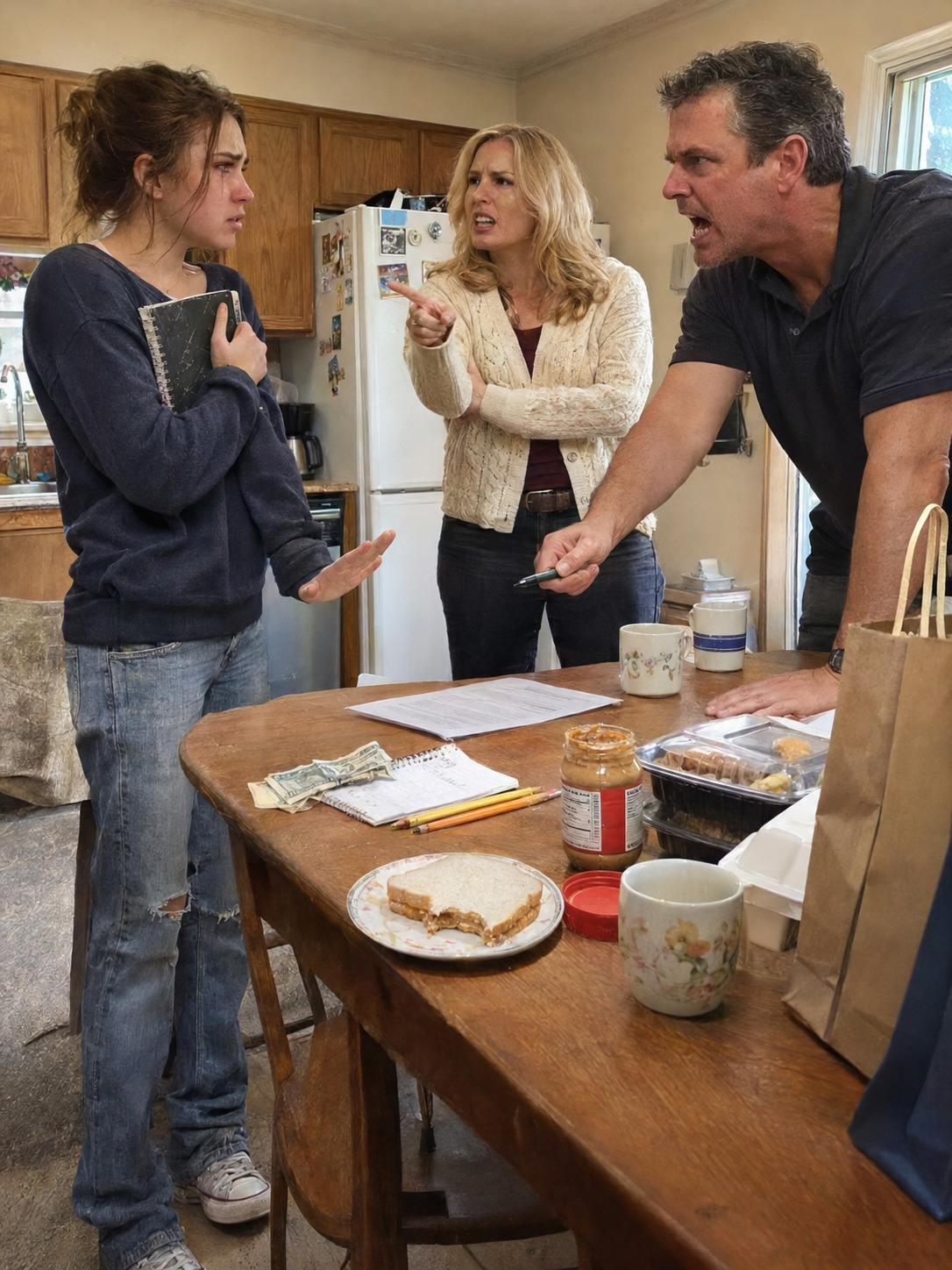
"You're making more money than some adults, and you still expect us to pay for everything?"
My father said it while writing a number beneath the words HOUSEHOLD CONTRIBUTION PLAN.
I watched his pen move across the paper.
One hundred dollars.
That was the amount he had decided I should contribute every month.
I was twelve years old.
And the little lawn-mowing business I'd started to keep myself fed had suddenly become another reason my parents believed I owed them money.
"Dad, I don't make that much every month," I said.
He looked up from the calculator.
"You just told me you can make a hundred and twenty dollars a week."
"I said I could make that if I had four lawns."
"What's the difference?"
"I don't always have four lawns."
"Then find more."
Mom stood behind my chair, drinking coffee from her favorite white mug.
"Your father is trying to teach you how to manage your income," she said.
I stared at the paper.
The words sounded familiar.
Responsibility.
Independence.
Managing money.
Every time my parents wanted something from me, they used the same language.
But I was beginning to notice that the lessons always seemed to cost me something.
"Is this rent?" I asked.
Dad laughed.
"Don't be ridiculous. You're a child."
I looked at the number.
"Then what is it?"
"A contribution."
"To what?"
"The household."
I waited for him to explain.
He didn't.
"Does that mean I won't have to buy my own groceries anymore?"
Mom lowered her mug.
"Why would it mean that?"
"Because if I'm paying for the household, I thought maybe—"
"You're not paying for the household," Dad interrupted. "You're helping."
I tried to understand the distinction.
A hundred dollars was a hundred dollars whether he called it rent, help, or a contribution.
And I still needed food.
"I need that money for my business," I said.
Dad's expression changed.
"Your business?"
I nodded.
He leaned back in his chair.
"Listen to yourself. You mow a few lawns and suddenly you think you're running a corporation."
My face grew warm.
"I didn't say that."
"Then stop acting like it."
I looked down at my notebook.
Inside were the names of six neighbors, their addresses, the services they needed, and the amounts they'd agreed to pay.
It wasn't a corporation.
But it was something I'd built.
Something that belonged to me.
And for the first time in a long while, it made me feel hopeful.
Dad tapped the paper.
"One hundred dollars a month is reasonable."
I swallowed.
"What if I can't pay it?"
He gave me a long look.
"Then you'll have to work harder."
Mom nodded approvingly.
"That's how the real world works."
I looked at the kitchen clock.
It was seven fifteen in the morning.
I had a lawn to mow at nine.
I still hadn't eaten breakfast.
"Can I think about it?" I asked.
Dad sighed.
"You always need to think about everything."
"I just want to figure out my expenses."
He pushed the paper toward me.
"Fine. Figure them out."
I took it upstairs.
And for the first time, I began keeping two separate sets of calculations.
One showed what I actually earned.
The other showed what my parents seemed to think I earned.
The difference was enormous.
A thirty-dollar lawn wasn't thirty dollars of profit.
I had to buy gasoline.
Sometimes I needed trash bags.
Sometimes I replaced gloves.
I also needed to save for repairs, because the borrowed mower wouldn't last forever.
And after all that, I still had to eat.
I opened my notebook and wrote down the previous month's income.
Dog walking: $65.
Babysitting: $80.
Yard work: $90.
Total: $235.
Then I listed my expenses.
Food: $96.
School supplies: $14.
Clothing savings: $20.
Business expenses: $25.
That left eighty dollars.
Before emergencies.
Before replacing my shoes.
Before buying anything I might actually want.
Dad's hundred-dollar contribution would leave me twenty dollars short.
I checked the arithmetic twice.
Then I checked it again.
The numbers didn't change.
I took the notebook downstairs.
Dad was watching television.
"Can I show you something?"
He glanced at me.
"What?"
"My budget."
He sighed.
"Make it quick."
I placed the notebook on the coffee table.
"I made two hundred and thirty-five dollars last month."
"Good."
"But I spent money on groceries and supplies."
"Everyone has expenses."
"I know. That's why I can't pay a hundred dollars."
Dad looked at the figures.
For a moment, I thought he might understand.
Then he pointed at the food category.
"Ninety-six dollars?"
I nodded.
"That's too much."
I stared at him.
"For a whole month?"
"You need to shop smarter."
"I buy store brands."
"Then buy less."
I didn't answer.
He pointed at the business expenses.
"What's this twenty-five dollars?"
"Gasoline and supplies."
"Use less gasoline."
I looked at him.
The mower ran on gasoline.
That wasn't a preference.
It was how the machine worked.
Dad closed the notebook.
"You're overcomplicating this."
I felt something tighten inside my chest.
"I just wanted you to see the numbers."
"I've seen them."
"Then you understand?"
He handed the notebook back.
"I understand that you're making excuses."
I stood there.
For a moment, I couldn't speak.
Then Mom called from the kitchen.
"Don't argue with your father."
I picked up my notebook.
"Okay."
That was the end of the conversation.
At least for them.
For me, it was the beginning of something else.
I realized that I couldn't rely on my parents to understand my finances.
Not because the numbers were complicated.
Because understanding them would mean acknowledging that their expectations were unreasonable.
And they weren't willing to do that.
That Saturday, I mowed three lawns.
The first belonged to Mrs. Henderson.
She had a small front yard with a narrow strip of grass beside the driveway.
I finished in forty minutes.
She paid me twenty-five dollars.
"You're getting faster," she said.
I smiled.
"Practice."
She handed me a bottle of water.
"Don't forget to take breaks."
I thanked her.
Then I walked the mower to the next house.
Mr. Alvarez had a larger yard.
The grass had grown thick after several days of rain.
It took nearly two hours.
By the time I finished, my shirt was damp with sweat and my arms ached.
He paid me forty dollars.
"Good work," he said.
I thanked him and sat on the curb for a few minutes.
I drank water.
Then I checked my notebook.
Sixty-five dollars.
One more lawn.
The third belonged to a family near the end of the street.
Their backyard was uneven, with roots sticking up near the fence.
I had to move slowly to avoid damaging the mower.
Halfway through, the engine stalled.
I pulled the starter cord.
Nothing.
I checked the fuel.
There was enough.
I tried again.
The engine coughed, then died.
My stomach dropped.
If the mower broke, I couldn't finish the job.
If I couldn't finish the job, I wouldn't get paid.
And if I couldn't get paid, I wouldn't have enough money for groceries the following week.
I sat beside the mower, trying not to panic.
Then I remembered something Mrs. Henderson had shown me.
Sometimes grass collected beneath the deck and made the engine struggle.
I turned the mower off completely, disconnected the spark plug wire as she'd taught me, and carefully checked underneath.
Wet grass had packed around the blade housing.
I cleared it with a stick and my gloved hands, keeping away from the blade.
Then I reconnected the wire.
The engine started.
I nearly cried from relief.
But I didn't.
I finished the yard.
The homeowner paid me thirty dollars.
I walked home with ninety-five dollars in my pocket.
My legs felt like rubber.
My hands were sore.
But I was proud.
Ninety-five dollars.
In one day.
I had never earned that much before.
I stopped at the grocery store and bought enough food for the week.
Bread.
Eggs.
Peanut butter.
Pasta.
Bananas.
A small bag of rice.
I also bought a package of chocolate cookies.
They were on sale.
I stood in the aisle for almost five minutes deciding whether I deserved them.
Then I put them in the basket.
At checkout, the total came to twenty-eight dollars and sixty-three cents.
I paid in cash.
The cashier handed me my change.
"Busy day?" she asked, noticing the grass stains on my clothes.
I smiled.
"Very."
She laughed.
"Well, you look like you've earned a rest."
I carried my groceries home.
When I entered the kitchen, Mom was opening a takeout container.
She glanced at my bags.
"More groceries?"
I nodded.
"How much did you spend?"
"About twenty-nine dollars."
She frowned.
"That's a lot."
I looked at the three takeout containers on the counter.
I didn't ask how much she'd spent.
I already knew the answer would start an argument.
Instead, I put my food away.
Then I went upstairs and counted my remaining money.
Sixty-six dollars and thirty-seven cents.
I placed twenty dollars in my business envelope.
Ten in my clothing envelope.
The rest went toward food and savings.
I felt organized.
Prepared.
For once, I thought I might be getting ahead.
Then Dad knocked on my bedroom door.
"How much did you make today?"
I hesitated.
"Ninety-five."
His eyebrows rose.
"Ninety-five dollars?"
I nodded.
He smiled.
"See? I told you that you could do it."
I waited.
He held out his hand.
"Well?"
I stared at him.
"What?"
"Your contribution."
My stomach sank.
"Dad, I haven't agreed to that."
His smile disappeared.
"We discussed this."
"You told me to think about it."
"And?"
"I did."
He crossed his arms.
"Then what's your answer?"
I looked at my envelopes.
"I can't afford it."
He stared at me for several seconds.
Then he laughed once.
Not because anything was funny.
Because he didn't believe I had the right to refuse.
"You're twelve years old," he said. "You don't get to decide how this household works."
I swallowed.
"I know."
"Then stop acting like you do."
He turned toward the hallway.
"We'll talk about this later."
I watched him leave.
Then I closed the door.
My hands were shaking.
I sat on the bed and stared at the money.
For the first time, earning more hadn't made me feel safer.
It had made me feel exposed.
The more I earned, the more my parents expected.
And I was beginning to wonder whether there was any amount that would ever satisfy them.
Over the next several weeks, I became more careful about discussing money.
When Dad asked how much I'd earned, I gave vague answers.
"Not much."
"A little."
"Enough for groceries."
He didn't like that.
He accused me of being secretive.
Mom said I was becoming selfish.
But I kept my records.
I knew exactly what I earned.
I knew exactly what I spent.
And I knew that if I started giving away money I needed for food and equipment, the business would collapse.
I couldn't let that happen.
By the end of summer, I had saved enough to buy a used lawn mower.
It wasn't pretty.
The red paint was chipped.
One wheel squeaked.
The handle had been repaired with a metal bracket.
But it worked.
I bought it from a retired man named Mr. Franklin, who lived two streets away.
He showed me how to check the oil, clean the air filter, and inspect the blade safely.
"Take care of your tools," he said, "and they'll take care of you."
I nodded.
I paid him seventy-five dollars.
It was the largest purchase I'd ever made with my own money.
When I rolled the mower home, I felt like I'd bought a car.
Mrs. Henderson came outside to see it.
"Look at you," she said, smiling. "A business owner."
I laughed.
"Kind of."
"No kind of about it. You have customers, equipment, and a schedule. That's a business."
I looked down at the mower.
For the first time, I let myself believe her.
That evening, I cleaned the mower and stored it carefully in the garage.
Dad noticed it the next morning.
"Where'd that come from?"
"I bought it."
He looked surprised.
"With your money?"
I nodded.
"Seventy-five dollars."
He walked around it.
"Not bad."
I smiled.
Then he asked, "How much are you making now?"
I hesitated.
"Depends on the week."
He looked at me.
"Don't start that again."
I swallowed.
"I'm not trying to be difficult."
"Then answer the question."
I looked toward the garage door.
I wanted to tell him the truth.
I wanted him to be proud.
I wanted him to see how hard I'd worked.
But I was afraid that every number I gave him would become another reason he believed I owed him something.
"Enough to keep the business going," I said.
His expression hardened.
"That's not an answer."
I looked down.
He stepped closer.
"You're getting awfully independent lately."
I didn't speak.
He stared at me for another moment.
Then he walked away.
I stood beside the mower, listening to his footsteps disappear into the house.
I had never wanted to fight with my parents.
I had only wanted to buy lunch.
Somehow, that had turned into a struggle over money, privacy, and whether I was allowed to keep what I earned.
Still, I continued working.
I added two more customers.
I began offering pet sitting during school holidays.
I kept receipts in a plastic folder.
I learned to set aside money for gasoline before spending anything else.
By the time I turned thirteen, I had a small but steady income.
Not enough to make me rich.
Not enough to solve every problem.
But enough to keep me fed most weeks.
And that mattered more than anything.
One Friday afternoon, Mrs. Henderson asked whether I could help her neighbor with a larger yard.
The job would pay sixty dollars.
I accepted immediately.
It took nearly four hours.
When I finished, the homeowner thanked me and handed me three twenty-dollar bills.
I folded them carefully and slipped them into my pocket.
On the walk home, I stopped at the grocery store.
I bought food for the weekend.
Then I returned home, tired but satisfied.
Dad was sitting at the kitchen table.
Mom stood beside him.
My business notebook lay open between them.
I stopped in the doorway.
Dad looked up.
"Come sit down."
I didn't move.
"Why?"
He tapped the notebook.
"Your mother and I have been talking."
My stomach tightened.
"About what?"
He reached for a sheet of paper.
At the top was a list of my customers.
Every name.
Every address.
Every payment amount.
I recognized the handwriting.
It was mine.
But beside the list, someone had added a new column.
Dad turned the paper toward me.
"We've decided it's time to make this official."
I looked at the new column.
Then I saw the heading.
PARENTAL MANAGEMENT FEE.
And beneath it, my father had written a percentage.






Comments 0