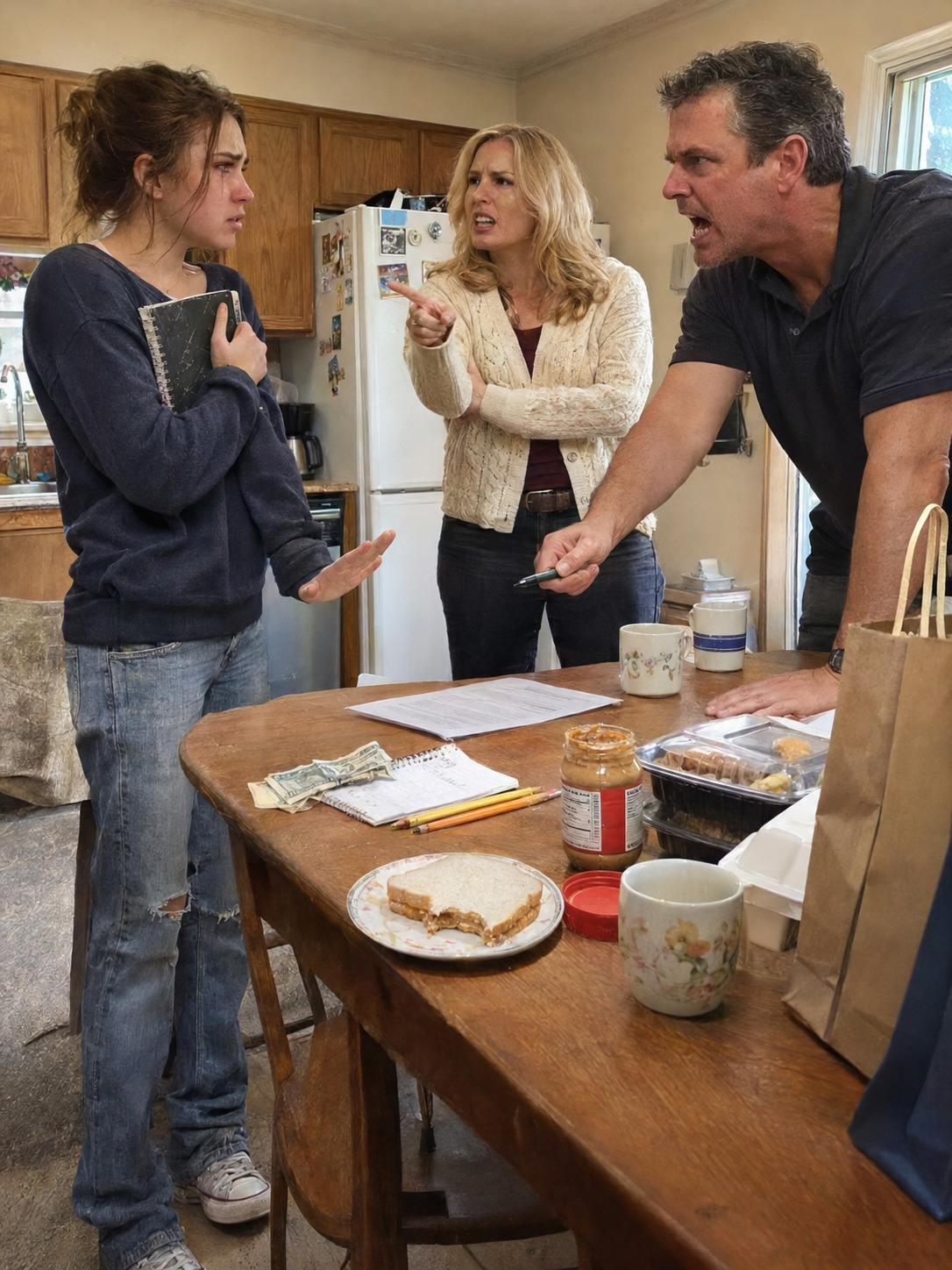
"What are you doing here?"
My voice came out barely louder than a whisper.
Dad stood in the doorway of Mrs. Carter's office, wearing the same gray sweatshirt he'd worn at breakfast. His hair was combed, but his face looked tired, and there was a dark stain near the cuff of his sleeve.
He looked past me toward the empty hallway.
"I could ask you the same question."
My fingers tightened around my backpack strap.
"I came to see Mrs. Carter."
"I know."
Two words.
That was all he said.
But something about the way he said them made my stomach drop.
"How?"
Dad stepped into the hallway and pulled the office door almost closed behind him.
"Your mother called the school."
I stared at him.
"Why?"
"Because we were concerned about you."
I couldn't speak.
He looked at the papers sticking out of my backpack.
"You've been acting strangely. Questioning everything. Accusing us of things."
"I didn't accuse you."
"You asked whether I forged your signature."
"Because there's a signature on the contract."
He leaned closer.
"Lower your voice."
I hadn't raised it.
Students were beginning to fill the hallway. A few passed us without looking. Others glanced at Dad and kept walking.
He waited until a group of seventh graders moved past.
"Your mother was worried you might come here and say something you didn't understand."
I felt cold.
"So she called Mrs. Carter?"
"Yes."
"And you came too?"
"I wanted to make sure there wasn't any confusion."
I looked at the closed office door.
"Did you tell her about the rent?"
Dad's jaw tightened.
"We discussed a family budgeting arrangement."
"Did you tell her it was six hundred dollars?"
He didn't answer.
I tried again.
"Did you tell her you said I'd have to leave if I couldn't pay?"
Dad looked sharply toward the hallway.
"Enough."
I flinched.
He lowered his voice.
"You're embarrassing yourself."
My cheeks burned.
For a moment, I wanted to turn around and run.
I had imagined walking into Mrs. Carter's office and showing her the agreement privately.
I had imagined explaining everything without my parents interrupting.
Instead, Dad had arrived first.
He'd gotten to tell his version before I'd even opened my mouth.
And I knew exactly how convincing he could sound when he wanted to.
He could make a threat sound like advice.
He could make a demand sound like generosity.
He could describe taking my savings as teaching responsibility.
I looked at him.
"What did you say to her?"
He sighed.
"I explained that we're teaching you financial literacy."
I stared.
"Financial literacy?"
"Yes."
"By charging me rent?"
He leaned forward.
"Keep your voice down."
I swallowed.
Dad glanced at the office door.
"Mrs. Carter understands that parents sometimes have to set firm expectations."
My heart sank.
"She said that?"
"She was very understanding."
I looked at the door again.
Maybe I'd made a mistake.
Maybe Mrs. Carter believed him.
Maybe she'd decided I was an ungrateful teenager complaining about chores.
I imagined her looking at my agreement and telling me to respect my parents.
The thought made my eyes sting.
Dad held out his hand.
"Give me the paperwork."
I stepped back.
"What?"
"The agreement."
"Why?"
"Because we don't need you waving private family documents around school."
I gripped my backpack.
"I wasn't waving it around."
"Then give it to me."
I didn't move.
His expression changed.
"Don't make a scene."
I looked down at his open hand.
For two years, I'd learned that refusing him usually made things worse.
If he asked how much money I'd earned, I was expected to answer.
If he wanted to inspect my notebook, I was expected to hand it over.
If he told me to stop asking questions, I was expected to be quiet.
But this was different.
The agreement was the only proof I had of what he'd demanded.
And something inside me knew that if I gave it back, I might never see it again.
"No," I whispered.
Dad blinked.
"What?"
"I need it."
His hand remained extended.
"For what?"
"To ask questions."
His face hardened.
"You can ask me questions."
"I already did."
For a moment, neither of us spoke.
Then Dad took another step toward me.
I stepped back automatically.
He noticed.
His expression shifted from anger to something almost offended.
"Are you afraid of me now?"
I stared at him.
I didn't know how to answer.
I wasn't afraid he would hit me.
He never had.
But I was afraid of his anger.
Afraid of his threats.
Afraid of the way he could make me feel as though I had no right to question anything.
I was afraid that he could take away my room.
My phone.
My ability to work.
My savings.
And maybe, if he decided I had disappointed him enough, my place in the family.
I looked toward the office door.
"I want to talk to Mrs. Carter."
Dad's expression hardened again.
"She's busy."
"Can I wait?"
"You're going to be late for class."
"I can get a pass."
He stared at me.
Then he reached for my backpack.
I stepped away.
"Dad, please."
A voice came from behind him.
"Is everything all right out here?"
Mrs. Carter stood in the doorway.
She was wearing a blue cardigan over a white blouse. Her glasses hung from a thin silver chain, and she held a yellow folder in one hand.
Dad turned immediately.
His expression changed so quickly that I almost didn't recognize him.
"Everything's fine," he said with a smile. "Just a little misunderstanding."
Mrs. Carter looked at me.
I couldn't read her expression.
"Good morning," she said gently.
"Morning," I whispered.
She glanced at my backpack.
"Did you want to speak with me?"
I nodded.
Dad laughed lightly.
"She gets anxious about money. We've been working on a family budgeting project, and I think she's misunderstood some of the expectations."
Mrs. Carter looked at him.
Then back at me.
"Would you like to come inside?"
I hesitated.
Dad answered for me.
"She really needs to get to class."
Mrs. Carter didn't look away from me.
"I can give her a pass."
Dad's smile tightened.
"Well, I don't want her missing instruction time over something we can handle at home."
Mrs. Carter nodded slowly.
"I understand your concern."
Then she said, "I'd still like to hear what she came to ask."
I looked at Dad.
He was watching me closely.
I felt trapped between two fears.
If I spoke, Dad would be angry.
If I stayed silent, nothing would change.
Mrs. Carter waited.
She didn't rush me.
She didn't tell me what to say.
She simply held the door open.
I took one step toward her.
Dad spoke.
"Remember what we discussed this morning."
I stopped.
Mrs. Carter looked at him.
"What was that?"
Dad hesitated.
"Just that private family matters should stay private."
The hallway seemed suddenly quiet.
Mrs. Carter's expression changed.
Not dramatically.
She didn't gasp.
She didn't accuse him of anything.
But her voice became firmer.
"Students are allowed to speak with their school counselor about concerns affecting them."
Dad's smile disappeared.
"Of course."
She looked at me.
"Would you like a few minutes alone?"
I stared at her.
Alone.
The word felt almost impossible.
Dad opened his mouth.
Mrs. Carter continued.
"I've heard your father's concerns. I'd like to hear yours as well."
I nodded.
"Yes, please."
Dad stared at me.
Then he looked at Mrs. Carter.
"Fine."
He stepped aside.
I walked into the office.
Mrs. Carter closed the door gently behind me.
Through the narrow window, I could see Dad standing in the hallway.
He looked at his phone.
Then he looked toward the office.
I sat in the chair across from Mrs. Carter's desk.
My hands were shaking.
She noticed.
"Would you like some water?"
I shook my head.
"Okay."
She sat down.
For a moment, neither of us spoke.
Then she said, "Your father told me he's recently lost his job."
I nodded.
"I'm sorry your family is going through that."
I looked at my shoes.
"He said he's teaching you about household expenses."
I nodded again.
Mrs. Carter leaned forward slightly.
"Is that what you came to talk about?"
I swallowed.
"Sort of."
She waited.
I opened my backpack.
Then I took out the three-page rental agreement.
I placed it on her desk.
"Can you tell me if this is normal?"
She looked down.
Her eyes moved across the first page.
I watched her expression.
At first, she looked puzzled.
Then she read the rent amount.
Her eyebrows drew together.
She turned to the second page.
Then the third.
She read the termination clause.
She read the paragraph about basic living expenses.
Finally, she looked up.
"How old are you?"
"Fourteen."
"I know your school record says fourteen. I just wanted to confirm."
I nodded.
She looked down at the document again.
"Your father gave you this?"
"Last night."
"And he expects you to sign it?"
"Today."
Mrs. Carter was quiet.
Then she asked, "What happens if you don't?"
My throat tightened.
"He said I might have to leave."
She didn't speak immediately.
I looked down.
"Maybe he didn't mean it."
Mrs. Carter leaned forward.
"Did he say those words?"
I nodded.
"Yes."
"Did he explain where you would go?"
I shook my head.
"He said I'd have to figure it out."
She set the agreement down.
For several seconds, the only sound was the faint hum of the air conditioner.
Then she asked, "Have your parents been asking you to pay for other things?"
I stared at her.
The question was so simple.
But I didn't know where to begin.
"Food," I whispered.
She leaned closer.
"What about food?"
"I buy my own."
"Sometimes?"
I shook my head.
"Most of the time."
She watched me carefully.
"How long has that been happening?"
"Since I was twelve."
Her expression changed again.
"Two years?"
I nodded.
"And school supplies?"
"I buy those too."
"Clothes?"
"Usually."
She glanced at the agreement.
"How have you been earning money?"
I told her.
Dog walking.
Babysitting.
Lawn mowing.
Yard work.
Pet sitting.
I told her about Mrs. Henderson and Cooper.
About the used mower.
About the notebook where I tracked my expenses.
Mrs. Carter listened without interrupting.
Then she asked, "Do you ever go without meals because you don't have enough money?"
I froze.
I thought about the apple I'd eaten for lunch when I was twelve.
The cold baked potato.
The crackers.
The days when I'd told teachers I wasn't hungry.
I looked at my hands.
"Sometimes."
Mrs. Carter's voice softened.
"How often?"
"I don't know."
"Has it happened recently?"
I nodded.
"Yes."
She took a slow breath.
Then she asked, "Do your parents know?"
I looked up.
"They're the ones who told me to pay for it."
Mrs. Carter was silent.
I felt tears gathering.
I hated that.
I had managed to explain everything without crying.
But now that someone was listening, the words seemed heavier.
"I don't want them to get in trouble," I whispered.
Mrs. Carter handed me a tissue.
"You don't have to decide what happens next all by yourself."
I took it.
She continued.
"My first concern is whether you're safe and whether your basic needs are being met."
I stared at her.
She said basic needs as though food and shelter were ordinary things a child should have.
Not rewards.
Not privileges.
Not something to earn.
I looked down at the agreement.
"Can they make me sign this?"
Mrs. Carter considered the question.
"I'm not an attorney, so I don't want to give you a legal answer I'm not qualified to give."
My heart sank.
Then she added, "But this raises serious concerns, and we can get you help from people who understand the law."
I looked up.
"Really?"
"Yes."
She turned the agreement toward herself.
"Before we do anything else, I need to understand a few things."
I nodded.
She asked whether my parents had ever locked me out.
No.
Whether they'd ever physically hurt me.
No.
Whether I had a safe place to sleep that night.
I hesitated.
"I think so."
She looked at me.
"Why do you say 'I think so'?"
"Because I haven't signed."
She nodded slowly.
"Has your father given you a deadline?"
"Tonight."
She made a note.
Then she asked about the signature.
I felt my stomach tighten.
"There's something else."
I turned to the last page.
I pointed at the line beneath my name.
"That's supposed to be my signature."
Mrs. Carter leaned forward.
"Did you write it?"
I shook my head.
"No."
"Did you authorize anyone to write it?"
"No."
She looked at the page for a long moment.
Then she asked, "Do you know who did?"
"I think Dad."
"Did he tell you that?"
"He said it was a sample."
Mrs. Carter nodded.
She didn't make an accusation.
She simply wrote something in her notes.
Then she asked whether she could make a copy of the agreement.
I hesitated.
"Will my parents know?"
She answered carefully.
"I can't promise that everything you tell me will stay private. When a student may be at risk, I have responsibilities to help keep them safe. But I'll explain the steps I take, and we'll talk about your safety before you go home."
I looked at her.
I appreciated that she hadn't promised something she couldn't guarantee.
For two years, I'd heard adults make promises about what was best for me.
Mrs. Carter was the first one who seemed interested in explaining what would actually happen.
"Okay," I said.
She stood and walked to the copier.
I watched her place the agreement on the glass.
The machine hummed.
Three pages emerged.
She returned the originals to me.
"Keep these somewhere safe."
I nodded.
Then she asked whether I had any records of my expenses.
I opened my notebook.
I showed her the pages.
Food.
School supplies.
Clothing.
Business expenses.
I showed her the amounts I'd earned and spent.
I showed her the photographs of grocery receipts on my phone.
Mrs. Carter studied them.
"You've kept very detailed records."
I shrugged.
"I had to."
She looked at me.
"Why?"
I stared at the notebook.
"Because if I ran out of money, I couldn't eat."
The words came out quietly.
But once I'd said them, I couldn't take them back.
Mrs. Carter set down her pen.
For a moment, she looked genuinely upset.
Not angry with me.
Upset about what I'd told her.
I felt something strange in my chest.
I had expected judgment.
Instead, I was seeing concern.
She asked whether I'd eaten breakfast.
I shook my head.
She opened a drawer and took out a granola bar.
"Would you like this?"
I hesitated.
Then I nodded.
"Thank you."
I unwrapped it carefully.
I took a bite.
And suddenly, for reasons I couldn't explain, I began to cry.
Not loudly.
Not dramatically.
Just tears slipping down my face while I sat in a school counselor's office eating a granola bar.
Mrs. Carter passed me another tissue.
She didn't tell me to stop.
She didn't tell me to be strong.
She waited.
When I could speak again, I whispered, "I don't know what I'm supposed to do."
She nodded.
"That's why you came here."
I looked at her.
"Can you help me?"
"Yes."
The word was simple.
But I felt it all the way through my chest.
She continued.
"We're going to take this seriously. I'll consult the appropriate school support staff, and I want to connect you with someone who can explain your legal rights. We also need to make sure you have food and a safe place to stay."
I nodded.
"Okay."
She glanced toward the door.
"Your father is still waiting outside."
My stomach tightened.
"I know."
"I'd like to speak with him, but I want to be careful about how we handle this."
I stared at her.
"Will he be angry?"
She didn't pretend otherwise.
"He may be upset."
I looked down.
"But his feelings don't change your right to ask for help."
I swallowed.
Mrs. Carter reached for her phone.
"There's a student support coordinator I want to consult. We can also discuss whether a legal aid referral would be appropriate."
I watched her dial.
My hands were still shaking.
But I didn't feel quite as alone.
She spoke quietly into the phone.
Then she hung up.
"Someone will be joining us shortly."
I nodded.
She looked at the agreement again.
Then at me.
"One more question."
"Okay."
"Have your parents ever asked you to give them your savings?"
I hesitated.
Then I told her about the family financial agreement.
The one they'd slipped beneath my bedroom door.
The one declaring that my earnings and savings were available for household expenses.
Mrs. Carter asked whether I still had it.
I nodded.
"In my notebook."
I took it out.
She read the page.
Her expression grew serious.
Then she placed it beside the rental agreement.
"These documents are important," she said.
I looked at her.
"Why?"
"Because they help us understand exactly what your parents have been asking of you."
I nodded.
She glanced at the clock.
Then she stood.
"I'm going to ask the front office to keep your father in the waiting area while we speak with the support coordinator."
My stomach tightened.
"Will he know?"
"He'll know we're taking time to address your concerns. I'll explain that you're safe here and that we're working through the situation."
I nodded.
She walked toward the door.
I watched her reach for the handle.
Then she stopped.
Someone was knocking.
Three sharp knocks.
Mrs. Carter opened the door.
Dad stood outside.
His face was pale.
His phone was clenched in his hand.
He looked past Mrs. Carter directly at me.
Then he said, "Your mother just called. She says someone from the school contacted her about a report."
Mrs. Carter stepped forward.
"Sir, I need you to wait in the front office."
Dad didn't move.
He looked at the papers on her desk.
Then at my notebook.
Then at me.
His expression changed.
He lifted his phone.
"Your mother wants to know something."
I couldn't speak.
Dad's voice dropped.
"She wants to know whether you told them about the money."
Mrs. Carter moved between us.
"Sir—"
But Dad was already looking at his screen.
A new message appeared.
He read it.
His face went white.
Then he looked up at Mrs. Carter.
And said, "Why is there a child protection investigator standing at my front door?"






Comments 0