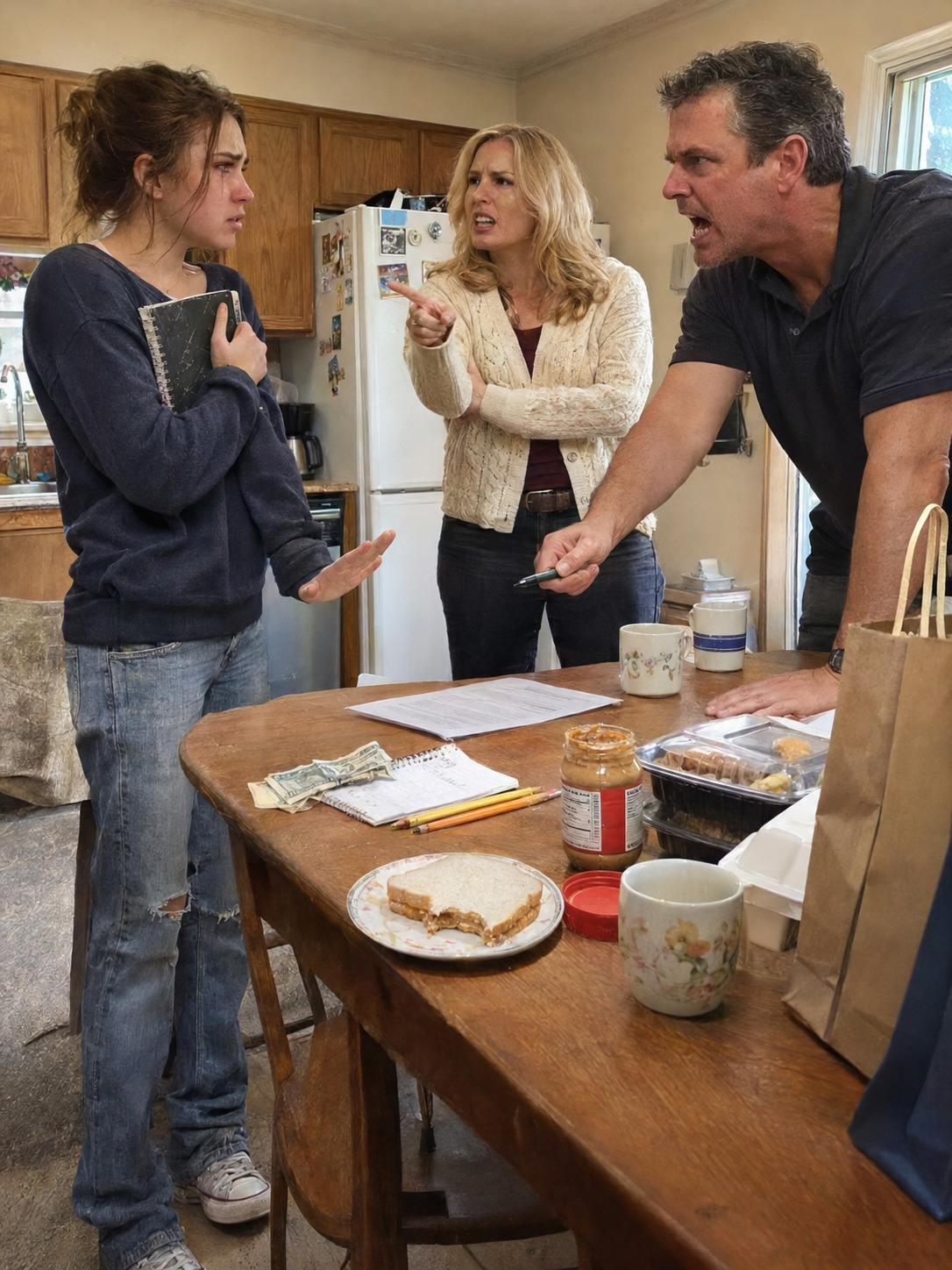
"You're not getting another dollar for lunch!"
My mother's voice cut through the kitchen as she slapped a school lunch permission form onto the counter.
At the bottom of the page, beside her signature, she had checked a box confirming that I would purchase my own meals.
There was one problem.
I was twelve years old, and I didn't have any money.
I remembered that afternoon more clearly than I remembered most birthdays.
It was the first time I understood that being hungry could become a punishment without anyone ever calling it one.
Two years later, sitting on my bed with a six-hundred-dollar rental agreement in my hands, I could still hear the way she'd said those words.
Not angrily.
Not even particularly loudly.
She'd said them like she was announcing a new household rule about leaving shoes by the door.
And somehow, that had made everything worse.
The lunch form had arrived during the second week of sixth grade.
Our school had introduced a new payment system, and every student needed a parent to sign a card confirming how lunches would be purchased.
Most of my classmates barely noticed.
Their parents signed the forms, loaded money onto their accounts, and sent them back.
I brought mine home in a blue folder, along with a spelling assignment and a flyer advertising the upcoming school book fair.
Mom was standing at the kitchen counter, opening a container of leftover Chinese food.
"Can you sign this?" I asked.
She glanced at the paper.
"What's it for?"
"Lunch."
She took the form, read it, and reached for a pen.
I thought that would be the end of it.
Instead, she asked, "How much is lunch now?"
"Three dollars and twenty-five cents."
"Every day?"
I nodded.
She made a face.
"That's ridiculous."
I didn't know what to say.
Three dollars and twenty-five cents was the price the school charged. I hadn't negotiated it.
"Can't you bring something from home?"
"Sometimes."
"Then do that."
"We don't always have stuff for sandwiches."
She stopped writing.
Her eyes lifted toward mine.
"Excuse me?"
I immediately wished I hadn't said anything.
"We just don't always have bread," I explained. "Or lunch meat."
Mom set down the pen.
"Do you know how expensive groceries are?"
I shook my head.
"Of course you don't. You don't pay for anything."
I looked at the open takeout container beside her.
She had ordered dinner the night before because she didn't feel like cooking.
I remembered the delivery driver handing Dad three white plastic bags.
There had been enough food left over to fill an entire shelf in the refrigerator.
But I didn't mention it.
At twelve, I was already learning that pointing out contradictions usually made adults angrier.
Mom signed the form.
Then she checked the box indicating that I would pay for my own meals.
"There," she said. "From now on, you can figure out your lunches yourself."
I stared at her.
"What do you mean?"
"Exactly what I said."
"But I don't have money."
"Then you'll need to earn some."
I waited for her to smile.
She didn't.
"Mom, I'm twelve."
"And?"
"I can't get a regular job."
"People your age babysit. They walk dogs. They do chores for neighbors."
I looked toward the living room.
Dad was sitting on the couch watching a baseball game.
"Can I ask Dad?"
Mom's expression changed.
It was a small change, but I recognized it immediately.
"Are you trying to go around me?"
"No."
"Then don't."
She handed me the form.
"You're old enough to start learning responsibility."
I took the paper.
My fingers had left a faint smudge on the corner.
I remember staring at that smudge because I didn't know where else to look.
"How am I supposed to eat tomorrow?"
Mom turned back to her food.
"That's something you should think about."
I stood there for several seconds.
Then I went upstairs.
I had seven dollars and forty-three cents in my bedroom.
Most of it was birthday money I'd saved in a little plastic container shaped like a pink pig.
I counted it twice.
If I bought school lunch, I could eat for two days.
After that, I would have ninety-three cents.
I sat cross-legged on my bedroom carpet, arranging the coins into little piles.
I remember feeling strangely embarrassed.
Not because I had so little money.
Because I had never imagined I would need to calculate how many meals I could afford.
Until that afternoon, lunch had been something that happened at school.
You stood in line.
You carried your tray.
You sat with your friends.
You complained about the vegetables.
You never wondered whether your parents would decide you hadn't earned the right to eat.
The next morning, I bought lunch as usual.
I ordered pizza, a small carton of milk, and an apple.
I remember every item because I knew I couldn't keep doing it.
My best friend, Emily, sat across from me.
"Are you going to the book fair Friday?" she asked.
"Maybe."
"They have those mystery books we like."
I nodded.
I had wanted one of those books for weeks.
Now the idea of spending money on a book seemed impossible.
Emily took a bite of her sandwich.
"What's wrong?"
"Nothing."
"You've been quiet."
"I'm just tired."
It was the first of many lies I would tell over the next two years.
Not big, complicated lies.
Small ones.
The kind children use when they know something is wrong but don't yet have the words to explain it.
I'm tired.
I already ate.
I'm not hungry.
I forgot my lunch.
By Thursday, I had enough money for one more school meal.
On Friday, I brought an apple from home.
It was slightly bruised.
I ate it slowly during lunch, taking tiny bites while my classmates opened their containers and traded snacks.
Emily offered me half a cookie.
I refused.
I don't know why.
Maybe because accepting it would have meant admitting that I needed it.
Maybe because I could already hear Mom's voice telling me not to expect other people to give me things.
By the time afternoon classes began, my stomach hurt.
I tried to concentrate on fractions.
Instead, I kept thinking about dinner.
When I got home, I went straight to the kitchen.
There was a package of crackers in one cabinet.
A little peanut butter.
Two cans of soup.
I reached for the crackers.
Mom appeared behind me.
"What are you doing?"
"Getting something to eat."
"Didn't you eat at school?"
"Not much."
She looked at the crackers in my hand.
"Those are for the weekend."
I put them back.
"Can I have soup?"
"That's for dinner."
"Okay."
She watched me close the cabinet.
"You're going to have to learn to plan better."
I wanted to ask what I was supposed to plan with ninety-three cents.
Instead, I said, "Okay."
That evening, Dad came home carrying a large cardboard box.
He was smiling.
Actually smiling.
It was the kind of expression I rarely saw when he talked about household expenses.
"Come help me with this," he called.
I followed him into the living room.
The box was enormous.
A sixty-inch television.
Dad had been talking about upgrading our old one for months.
Now he'd finally done it.
"Got a great deal," he announced.
Mom came downstairs and admired it.
They discussed the picture quality, the sound, and whether they should rearrange the furniture.
Dad carefully removed the television from its packaging.
I stood beside the couch, watching him peel away the protective plastic.
"How much was it?" I asked.
He glanced at me.
"Why?"
"Just wondering."
"More than you need to worry about."
Mom laughed.
"Your father works hard. He's allowed to enjoy something."
I nodded.
But I couldn't stop thinking about lunch.
Three dollars and twenty-five cents.
That was all I needed each day.
Dad connected the television.
The screen lit up, bright and enormous.
He grinned.
"Look at that picture."
I looked.
Then I went upstairs.
I wasn't angry yet.
That came later.
At twelve, I mostly felt confused.
I believed my parents when they said money was tight.
I believed them when they said I needed to become responsible.
I believed them because children are supposed to be able to trust their parents.
But I couldn't understand why there was money for a television and not for my lunch.
For a while, I tried to solve the problem without asking anyone for help.
I started packing whatever food I could find.
A piece of toast.
A banana.
Sometimes crackers wrapped in a paper towel.
Once, I brought a plain baked potato.
I had cooked it the night before and wrapped it in aluminum foil.
By lunchtime, it was cold.
I ate it anyway.
A boy at the next table looked over.
"Why are you eating a potato?"
I shrugged.
"Because I like potatoes."
He laughed.
I laughed too.
Then I went to the bathroom and stayed there until the bell rang.
I wasn't crying.
I just didn't want anyone looking at me.
The following week, our science teacher announced that we needed notebooks for a new unit.
Mine was almost full.
I brought home the supply list and placed it beside Mom's purse.
She picked it up that evening.
"What's this?"
"School stuff."
She scanned the list.
"Another notebook?"
"Mine's full."
"Then use the back of something."
"I already did."
She sighed.
"Schools act like parents are made of money."
I stood beside the counter.
"Can we get one this weekend?"
"Figure it out yourself."
I stared at her.
"Mom, it's for school."
"And learning how to manage your own needs is part of growing up."
She handed back the list.
I went to my room and searched through every drawer.
I found an old notebook from fifth grade.
Twenty-three blank pages.
I tore out the completed assignments and tried to smooth the remaining sheets.
The spiral binding was bent.
The cover had a cartoon dolphin on it.
I used it anyway.
A few days later, I ran out of pencils.
I asked my teacher, Mr. Bennett, whether I could borrow one.
He opened a drawer and handed me a yellow pencil.
"Keep it," he said.
"Thank you."
The next week, I asked again.
He gave me another.
By the third time, he looked at me more carefully.
"Are you having trouble getting supplies at home?"
My face became hot.
"No."
"Are you sure?"
"Yes. I just keep losing them."
He nodded slowly.
"All right. Let me know if you need anything."
I thanked him and returned to my desk.
My hands were shaking.
I was terrified he would call home.
My parents had always been very clear about discussing family matters with outsiders.
What happened in our house stayed in our house.
Dad called it loyalty.
Mom called it privacy.
I had never questioned either word.
But now I was beginning to understand that privacy could also mean nobody knew when you were hungry.
The first money I earned came from walking a neighbor's dog.
Her name was Mrs. Henderson.
She lived three houses down and had a golden retriever named Cooper.
One Saturday morning, I saw her struggling to carry grocery bags while holding Cooper's leash.
I offered to help.
She thanked me and asked whether I liked dogs.
I said yes.
Then she asked if I'd be interested in walking Cooper after school three days a week.
"Five dollars a walk," she offered.
I nearly dropped her groceries.
Five dollars.
For walking a dog.
That was more than one school lunch.
"Really?" I asked.
She smiled.
"Really."
I agreed immediately.
That Monday, I walked Cooper for twenty minutes.
He pulled on the leash whenever he saw a squirrel.
He tried to eat a discarded napkin.
He barked at a delivery truck.
By the time I brought him home, my arms were tired.
Mrs. Henderson handed me a five-dollar bill.
"Good job, sweetheart."
I stared at the money.
It was the first time I'd earned cash for something other than household chores.
I thanked her three times.
Then I went home and put the bill in my piggy bank.
I didn't tell my parents.
Not because I thought they'd steal it.
At least, not then.
I simply wanted to keep one good thing to myself.
Over the next two weeks, I earned thirty dollars.
I bought lunch on Monday.
And Tuesday.
And Wednesday.
For the first time in weeks, I sat in the cafeteria without worrying about what I would eat the next day.
I remember buying a small chocolate milk on Friday.
It cost extra.
I almost put it back.
Then I decided I had earned it.
That chocolate milk tasted better than any dessert I'd ever had.
I was proud.
Painfully proud.
I wanted someone to notice.
So that evening, when Dad asked what I'd been doing after school, I told him about Cooper.
His eyebrows rose.
"You're getting paid?"
I nodded.
"Five dollars a walk."
Dad looked impressed.
"Well, look at that."
Mom turned from the sink.
"See? I told you she could figure things out."
Dad laughed.
"That's my girl. Learning how the real world works."
For one brief moment, I felt happy.
They were proud of me.
They weren't angry.
Maybe, I thought, this was what they'd wanted all along.
Maybe once they saw how hard I was trying, things would go back to normal.
Then Dad asked, "How much have you saved?"
I told him.
"Thirty dollars."
He whistled.
"Not bad."
Mom dried her hands.
"Then you won't need us buying your school supplies anymore."
The happiness vanished.
I looked at her.
"What?"
"You have money now. You can take care of those things yourself."
"But I was saving it."
"For what?"
I didn't know how to answer.
For feeling safe?
For not being hungry?
For the possibility that one day I might want something without having to justify it?
I looked down at my shoes.
"Nothing."
Mom smiled.
"Good. Then we're all on the same page."
That night, I moved the thirty dollars out of my piggy bank.
I placed it inside an envelope.
On the front, I wrote FOOD.
Then I found another envelope.
SCHOOL.
A third.
CLOTHES.
I lined them up on my desk.
I was twelve years old, and I was making a household budget for one person.
Not because I wanted to play grown-up.
Because I was beginning to understand that nobody else was going to do it for me.
The next morning, I found Dad in the kitchen.
He was drinking coffee and looking at his phone.
"Can I ask you something?" I said.
He grunted.
"Sure."
"Do I still have to buy all my own lunches?"
He didn't look up.
"Your mother already explained that."
"I know. I just thought maybe—"
"Maybe what?"
I swallowed.
"Maybe I could use my dog-walking money for savings instead."
Dad finally raised his eyes.
"Listen. Your mother and I are teaching you something important. The sooner you understand that nothing in life is free, the better off you'll be."
I nodded.
He returned to his phone.
"Besides, you're doing fine."
I wanted to tell him that doing fine shouldn't mean counting crackers.
But I didn't.
I went upstairs and added another line to my budget notebook.
Emergency money.
I didn't know what kind of emergency a twelve-year-old was supposed to prepare for.
I only knew that I never wanted to be caught without enough money for lunch again.
For the next several months, I walked Cooper, helped Mrs. Henderson pull weeds, and occasionally babysat for a family on our street.
My parents continued treating every dollar I earned as proof that their decision had been wise.
They told relatives I was independent.
They told neighbors I had a wonderful work ethic.
They never mentioned why I'd started working.
And I never corrected them.
Until one afternoon, when a teacher asked why I hadn't eaten lunch for three consecutive days.
I told her I wasn't hungry.
She didn't believe me.
She asked whether there was enough food at home.
I said yes.
Then she opened a drawer, took out a small packet of crackers, and placed it on my desk.
"You don't have to explain anything right now," she said.
I stared at the crackers.
My throat tightened.
I wanted to tell her everything.
I wanted to say that I was trying as hard as I could, that I was tired of pretending, and that I didn't understand why buying my own food had become my responsibility.
Instead, I whispered, "Thank you."
She watched me for a moment.
Then she reached for a yellow folder.
"I think there's someone at school you should talk to."
She opened the folder and removed a pale blue form.
At the top were the words STUDENT SUPPORT REFERRAL.
My stomach dropped.
Then she turned the paper toward me.
Someone had already written my name on the first line.
And beneath it, in the section marked REASON FOR CONCERN, there was a sentence I had never told anyone.






Comments 0