"Please don't call my parents," I whispered.
My teacher held the blue student support form between us, her finger resting beside a sentence that made my stomach turn.
Student may be experiencing food insecurity and inadequate access to basic school supplies.
I had never told anyone those words.
But someone had noticed.
And suddenly, the secret I'd been protecting felt much bigger than I was.
Mrs. Whitmore didn't answer immediately. She was my sixth-grade language arts teacher, a woman with short brown hair who always smelled faintly of coffee and the peppermint candies she kept in her desk.
She looked at me for a long moment.
"Why don't you want me to call them?"
I stared at the paper.
Because Dad would get angry.
Because Mom would say I'd embarrassed her.
Because they'd tell everyone I was making things up.
Because I was afraid that if I complained about the little they still provided, they might decide to take that away too.
But I couldn't say any of those things.
"They're busy," I whispered.
Mrs. Whitmore leaned back in her chair.
"Sweetheart, being busy doesn't mean your parents can't be contacted about something important."
I twisted the sleeve of my sweatshirt around my fingers.
"I'm okay."
"Have you been eating lunch?"
"Sometimes."
"How often is sometimes?"
I shrugged.
She waited.
That was the difficult thing about Mrs. Whitmore. She didn't rush to fill silence. She simply sat there, giving me enough time to decide whether I wanted to tell the truth.
"Most days," I finally said.
It wasn't exactly a lie.
I ate something most days.
Sometimes it was an apple. Sometimes crackers. Sometimes the remaining half of a sandwich I'd saved from breakfast.
She glanced toward the blue form.
"Is there enough food at home?"
"Yes."
The answer came too quickly.
She noticed.
"Do you have access to it?"
I looked up.
That was a different question.
There was food in our house. My parents bought groceries. They ordered takeout. They kept snacks in cabinets and leftovers in the refrigerator.
But some of those things were theirs.
And I had learned that taking food without permission could turn an ordinary evening into an argument about gratitude and respect.
"I can make sandwiches," I said.
Mrs. Whitmore nodded slowly.
"All right."
She placed the form inside the folder.
"I want you to know something. If you need help with meals or school supplies, there are people here who can help you."
My cheeks burned.
"I don't need charity."
She didn't look offended.
"Getting what you need isn't something to be ashamed of."
I wanted to believe her.
But my parents had spent years teaching me that needing help was the same as being weak.
Dad liked to say that the world didn't owe anybody a living.
Mom said children who received too much became spoiled.
I heard those phrases so often that they became part of the way I thought about myself.
If I was hungry, I hadn't planned well enough.
If my shoes were falling apart, I hadn't saved enough.
If I couldn't afford a notebook, I should have worked harder.
There was always something I should have done differently.
Mrs. Whitmore opened her desk drawer and took out another pencil.
"Keep this one too."
I accepted it.
"Thank you."
"And if you ever want to talk, my door is open."
I nodded.
Then I returned to class.
For the rest of the afternoon, I kept touching the pencil inside my backpack.
It was ordinary.
Yellow paint. Pink eraser. A silver metal band.
Probably worth less than twenty cents.
But someone had given it to me without making me feel indebted.
That frightened me almost as much as the referral form.
Because it made me wonder whether the way things worked at home was normal at all.
That evening, I decided to ask Mom a question.
Not about the school referral.
I wasn't brave enough for that.
Instead, I waited until she was folding laundry in the living room.
"Mom?"
"What?"
"Do other kids have to buy their own lunches?"
She continued folding a towel.
"Some do."
"Like kids my age?"
"Plenty of children learn to earn money."
I shifted my weight.
"Emily doesn't."
Mom stopped folding.
"Emily's family has different rules."
"Her parents buy her school stuff too."
She placed the towel down.
"Are you seriously comparing us to other parents?"
"No. I was just asking."
"Then stop asking questions designed to make us look bad."
I lowered my eyes.
She picked up another towel.
"Your father and I provide a home for you. We pay the mortgage, the insurance, the taxes. You have no idea what it costs to keep this family running."
I knew what came next.
She would list the things they paid for.
The electricity.
The water.
The furniture.
The roof.
Sometimes she mentioned the hospital bill from when I was born.
As though my existence were an outstanding debt.
"I'm not saying you don't do anything," I said.
"Good. Because we do plenty."
I nodded.
Then I went upstairs.
I didn't ask again.
The next morning, I opened my three envelopes.
FOOD.
SCHOOL.
CLOTHES.
There were twenty dollars in the first, seven in the second, and nothing in the third.
I counted everything twice.
Then I wrote the totals in my notebook.
I had started keeping records because I was afraid of running out of money.
But the numbers were beginning to serve another purpose.
They gave me something I could control.
My parents could change the rules whenever they wanted.
They could decide that a snack was off-limits or that a school expense was unnecessary.
But they couldn't change the amount written on a page.
If I earned fifteen dollars, I had fifteen dollars.
If I spent three, I had twelve.
The arithmetic didn't judge me.
It didn't call me dramatic.
It didn't accuse me of being ungrateful.
It simply told the truth.
By the beginning of winter, I had three regular dog-walking customers.
Mrs. Henderson recommended me to a neighbor who owned a nervous terrier named Biscuit.
Another family hired me to feed their cat when they traveled.
I carried a small notebook with addresses, appointment times, and payment amounts.
I was careful about accepting jobs. My parents knew which neighbors I worked for, and I stayed within walking distance of our street.
Most of the adults were kind.
Mrs. Henderson sometimes offered me hot chocolate after I brought Cooper home.
Mr. Alvarez, who lived near the corner, paid me an extra five dollars when I shoveled the snow from his front steps.
Once, the Miller family sent me home with leftover birthday cake after I babysat their two children.
I remember carrying that cake home in a plastic container, feeling absurdly rich.
Not because it was expensive.
Because it was mine.
Nobody had told me I needed to earn the right to eat it.
At home, I placed it in the refrigerator with a small piece of masking tape on the lid.
I wrote my name.
The next afternoon, half of it was gone.
Dad was sitting at the kitchen table.
"Did you eat my cake?" I asked.
He looked up.
"What cake?"
"The one in the fridge."
"Oh. Yeah. It was good."
I stood there.
"That was mine."
Dad raised an eyebrow.
"Excuse me?"
"The Millers gave it to me."
He leaned back.
"Are we seriously arguing over cake?"
"No, I just—"
"Food in this house is for the family."
I looked toward the refrigerator.
The words came out before I could stop them.
"Then why do I have to buy my own?"
The room went quiet.
Dad slowly set down his coffee mug.
"What did you say?"
My heart started pounding.
"Nothing."
"No. Repeat it."
I couldn't.
He stared at me.
"Your mother and I are trying to teach you independence. If you're going to throw that back in our faces, maybe we need to rethink how much freedom you're getting."
"I'm sorry."
He watched me for another moment.
Then he returned to his coffee.
"That's what I thought."
I went upstairs without the cake.
That was the first time I understood that the rules weren't meant to apply equally.
When my parents wanted something of mine, it belonged to the family.
When I needed something from them, I was supposed to provide it myself.
I didn't have the language to describe that contradiction.
I only knew how it felt.
Like standing on a floor that shifted every time I tried to find my balance.
A few weeks later, my sneakers began falling apart.
The rubber separated from the toe of my right shoe.
At first, I ignored it.
Then rainwater started getting inside.
I tried using tape.
It peeled off.
I found an old tube of glue in the garage and pressed the sole back into place beneath a stack of books.
That worked for four days.
On the fifth, the sole came loose again while I was walking Cooper.
I nearly tripped on the sidewalk.
Mrs. Henderson noticed.
"Those shoes have seen better days."
I laughed.
"Yeah."
"Do you have another pair?"
"At home."
That wasn't true.
I had an old pair from the previous year, but they were too small.
She looked down at my feet.
"Make sure you get those replaced, honey."
"I will."
That evening, I asked Mom whether we could buy new sneakers.
She was scrolling through her phone at the kitchen counter.
"What's wrong with the ones you have?"
I showed her the sole.
She frowned.
"How did you manage that?"
"They're old."
"Well, you walk dogs all the time. Of course they're wearing out."
I waited.
She returned to her phone.
"Can we get new ones?" I asked.
"You have money."
"Not much."
"Then save."
"I need them now."
Mom looked irritated.
"Then buy a cheaper pair."
I stared at the floor.
"Okay."
That Saturday, I went to a thrift store with twenty-eight dollars.
I found a pair of black sneakers for eleven dollars and ninety-nine cents.
They were a little too wide, but the soles were intact.
I bought them.
Then I stopped at the grocery store and spent the remaining money on bread, peanut butter, apples, and a small package of cheese.
At the checkout, I watched the total climb.
Eleven dollars.
Fourteen.
Seventeen.
I put the cheese back.
The cashier was an older woman with silver glasses.
She looked at the items, then at me.
"Shopping for your family?"
"Just me."
She smiled politely.
"Learning to cook?"
"Something like that."
I paid and carried the groceries home.
My arms ached by the time I reached our driveway.
Dad was in the garage cleaning his golf clubs.
He glanced at my bags.
"What's all that?"
"Groceries."
"With your money?"
I nodded.
He smiled.
"That's what I like to see. Taking initiative."
I stood there holding the bags.
For a second, I wanted to tell him about the shoes.
About the cheese I'd put back.
About how I'd spent ten minutes deciding whether apples were worth buying because they cost more than crackers.
Instead, I carried everything inside.
I had learned that explaining my difficulties rarely changed anything.
It usually just gave my parents another opportunity to tell me I wasn't trying hard enough.
By spring, I had developed a routine.
School during the day.
Dog walking afterward.
Homework in the evening.
Babysitting when families needed help.
On weekends, I looked for small jobs around the neighborhood.
I pulled weeds.
Swept porches.
Washed patio furniture.
Helped elderly neighbors carry groceries.
Sometimes I earned money.
Sometimes people thanked me with food.
I accepted both.
My grades remained good, though I was often tired.
I started falling asleep with textbooks open beside me.
Once, during a history lesson, I woke up because someone tapped my desk.
My teacher asked whether I was feeling well.
I said I hadn't slept much.
She suggested going to the nurse.
I refused.
I didn't want another adult asking questions.
By then, I had become very good at hiding things.
I knew which teachers kept spare supplies.
I knew which cafeteria workers might quietly give a student an extra apple.
I knew how to make one jar of peanut butter last nearly two weeks.
I knew how to smile when friends complained about having to do chores for allowance.
And I knew that if I told my parents I was exhausted, they would remind me that I had chosen to work.
That was the strangest part.
They had created the situation.
Then they treated my response as proof that I didn't need their help.
One Friday afternoon, Emily invited me to sleep over.
Her mother had planned homemade pizza and a movie night.
I wanted to go so badly that I almost said yes immediately.
Then I remembered my Saturday morning jobs.
"I can't," I said.
"Why not?"
"I have work."
Emily stared at me.
"You're twelve."
"I know."
"You work more than my dad."
I laughed.
She didn't.
"Seriously. Why are you always working?"
I looked away.
"Saving for stuff."
"What stuff?"
I hesitated.
"School. Clothes. Food."
She frowned.
"Food?"
I felt my face heat up.
"I mean snacks."
"Oh."
She didn't look convinced.
"Can't your parents buy snacks?"
I shrugged.
"They want me to learn responsibility."
Emily was quiet for a moment.
Then she said something I would remember for years.
"That sounds really unfair."
I forced a smile.
"It's fine."
But after she walked away, I stood beside my locker for a long time.
Unfair.
It was such a simple word.
I had spent months thinking I was failing at something.
Not earning enough.
Not saving enough.
Not planning enough.
Emily had looked at the same situation and called it unfair.
For the first time, I wondered whether she might be right.
That evening, I found Mom in the kitchen reviewing a grocery receipt.
She was complaining about the cost of eggs.
I stood near the doorway.
"Mom?"
"What now?"
"Do you think I work too much?"
She looked up.
"Why would you ask that?"
"Emily said—"
Mom's expression changed immediately.
"What have you been telling Emily?"
"Nothing."
"Then why is she commenting on our family?"
I swallowed.
"She just thinks I work a lot."
Mom put down the receipt.
"Your friends don't understand what we're trying to teach you."
I nodded.
"Children who have everything handed to them grow up helpless. You're going to thank us someday."
I looked at the grocery bags on the counter.
Inside one was a large package of steaks.
Another contained expensive coffee.
I thought about the shoes I'd bought secondhand.
The apples I'd counted.
The notebooks I'd pieced together from unused pages.
"Okay," I whispered.
Mom studied me.
"Don't let other people make you feel sorry for yourself."
"I won't."
She returned to the receipt.
I went upstairs.
That night, I added a new page to my budget notebook.
I wrote down every expense I could remember.
School lunches.
Bread.
Peanut butter.
Pencils.
Notebooks.
Shoes.
Shampoo.
Toothpaste.
The list filled nearly an entire page.
At the bottom, I wrote a question.
What are parents supposed to pay for?
I stared at it.
Then I tore the page out.
I was afraid Mom might find it.
I folded it twice and slipped it into the back of my dresser drawer.
I didn't know then that I would spend the next two years collecting answers to that question.
I only knew I was tired.
And hungry.
And frightened of what might happen if I stopped earning money.
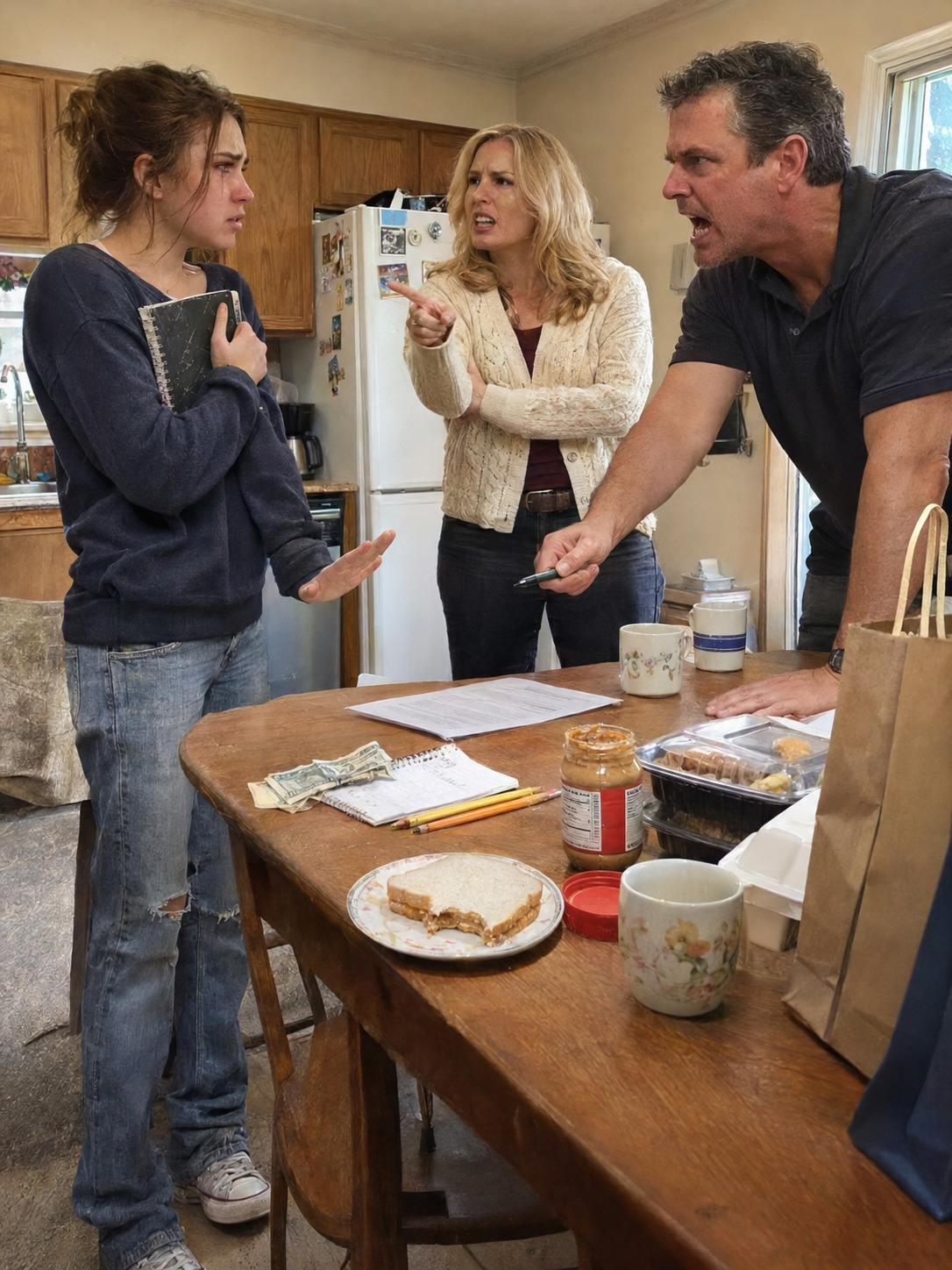
A few days later, I came home from school and found my mother standing beside the kitchen table.
My budget notebook lay open in front of her.
I had left it inside my backpack that morning.
Now it was on the table.
Beside it sat my three money envelopes.
FOOD.
SCHOOL.
CLOTHES.
All three had been opened.
Mom looked up as I entered.
Her expression was impossible to read.
"Come here," she said.
I stopped in the doorway.
Dad was standing behind her.
He held a sheet of paper covered in numbers.
I recognized my handwriting.
It was the page I'd torn from my notebook and hidden in my dresser.
Mom tapped the paper with one finger.
"We need to talk about what you've been writing."
I took one step closer.
Then Dad turned the sheet over.
There was something written on the back.
Something that hadn't been there when I'd hidden it.
And at the bottom, beneath my parents' handwriting, was a number I had never agreed to pay.






Comments 0