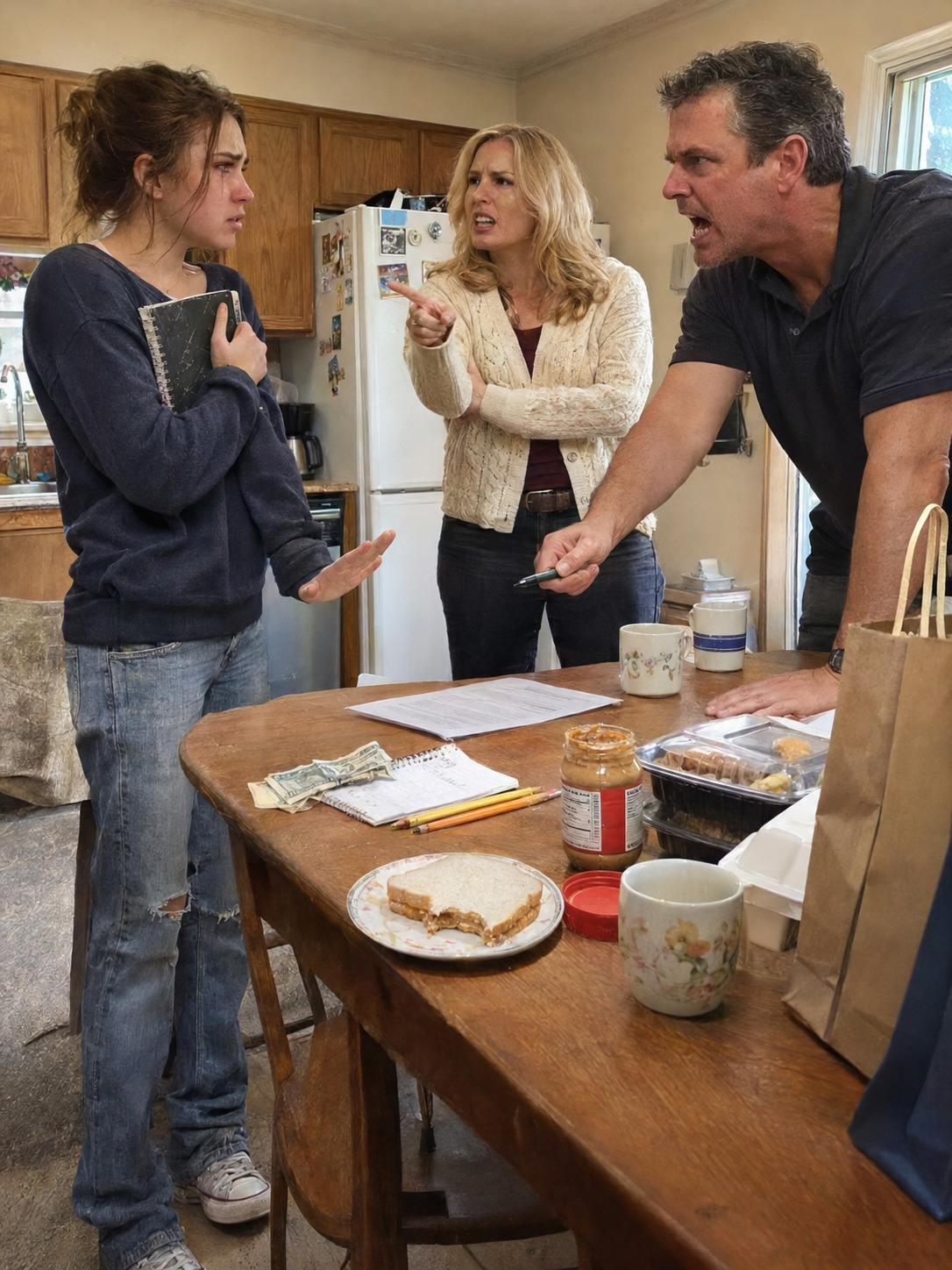
The doorknob turned slowly.
I froze on my bed, the rental agreement trembling between my fingers.
It was almost one in the morning.
Nobody had knocked.
Nobody had called my name.
And I was holding a document that appeared to contain a signature I hadn't written.
The door opened three inches.
"Are you awake?"
Mom.
I quickly lowered the paper.
"Yes."
She pushed the door farther open.
The hallway light outlined her face.
"Why is your lamp still on?"
"I couldn't sleep."
Her eyes moved to the papers in my lap.
"Still reading that?"
I nodded.
She stepped inside.
"Your father spent hours preparing it. There's nothing complicated about it."
I glanced at the signature line.
"Mom, did someone write my name on this?"
She stopped.
"What?"
"At the bottom. There's writing that looks like my signature."
Her expression didn't change.
"Your father filled out the paperwork."
"But I didn't sign it."
"Nobody said you did."
I held up the page.
"Then what's this?"
Mom took one step closer.
For a moment, I thought she would reach for the document.
Instead, she folded her arms.
"Your father was probably testing how the form would look."
"By signing my name?"
"Don't be ridiculous. He was preparing a draft."
I looked down at the page.
The signature was faint but visible.
My name had been written in the same looping style I used at school.
The last letter curved upward in almost exactly the same way.
Almost.
The difference was small.
But I knew my own handwriting.
"Can I keep this copy?" I asked.
Mom frowned.
"Why wouldn't you?"
"I just want to read it."
She studied me.
"You're not planning to make trouble, are you?"
My stomach tightened.
"No."
"Because your father is already under enough stress."
"I know."
"He lost his job. He's worried about the mortgage. The last thing he needs is you acting like we're doing something terrible."
I stared at the paper.
I wanted to ask whether she thought threatening to evict a fourteen-year-old was terrible.
But I didn't.
Mom moved toward the door.
"Turn off the light. You have school tomorrow."
"Okay."
She paused.
"And don't forget. Your father expects an answer in the morning."
Then she closed the door.
I waited until her footsteps disappeared.
Only then did I breathe normally.
I looked at the signature again.
Mom hadn't denied that Dad had written it.
She'd simply called it a draft.
I didn't know whether that made it less serious.
I didn't know what a forged signature meant on a document that might not even be legally valid.
I didn't know whether my parents could force me to pay rent.
There were too many things I didn't know.
And the more I thought about them, the more frightened I became.
I reached for my phone.
The screen showed 1:08 a.m.
I opened the camera.
Then I photographed every page of the agreement.
The title.
The rent amount.
The utilities clause.
The late fees.
The paragraph about terminating my right to occupy the room.
And the signature that wasn't mine.
I took close-up photographs of the small print.
Then I photographed the entire document laid flat on my bed.
I checked each image to make sure the words were readable.
Only after that did I put the papers back into my backpack.
I didn't know whether the photographs would matter.
But I had learned something over the past two years.
When my parents changed the rules, they often changed the story afterward.
I wanted to remember exactly what they'd put in front of me.
Especially if they later claimed it had never happened.
I opened my budget notebook.
At the top of a fresh page, I wrote:
THE COST OF STAYING HOME.
Then I drew a line underneath.
Rent: $600.
Utilities: unknown.
Food: approximately $120.
School supplies: $20.
Clothing and personal items: $30.
Business expenses: $35.
I added the numbers.
$805.
And that didn't include utilities.
I stared at the total.
Eight hundred and five dollars.
Every month.
For a fourteen-year-old girl to continue living in the house where she'd grown up.
I opened my calculator.
If utilities cost another fifty dollars, the total would be $855.
If they cost seventy-five, it would be $880.
I looked at my savings balance.
$1,547.63.
I had worked for two years to build that account.
If I paid the first month's expenses entirely from savings, more than half would disappear.
If I paid a second month, the account would be nearly empty.
And I still wouldn't have enough to survive a third.
I checked the numbers again.
Then I wrote another heading.
WHAT I CAN ACTUALLY EARN.
During the summer, when lawns needed mowing and families traveled, I sometimes earned seven hundred dollars in a very good month.
But summer was over.
The weather was cooling.
Soon there would be fewer lawns.
Dog walking and babysitting were more dependable, but they didn't pay nearly as much.
I estimated what I might earn during an ordinary school month.
Dog walking: $100.
Babysitting: $120.
Yard work and odd jobs: $80.
Total: $300.
Three hundred dollars.
Before expenses.
I looked at the rental agreement.
Six hundred dollars.
Just for rent.
My father was demanding twice what I expected to earn.
And that was before I bought a single meal.
I pressed the calculator's clear button.
Then I did the calculation again.
The result was the same.
I leaned back against my pillow.
For a moment, I wanted to laugh.
Not because anything was funny.
Because the numbers were so impossible that they almost stopped feeling real.
It was like being told I needed to climb a mountain before breakfast.
And when I explained that I couldn't, my parents told me to walk faster.
I put the calculator down.
Then I looked toward my bedroom door.
I thought about what Dad had said.
If you can't meet your obligations, the arrangement ends.
I imagined him standing in the hallway with my suitcase.
I imagined Mom telling me I'd brought it on myself.
I imagined calling Emily and asking whether I could sleep on her couch.
The thought made my throat tighten.
Emily's parents were kind.
But they had their own lives.
Their own bills.
Their own responsibilities.
I couldn't simply appear at their door and expect them to take care of me.
Then I thought about Mrs. Henderson.
She had a spare bedroom.
I'd seen it once when I helped her carry boxes upstairs.
It had a small bed, a wooden dresser, and a window overlooking the backyard.
I remembered thinking how peaceful it looked.
But Mrs. Henderson was my customer.
She wasn't my guardian.
And I couldn't ask her to solve a problem my parents had created.
I closed my eyes.
I had spent two years learning to depend on myself.
Now I was discovering that some problems were too large for a child to solve alone.
That realization frightened me more than the rent.
Because I didn't know how to ask for help.
I had become very good at saying I was fine.
So good that sometimes I almost believed it.
At 1:42 a.m., I opened my phone again.
I searched for information about minors and rental agreements.
Some websites said contracts signed by minors could be treated differently from contracts signed by adults.
Others discussed a parent's duty to provide shelter and basic necessities.
I read a page from a legal aid organization explaining that parents generally had obligations toward their minor children.
The wording was cautious.
Laws varied by state.
Circumstances mattered.
There were exceptions I didn't understand.
But one idea appeared repeatedly.
A parent couldn't simply erase parental responsibilities by calling a child a tenant.
I stared at that sentence.
Then I looked at the agreement.
The paragraph near the bottom claimed that by signing, I acknowledged my parents were no longer responsible for providing my basic living expenses.
I read the legal aid page again.
Then the contract.
Then the legal aid page.
The two seemed to contradict each other.
I didn't know which one was right.
But I knew who might be able to help me find out.
Mrs. Carter.
Our school counselor.
I pictured her office near the main hallway.
The pale green walls.
The small plants on the windowsill.
The basket of tissues beside her chair.
The poster that said:
You don't have to handle everything alone.
I'd passed that poster dozens of times.
I'd never really looked at it.
Now I couldn't stop thinking about it.
I opened my notebook and wrote:
Ask Mrs. Carter if this is legal.
Then I added:
Ask whether my parents can make me leave.
And beneath that:
Ask what happens if they try.
I stared at the last question.
I hoped I would never need the answer.
But I wanted to know.
I needed to know.
At two in the morning, I finally turned off the lamp.
I lay in the dark, listening to the house.
The refrigerator hummed downstairs.
A car passed outside.
Somewhere in the hallway, the floor creaked.
I wondered whether my parents were sleeping.
I wondered whether Dad had already decided what he would do if I refused.
I wondered whether Mom would stop him.
Then I remembered her expression when I'd asked where I was supposed to live.
She hadn't looked frightened.
She hadn't looked shocked.
She'd told me not to make it emotional.
I turned onto my side.
For the first time, I understood that my parents might genuinely believe they were being reasonable.
That made the situation even scarier.
If they knew they were doing something wrong, perhaps they could be persuaded to stop.
But if they believed I owed them six hundred dollars simply because I existed in their house, what argument could possibly change their minds?
I didn't sleep much.
At six-thirty, my alarm rang.
I sat up immediately.
My eyes burned.
My head hurt.
But I knew I couldn't stay in bed.
I had to get to school.
I had to speak with Mrs. Carter.
I got dressed quietly.
Jeans.
Sweatshirt.
The black sneakers I'd bought secondhand.
I checked my backpack.
The rental agreement was inside.
So was my notebook.
My phone was charged.
I had twelve dollars in cash.
I looked around my room.
For a moment, I felt a strange urge to memorize everything.
The books on my shelf.
The faded curtains.
The small scratch on the desk.
The photograph of me and Emily at a school fair.
I didn't know why.
Maybe because Dad had made me feel as though my room could disappear at any moment.
I picked up my backpack.
Then I heard voices downstairs.
Dad and Mom were already awake.
I stopped at the top of the stairs.
Their conversation drifted up from the kitchen.
"She has the money," Mom said.
Dad answered, "For the first month."
"What about after that?"
"She'll figure it out."
Mom was quiet.
Then she asked, "And if she doesn't?"
Dad's reply was immediate.
"Then she'll learn what happens when people don't pay their bills."
I gripped the banister.
My stomach twisted.
Mom lowered her voice.
"She's fourteen."
There was a pause.
For one hopeful second, I thought she might finally say what I'd been waiting two years to hear.
That I was still a child.
That I needed help.
That the agreement was too much.
Instead, she said, "Maybe six hundred is a little high."
Dad scoffed.
"She's got savings."
"Those won't last forever."
"Then she'll have to work harder."
I closed my eyes.
I couldn't listen anymore.
I walked downstairs.
Both parents looked up when I entered.
Dad sat at the table with his coffee.
Mom stood beside the counter.
The rental agreement wasn't there.
Dad smiled.
Not warmly.
Confidently.
"Morning."
"Morning."
He glanced at my backpack.
"Got the paperwork?"
I nodded.
"Good."
Mom poured herself coffee.
Dad leaned back.
"Well? What's your decision?"
I looked at him.
Then at Mom.
I wanted to say no.
The word was right there.
But I remembered the threat.
The termination clause.
The signature that wasn't mine.
I didn't know what would happen if I refused.
So I said, "I have a few questions."
Dad sighed.
"We've been over this."
"I know."
"Then what questions?"
I swallowed.
"Can you make me leave if I don't sign?"
He stared at me.
Mom stopped pouring coffee.
For a moment, nobody spoke.
Then Dad said, "I can decide who lives in my house."
I felt cold.
"Even if I'm fourteen?"
He leaned forward.
"You're old enough to work. You're old enough to contribute."
"That's not what I asked."
His expression hardened.
"Watch your tone."
I lowered my eyes.
"I'm sorry."
Dad took a sip of coffee.
"You're making this more difficult than it needs to be."
I looked at the table.
"Can I ask one more thing?"
He sighed.
"What?"
"Did you sign my name?"
The kitchen went silent.
Mom looked at Dad.
Dad slowly set down his mug.
"What are you talking about?"
"On the agreement. There's a signature."
He stared at me.
Then he gave a short laugh.
"It's a sample."
I swallowed.
"It looks like mine."
"Because it's your name."
"But I didn't write it."
Dad's expression changed.
"Are you accusing me of something?"
"No."
"Then why are you asking?"
"Because I want to understand what I'm signing."
He leaned back.
"You know what? Forget it."
My heart began pounding.
He stood.
"If you're going to treat us like criminals, maybe we should stop trying to help you."
I stared at him.
"Help me?"
Mom stepped forward.
"Sweetheart, don't start."
I looked from one parent to the other.
Dad was breathing heavily.
Mom looked irritated.
And suddenly I realized that if I continued arguing, I might not make it to school on time.
I needed to leave.
I needed to get to Mrs. Carter.
"I'll think about it at school," I said.
Dad shook his head.
"No. We said this morning."
I gripped my backpack strap.
"Please."
He stared at me.
Then he looked at the clock.
"Fine. But I want an answer when you get home."
I nodded.
"And don't go showing that agreement around."
My stomach tightened.
I looked up.
Dad pointed at my backpack.
"That's family business."
Mom nodded.
"Exactly."
I swallowed.
"Okay."
I didn't say I wouldn't show it.
I only said okay.
Then I picked up my lunch.
A peanut butter sandwich.
An apple.
A bottle of water.
I walked toward the front door.
Dad called after me.
"And don't forget, we expect you to act like an adult if you want adult privileges."
I stopped.
For a moment, I wanted to turn around and ask what adult privileges he meant.
The privilege of buying my own lunch?
The privilege of working until my hands hurt?
The privilege of worrying about rent before I was old enough to drive?
But I didn't.
I opened the door and stepped outside.
The morning air was cold.
The sky was pale gray.
I walked quickly toward school.
Every few steps, I checked that my backpack was zipped.
I was afraid the agreement might somehow disappear.
I was afraid my parents might change their minds and call me back.
I was afraid that if I stopped walking, I'd lose the courage to ask for help.
By the time I reached the school entrance, my hands were numb.
Students were gathering near the doors.
Some laughed.
Some complained about homework.
Some talked about weekend plans.
I watched them for a moment.
They seemed so ordinary.
So free from the calculations filling my notebook.
I wondered whether any of them had ever been asked to pay rent.
Then I walked inside.
Mrs. Carter's office was at the end of the main hallway.
I knew exactly where it was.
I'd passed it hundreds of times.
But that morning, the distance felt enormous.
I walked past the trophy case.
Past the library.
Past the bulletin board covered with college posters.
Then I stopped outside her door.
The lights were on.
Through the small window, I could see her desk.
A plant sat beside the computer.
There was a stack of folders near the telephone.
I raised my hand to knock.
Then I hesitated.
What if she didn't believe me?
What if she called my parents immediately?
What if she said they were allowed to do whatever they wanted because it was their house?
I lowered my hand.
I almost walked away.
Then I remembered the rental agreement.
Six hundred dollars.
Plus utilities.
I remembered the signature.
I remembered Dad saying he could decide who lived in his house.
I remembered the nights I'd gone hungry.
I remembered the two years I'd spent working because my parents said I needed to learn responsibility.
I took a breath.
Then I knocked.
There was no answer.
I waited.
A moment later, I heard footsteps behind the door.
The handle turned.
The door opened.
But the person standing there wasn't Mrs. Carter.
It was my father.
He looked down at the agreement sticking out of my backpack.
Then he closed the office door behind him.






Comments 0