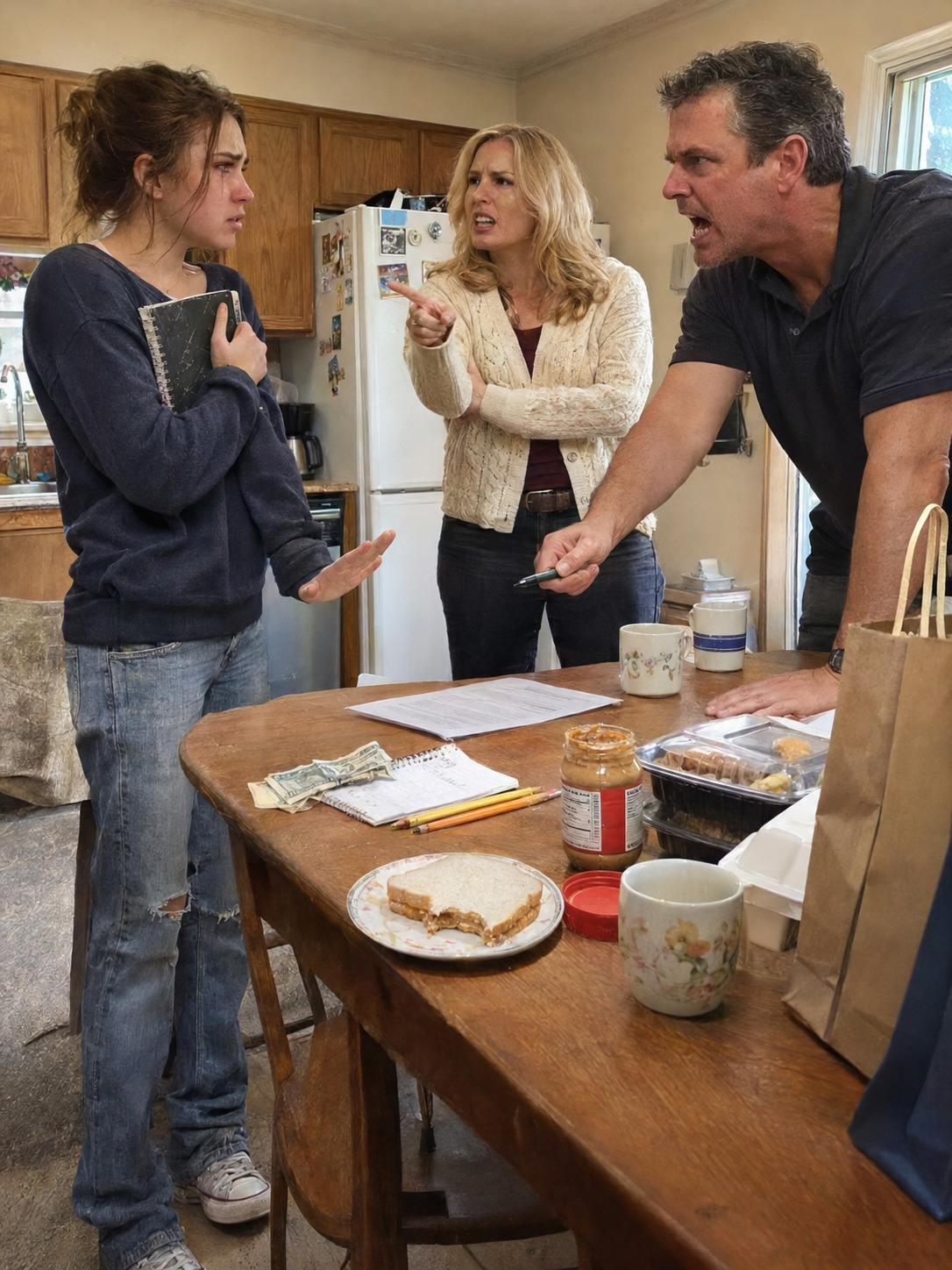
"Sign it. Right now!"
My father's palm struck the kitchen table beside a three-page rental agreement.
At the bottom of the document, beneath a paragraph about late fees, someone had typed my name into a space marked TENANT.
I was fourteen years old.
And my father was trying to make me his renter.
The pen rolled across the scratched wooden table and stopped against my plate. My peanut butter sandwich sat half-eaten beside it, the bread already beginning to dry around the edges.
Dad pointed at the signature line.
"Six hundred dollars a month," he said. "Plus your share of utilities. You're earning money now. It's time to contribute."
I stared at him.
For a moment, I genuinely thought he was joking.
Not because my father had a particularly good sense of humor. He didn't. But because the alternative was too ridiculous to understand.
Six hundred dollars.
Every month.
From a fourteen-year-old girl who had been buying her own lunches since sixth grade.
"Dad," I said carefully, "I'm fourteen."
"I know how old you are."
"Then why does this say I'm supposed to pay rent?"
His expression hardened.
"Because you live here. You eat here. You use electricity. You take showers. You think all that stuff is free?"
Behind him, my mother stood near the refrigerator with her arms folded.
She wore the expression she always wore when Dad was delivering one of his speeches about responsibility.
It was the look of someone watching a lesson unfold exactly as planned.
"Your father has explained this already," she said. "Families have to pull together."
I glanced at the empty takeout containers beside the coffee maker.
My parents had ordered Chinese food earlier that evening.
They hadn't asked whether I wanted anything.
They never did anymore.
My sandwich had cost me approximately forty cents to make, according to the little budget notebook I kept in my backpack.
I knew that because I calculated everything.
Bread. Peanut butter. School supplies. Shampoo. Gasoline for the lawn mower.
When you're twelve years old and responsible for feeding yourself, you learn to count pennies before you learn to understand why the adults in your house aren't helping.
"How much do you think I make?" I asked.
Dad leaned back.
"Enough."
"That's not a number."
His eyes narrowed.
"Don't get clever with me."
I looked down at the agreement.
The first page had a formal heading. The second listed payment obligations. The third contained signature lines for both my parents and me.
It looked like something a landlord would hand to an adult applying for an apartment.
Except the landlord was my father.
And the apartment was the bedroom I'd slept in since I was little.
"Six hundred dollars," I repeated.
"That's right."
"Plus utilities?"
"Your fair share."
"How much is that?"
Dad shrugged.
"Depends on the month."
My mother finally stepped closer.
"You're making this unnecessarily difficult."
I looked at her.
"Mom, I don't have six hundred dollars every month."
"You have savings."
My stomach tightened.
There it was.
The savings.
The money I'd spent nearly two years collecting, twenty dollars here, thirty-five dollars there, sometimes fifty if somebody needed an entire yard cleaned before a holiday weekend.
I had a little over fifteen hundred dollars saved.
My parents knew because Dad had asked me about my bank balance after he lost his job.
I'd made the mistake of answering honestly.
Now he looked at me as though that money belonged to him.
"That savings account isn't for rent," I said.
Dad gave a short laugh.
"Money is money."
"It's for emergencies. And college."
"College?"
He said the word as though I'd announced plans to purchase a private island.
"You're fourteen. College is years away."
"That's why I'm saving."
"Well, you can save again."
I looked from him to my mother.
Neither appeared troubled by what they were asking.
Neither seemed interested in whether I would have enough left to buy groceries next week.
They were looking at me the way people look at a locked drawer when they know there's cash inside.
Dad tapped the paper again.
"Sign."
I didn't move.
He pushed the pen closer.
I could hear the refrigerator humming behind my mother. Somewhere in the living room, the television played the opening music for a sports program.
It was the same television Dad had bought two years earlier.
Sixty inches.
Brand-new.
I remembered the box standing in the hallway, taller than I was at twelve.
I also remembered asking Mom for a ten-dollar pack of notebooks that same week.
She'd told me we couldn't afford unnecessary expenses.
The memory rose so suddenly that I almost laughed.
Instead, I pressed my lips together.
"I need to read it," I said.
Dad stared at me.
"What?"
"The agreement. I need to understand what I'm signing."
"It's straightforward."
"Then it shouldn't take long."
My mother exhaled sharply.
"Here we go."
I knew that tone.
It meant I was about to be accused of being difficult, ungrateful, dramatic, or all three.
Usually, I apologized before the accusation was finished.
That evening, I didn't.
I reached for the agreement.
Dad placed his hand on top of it.
"You're not taking that upstairs to play games."
"I'm not playing games."
"Then sign it."
I looked at his hand.
His wedding ring had left a faint indentation in the paper.
"I want to think about it."
For several seconds, nobody spoke.
Then Dad lifted his hand.
"Fine. Think. But don't think you're getting out of this."
I picked up the pages.
Mom shook her head.
"You know, most children would be grateful to have parents who teach them responsibility."
I almost asked whether most children bought their own food.
But I already knew how that conversation would end.
Dad would say I was disrespectful.
Mom would say I was exaggerating.
Eventually, somebody would remind me that I had a roof over my head.
As though the roof were a personal favor.
As though I hadn't been born beneath it.
I folded the agreement and slipped it into my burgundy notebook.
"I'll let you know tomorrow," I said.
Dad gave me a hard look.
"Tomorrow morning."
I nodded.
Then I took my sandwich and went upstairs.
I didn't run.
I didn't slam the door.
I walked slowly, because I knew my parents were watching and I didn't want either of them to see how badly my hands were shaking.
Only when I reached my bedroom did I put down my plate and lean against the door.
My heart was pounding.
Six hundred dollars.
The number seemed to follow me into the room.
I sat on my bed and opened the agreement again.
The first clause described my obligation to pay rent on the first day of every month.
The second described utilities.
The third said failure to pay could result in termination of the living arrangement.
I read that sentence three times.
Termination of the living arrangement.
Such a tidy phrase.
It sounded like something that happened when a business partnership ended.
Not when a child couldn't pay her parents enough money to remain in her own bedroom.
I took out my calculator.
My income varied depending on the season.
During a good month, I might earn seven hundred dollars.
Sometimes less.
Occasionally more, if several neighbors needed extra work.
Six hundred dollars in rent would leave one hundred.
Before utilities.
Before groceries.
Before school supplies.
Before the gasoline I needed for my mower.
Before replacing anything that broke.
I entered the numbers again.
Seven hundred minus six hundred.
One hundred.
I added an estimated utility payment.
The balance turned negative.
I stared at the screen.
It wasn't a budget.
It was a trap.
And the worst part was that my parents had to know.
Dad had watched me come home exhausted after mowing lawns in ninety-degree heat.
Mom had seen me count change at the kitchen table before buying groceries.
They knew I wasn't secretly earning thousands of dollars.
They knew exactly how hard I worked.
They simply didn't seem to care.
I turned to the back of my notebook, where I kept a record of my savings.
$1,547.63.
That was the balance I'd written after my last deposit.
I remembered earning nearly every dollar.
Thirty dollars from mowing Mrs. Henderson's front lawn.
Forty-five from watching the Miller family's children on a Saturday evening.
Twenty from walking a golden retriever named Cooper for an entire week.
Sixty from cleaning leaves out of a neighbor's yard.
Some of those jobs had been miserable.
I'd come home with blisters on my palms and grass stains on my knees.
Once, I'd worked through a headache because canceling meant losing the money I'd planned to use for groceries.
Another time, I'd babysat until nearly midnight and gone to school exhausted the next morning.
But every payment had given me something I desperately needed.
A little security.
A little independence.
The ability to buy food without asking permission.
Now my father wanted to take almost all of it.
I opened the agreement again.
There were words I didn't understand.
Occupancy.
Obligation.
Default.
Termination.
I wasn't a lawyer.
I wasn't even old enough to drive.
But something about those words frightened me more than Dad's shouting.
They made the arrangement look official.
And I had spent most of my childhood believing that when adults put something in writing, it became true.
I looked at the signature line.
My name had been typed beneath it.
For some reason, that bothered me more than anything else.
Dad hadn't left a blank space for a tenant's name.
He had already decided who would sign.
He had already decided I would agree.
The only part he hadn't completed was making me hold the pen.
I closed the notebook.
Then I opened it again.
Because there was something else I needed to calculate.
If I paid six hundred dollars a month, how long would my savings last?
I entered the numbers.
Even with my income, utilities and living expenses could consume everything I'd saved within months.
And if my mower broke?
If I got sick?
If schoolwork became too demanding?
I would have nothing.
No emergency fund.
No college savings.
No way to replace the tools that allowed me to earn money.
My parents called that responsibility.
I couldn't make the numbers agree.
Downstairs, I heard Dad laughing at something on television.
The sound drifted through the floorboards.
It was strange how ordinary everything seemed to them.
They had handed their daughter a document threatening her housing, then returned to their evening as though they'd asked her to take out the trash.
I sat there for a long time.
Eventually, I pulled out my phone.
I typed a question into the search bar.
Can parents charge a fourteen-year-old rent?
The results appeared immediately.
I opened one.
Then another.
Some discussed adult children living at home.
Others described different state laws.
I read slowly, trying to separate advice from actual legal information.
One phrase kept appearing.
Parental responsibility.
I searched again.
Are parents required to provide food for minor children?
More results.
Then another question.
Can parents make a minor pay for basic necessities?
I sat up straighter.
For two years, my parents had told me that providing my own meals was an important lesson.
They'd said I needed to become independent.
They'd said nobody owed me anything.
But the information on my phone suggested that the situation might not be as simple as they'd made it sound.
Parents had obligations.
Children had rights.
The details depended on where someone lived, and I didn't understand all of them.
But I understood enough to realize that I needed to ask someone who did.
Someone who wasn't my mother.
Someone who wasn't my father.
Someone who wouldn't get angry just because I asked a question.
I thought about my school counselor.
Mrs. Carter.
She had gray in her hair and kept little green plants along the windowsill of her office.
I'd only spoken to her a few times.
Once about choosing classes.
Once when a teacher thought I seemed unusually tired.
She'd asked whether everything was okay at home.
I'd smiled and said yes.
I remembered how easily the lie had come out.
I also remembered how she'd looked at me for a moment before saying her door was always open.
At the time, I'd thought she was just being polite.
Now I wondered whether she had noticed something.
I took a screenshot of the information on my phone.
Then another.
I placed the rental agreement beside my budget notebook and photographed both.
My hands were still trembling, but I could finally think clearly.
I wasn't going to sign something I didn't understand.
And I wasn't going to let my parents convince me that asking questions was disrespectful.
A little after eleven, I heard footsteps outside my bedroom.
They stopped at my door.
Three sharp knocks.
"Are you finished thinking?" Dad called.
I looked at the agreement.
"Not yet."
He made an irritated sound.
"You'd better have an answer in the morning."
"I will."
His footsteps moved away.
I waited until I could no longer hear them.
Then I opened a new page in my notebook.
At the top, I wrote:
Questions for Mrs. Carter.
Underneath, I listed everything I needed to know.
Could my parents legally charge me rent?
Were they supposed to provide my meals?
What happened if I refused?
Could they really make me leave?
I stared at that last question.
It was the one I was most afraid to ask.
Because I didn't know what I would do if the answer was yes.
I didn't have grandparents nearby.
I didn't have relatives I could easily stay with.
I had neighbors who trusted me with their children and pets, but that wasn't the same as having somewhere to live.
For all the money I'd saved, I was still fourteen.
I still needed adults.
And the two adults I was supposed to depend on had just handed me a bill for being their daughter.
I closed my notebook and turned off the lamp.
But I couldn't sleep.
At 12:47 a.m., I heard my parents talking downstairs.
Their voices were muffled.
I couldn't make out everything.
Then I heard Mom say something clearly enough to understand.
"She'll sign. Where else is she going to go?"
Dad answered.
"Exactly."
I lay completely still.
They weren't worried that I might leave.
They were counting on the fact that I couldn't.
I reached for my phone again.
Mrs. Carter's office hours were listed on the school website.
I saved the page.
Tomorrow, I would ask for help.
I had no idea whether she would believe me.
I didn't know whether showing someone the agreement would make things better or much worse.
But I knew one thing.
I couldn't solve this with a calculator.
I needed somebody to tell me whether the adults in my house were allowed to do what they were doing.
Just before one in the morning, I opened the agreement one final time.
A small line near the bottom of the third page caught my attention.
I hadn't noticed it before.
It was printed beneath the signature spaces in much smaller type.
I brought the paper closer to the light.
There, directly below my name, was a sentence beginning with the words:
"By signing, the tenant acknowledges..."






Comments 0